The Controller in the Bunker: How FPV Hobby Drones Changed Modern Warfare
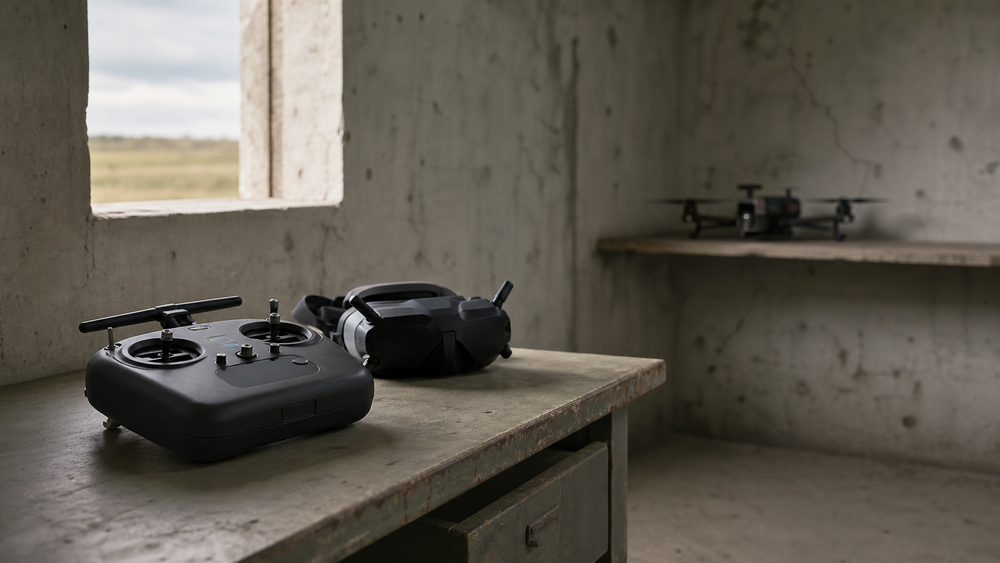
The controller is unremarkable. Two joysticks, a few switches, a grip that fits comfortably in both hands. Slip on the goggles and you're flying — not watching a dot on a screen but inhabiting a small aircraft moving at speed through whatever landscape the camera sees. First-person view (FPV) flight started as a sport and a maker obsession: hobbyists who found satisfaction in building, tuning and racing machines that weighed a few hundred grams and moved faster than common sense suggested they should.
On July 13, 2026, Auterion and Ukrainian drone manufacturer Skyfall announced a contract to supply 50,000 Shrike FPVs equipped with Auterion's Skynode S autonomy software, funded by an undisclosed European NATO state. The announcement describes a total more than double Auterion's own earlier deployments to Ukraine. This, against a backdrop in which Ukraine's Ministry of Defence reported producing more than 1.5 million FPVs domestically in 2024, and supplying more than one million more in the first seven months of 2025.
The controller did not change. What changed was everything around it.
From racing line to frontline
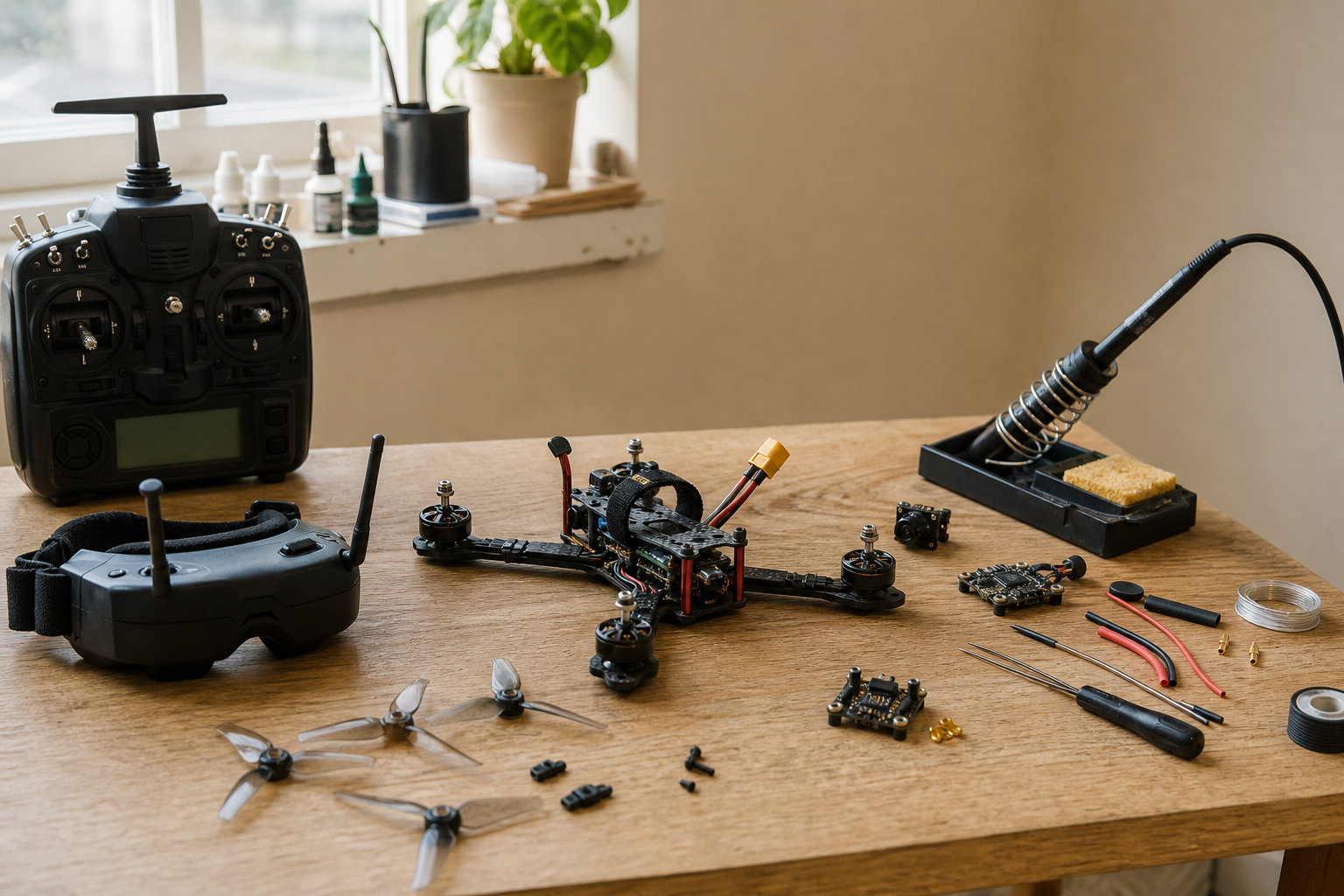
FPV racing developed a specific culture before the full-scale Russian invasion of Ukraine made that culture suddenly relevant to military planners. Enthusiasts learned to solder, repair and modify components. They shared knowledge in forums, on YouTube, in simulator communities where people practised flight before risking expensive hardware. What looked like a niche hobby was, in aggregate, a distributed pool of technical competence: people who understood motor timing, camera latency, battery chemistry and control-link behaviour as a matter of personal interest.
When the full-scale invasion began in February 2022, Ukraine had an acute need, a population of technically capable volunteers, access to globally available commercial components, and a military that had already adapted to experimental approaches through a decade of lower-intensity conflict. Commercial quadcopters had appeared in the earlier phase of fighting after 2014. By 2023, RUSI assessed that FPVs and one-way attack drones had become increasingly critical to Ukraine's defensive operations. By 2024, Ukraine had formalised that reality by creating the Unmanned Systems Forces.
The transformation in that period was not primarily technical. It was administrative. Ukraine created dedicated funding mechanisms for commercial unmanned systems, altered purchasing rules that had previously excluded non-traditional suppliers, and restructured the relationship between military customers and drone manufacturers. According to research published by the Center for Strategic and International Studies (CSIS), based on interviews with Ukrainian officials, military personnel and entrepreneurs, battlefield feedback could reach mass-produced FPVs in around two months. In traditional defence acquisition, that cycle takes years.
The process race
The US response makes the point explicitly. A Pentagon drone dominance memo, published in July 2025, describes the contest as "a process race as much as a technological race" and calls for the creation of small-UAS-focused programme offices with authority for rapid acquisition. The language is an admission: the relevant American challenge is not finding better drone technology, it is building institutional structures capable of moving at the speed the Ukrainian example demonstrated.
The Defence Post reported in July 2026 that Kopin's Sentinel FPV headset — hardware that traces its heritage directly to the racing and freestyle communities — received prototype orders from partners working on the Pentagon's reported billion-dollar Drone Dominance effort. The cultural reversal here is worth pausing on. Goggles associated with a hobbyist flying a racing circuit on a Saturday afternoon are entering a formal defence supply chain. Not as off-the-shelf consumer gear transplanted unchanged, but as a component in a military system that combines them with purpose-built autonomy software, encrypted communications and hardened airframes.
What made the two-month loop possible in Ukraine was precisely what traditional procurement finds difficult to accept: non-traditional suppliers who didn't go through standard certification, military customers who went directly to factories with feedback from the previous week's operations, and a willingness to accept a design that was good enough now rather than perfect in three years. The Pentagon memo suggests that Western militaries have understood this. Whether their institutions can actually change to accommodate it is a different question.
The loop has a further implication that often goes unmentioned. Whatever process enabled rapid iteration on the Ukrainian side was equally available to the adversary. The contest is not between one side that can iterate quickly and another that cannot. It is between two sides both trying to iterate faster than the other's countermeasures can catch up.
What "cheap" misses
The cost asymmetry is real and important. CSIS estimated FPVs used in Ukraine's 2025 Operation Spider's Web at roughly $600–1,000 each. That operation — exceptional in its coordination and intelligence preparation — demonstrated that a relatively modest system can threaten far more expensive military assets. The figure travels easily in defence analysis because it is striking.
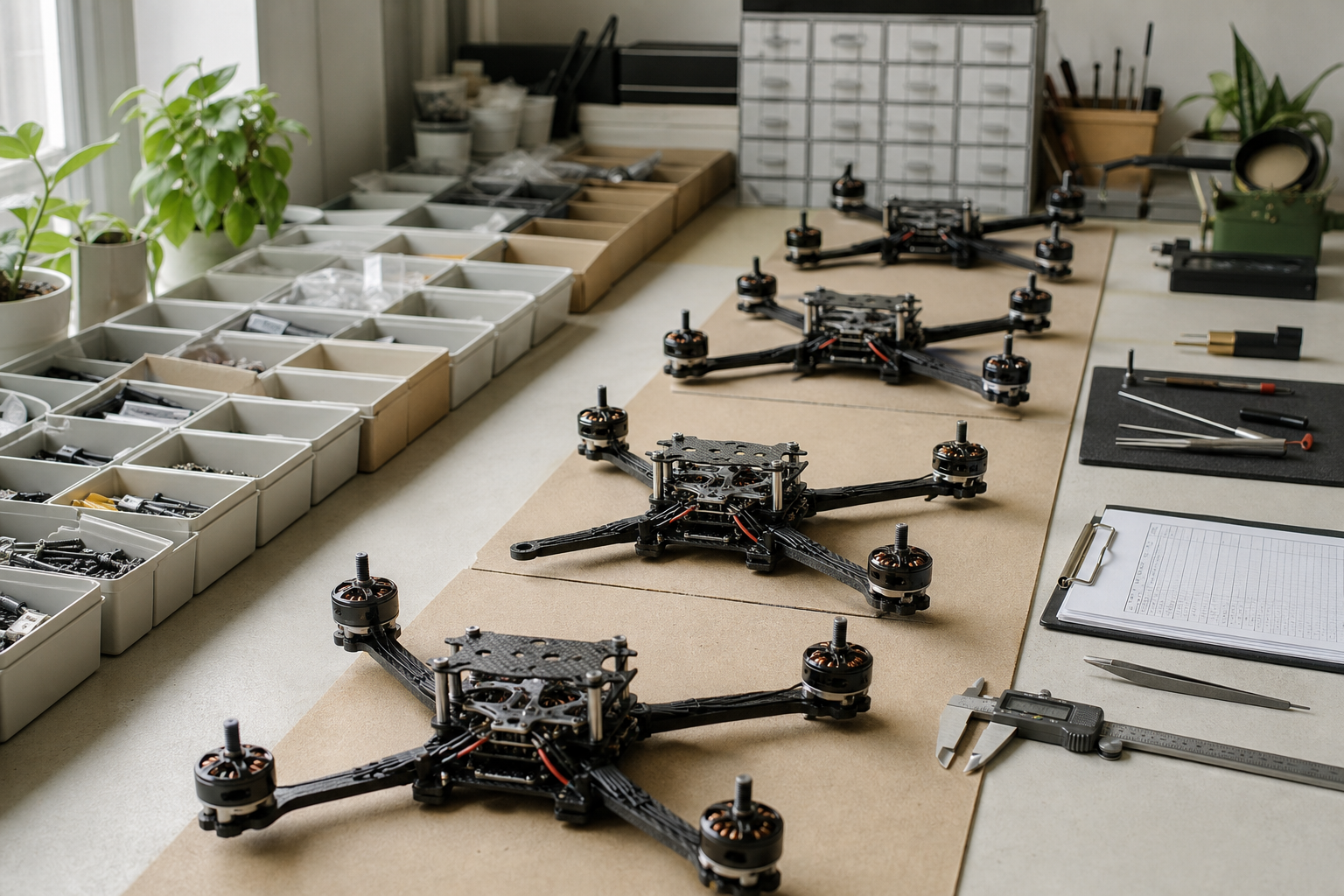
But it misrepresents the economics when taken alone. An FPV system at scale requires batteries, cameras, radios, motors, software, quality control, logistics and training. Commercial origin does not eliminate industrial constraints; it redistributes them. The supply chain becomes more distributed and potentially more fragile at the points where civilian production and military demand intersect. A manufacturer scaling from hundreds to hundreds of thousands of units faces different challenges than the hobbyist who built ten.
The consequences for the other side are similarly complex. Russia has developed layered counter-UAS responses that RUSI documents in detail: jamming that can interrupt control and navigation, modified infantry weapons effective at short range, short-range air defence against small aerial targets, and physical protection added to vehicles and positions. No single method works in every situation. The response is a defensive immune system whose components are in constant development. In July 2026, the US Army awarded AeroVironment a reported $500 million contract ceiling for layered counter-UAS capability — a three-year IDIQ arrangement that signals how comprehensively a distributed, low-altitude threat reshapes sensing, command-and-control and interception requirements. The figure is a contract ceiling across a range of counter-UAS work, not a unit cost for defeating any specific drone type. The direction it points is clear enough.
Armour has not become obsolete. What has changed, as CSIS describes, is the calculus of exposure: large visible columns of armour and personnel carriers face greater vulnerability from a persistent low-altitude threat, which encourages smaller, slower and more dispersed movement. Armour needs more protection. Air defence must address a lower, denser and cheaper threat. Logistics and static positions require concealment and hardening. RUSI is explicit that this does not mean NATO should replace traditional firepower with drones. Artillery, manoeuvre, air defence and electronic warfare remain indispensable. The drone changes the conditions under which armour moves and survives; it does not replace the armour.
"Cheap drone" does not mean "cheap war."
The human in the loop
The bunker in the title is deliberate. An FPV system requires a human operator with goggles or a screen, flying an aircraft in real time through whatever the camera shows. That operator is under pressure, managing a control link that can be jammed, flying in conditions that may include electronic interference and physical danger. This is not effortless remote warfare. It is human skill applied under operational stress, at range.
Range has extended. The same Breaking Defense report cited an early-war FPV operating range of roughly 5–15 kilometres and noted a Ukrainian claim of a strike 102 kilometres from the launch point in June 2026. Neither figure should be read as an independently verified technical benchmark; military claims of extreme performance require attribution and caution. The credible conclusion is more modest: contemporary systems are extending range and blurring a boundary that previously seemed clear between short-range FPV and other categories of fixed-wing aircraft.
The Auterion–Skyfall contract introduces a dimension that cannot be avoided. According to the July 2026 Breaking Defense report, the Skynode S software includes moving-target strike capability, with swarming described as a planned future direction. That places the system in territory where the line between a remotely piloted platform and a system that independently selects or tracks targets requires careful examination.
International humanitarian law applies to drone strikes as it applies to any other attack. Distinction — the requirement to differentiate civilians from combatants — proportionality and feasible precautions remain the governing rules regardless of the delivery system. The ICRC has flagged the particular difficulties small drones create: they are hard to detect, civilian and military systems may appear identical at a distance, and the live video feed that makes FPV flight possible can simultaneously improve observation and narrow the operator's situational awareness of what lies outside the frame.
The ethical and legal pivot is target selection. A system that navigates autonomously or tracks a moving object is different, in moral and legal terms, from one that autonomously decides to apply lethal force against a person. The ICRC urges binding rules against autonomous weapons designed or used to apply force against people. That distinction — between assistance and decision — is where the technology and the law are currently converging, without having yet arrived at the same answer.
There is a further dimension that belongs in any honest account of this technology. The civilian components in an FPV system — the motors, the camera module, the battery cells — are manufactured by companies that did not design them for military use. Volunteer engineers, online communities and technical schools in Ukraine contributed skills and knowledge that similarly were not originally offered with combat application in mind. A technology that spreads through the hobbyist network distributes the capacity for this kind of system more widely than conventional defence procurement ever did. For a country defending its territory, that distribution is resilience. As a general phenomenon, it is something more complicated.
The hobby's changed meaning
In May 2026, Le Monde reported from a FPV drone-racing event in Ukraine where soldiers competed on their leave from the front. The photographs show people in a field with controllers, cheering each other on. The language the participants used, Le Monde noted, emphasised community, camaraderie and a connection to something that existed before the war. The racing was partly an escape and partly a way of staying close to a skill that had become, for many of them, a matter of professional life.
The same hardware, the same year, prompted a different community response elsewhere. r/fpv — one of the largest international FPV communities online — instituted a zero-tolerance policy for military and war content in 2025, explicitly defining itself as a home for the hobby, for sport, and for the technology as civilian practice. The policy is anecdotal as community evidence goes; it is not a survey or a definitive statement of what hobbyists believe. But it documents a real fracture: people who share a technical culture and have arrived at opposite orientations toward its military deployment.
The war has permanently altered the public meaning of familiar hardware. A controller, a pair of goggles and a small airframe can still signify craft, play and the particular creative satisfaction of flight at speed through three-dimensional space. They now also evoke remote violence, export controls, geopolitical competition and debates about autonomous weapons that were marginal to the hobby community five years ago. Hobbyists carry that double meaning now regardless of whether they accept or reject its military association. The technology does not permit them to opt out of the symbolism.
What the controller now carries
The contest that began with volunteer pilots and commercial components has produced something that persists beyond any individual drone programme. The relevant transfer is not hardware — airframes can be shot down, components can be embargoed, designs can be reverse-engineered. The relevant transfer is institutional logic: the idea that a two-month feedback loop between frontline use and mass production is achievable, and that it can be made competitive with a traditional acquisition cycle that takes years.
That logic has moved from Ukraine to formal military planning documents in Washington. It has moved, by parallel routes, into the adversary's own adaptation. The Auterion–Skyfall contract is large. The Ukrainian numbers are larger. But the number that will prove most durable is the one that can't be put in a procurement order: the speed at which a civilian ecosystem can be compressed into military capability when necessity and institutional willingness exist simultaneously.
The controller in the bunker is the same object it was on the racing field. It is not the same thing.
Sources
Procurement and deployment
- Auterion and Skyfall, 50,000 FPV contract — Breaking Defense, July 2026. The contract that frames the article.
- Ukraine: 1.5 million FPVs in 2024 — Ukrainian Ministry of Defence. Domestic production figures.
- Ukraine: one million FPVs supplied in first seven months of 2025 — Ukrainian Ministry of Defence. Scale of supply in 2025.
- Kopin Sentinel FPV headset, Pentagon's Drone Dominance effort — The Defense Post, July 2026. Hobby-lineage hardware entering US procurement.
Analysis and strategy
- Unleashing US Military Drone Dominance: What the United States Can Learn from Ukraine — CSIS. The two-month feedback loop and its administrative basis.
- Chapter 9: Technological Evolution on the Battlefield — CSIS. Cost estimates and the calculus of exposure.
- NATO Should Not Replace Traditional Firepower with Drones — RUSI Defence Systems. Why drones change but do not replace conventional force.
- Protecting the Force from Uncrewed Aerial Systems — RUSI Occasional Papers. Layered counter-UAS responses in detail.
- Unleashing US Military Drone Dominance — DoD Memo — US Department of Defense, July 2025. The "process race" framing.
- US Army awards AeroVironment $500M contract for layered counter-drone defence — Army Recognition, July 2026. Scale of the counter-UAS response.
Law and ethics
- FAQ: International Humanitarian Law and Drones in Armed Conflict — ICRC. Distinction, proportionality and precautions.
- Autonomous weapons — ICRC position — ICRC. The case for binding rules on autonomous force.
Culture
- Drone racing to relax: a weekend away from the front with Ukrainian soldiers — Le Monde, May 2026. The hobby as escape and profession.
- Zero Tolerance for Military/War Content — r/fpv moderator post, December 2025 (community evidence; not a prevalence claim). The community fracture.