A Letter With No Return Address
What three interstellar visitors have — and have not — told us
Somewhere in a control room, a researcher is staring at a comet's spectrum. Not unusual work. But this particular comet was never inside our solar system before last year, and the ice sublimating off its nucleus was formed around a different star, possibly one that burned out before our sun ignited. The researcher is measuring the exhaust of another world's formation process, reacting to our sunlight for the first time.
How, exactly, do you know it isn't ours?
That question is the entrance to the story of 3I/ATLAS, the third confirmed interstellar object. The answer is not mysterious — it is precise, elegant, and worth understanding, because it is the foundation on which everything else rests.
The orbit cannot lie
An ordinary long-period comet can look indistinguishable from something interstellar when you first catch it falling toward the inner solar system. Both appear to arrive from the dark. The difference is orbital shape.
Orbital eccentricity measures how stretched an ellipse is. Below 1, the orbit is a closed loop, and the object is gravitationally bound to the Sun — it will return, even if it takes a hundred thousand years. At 1, an object is right at the escape boundary. Above 1, the orbit is an open hyperbola: the body came in, bent around the Sun's gravity, and is leaving forever.
3I/ATLAS has an eccentricity of approximately 6.14.
This is not a measurement that sits nervously on the boundary. A calculation error or a perturbing planet cannot nudge 6.14 back below 1. When 3I was detected by the ATLAS survey network on 1 July 2025, its trajectory through the data immediately confirmed what its discovery team suspected: this object was not born here. It entered our solar system as a visitor, was bent by solar gravity, and is now departing. It will never return.
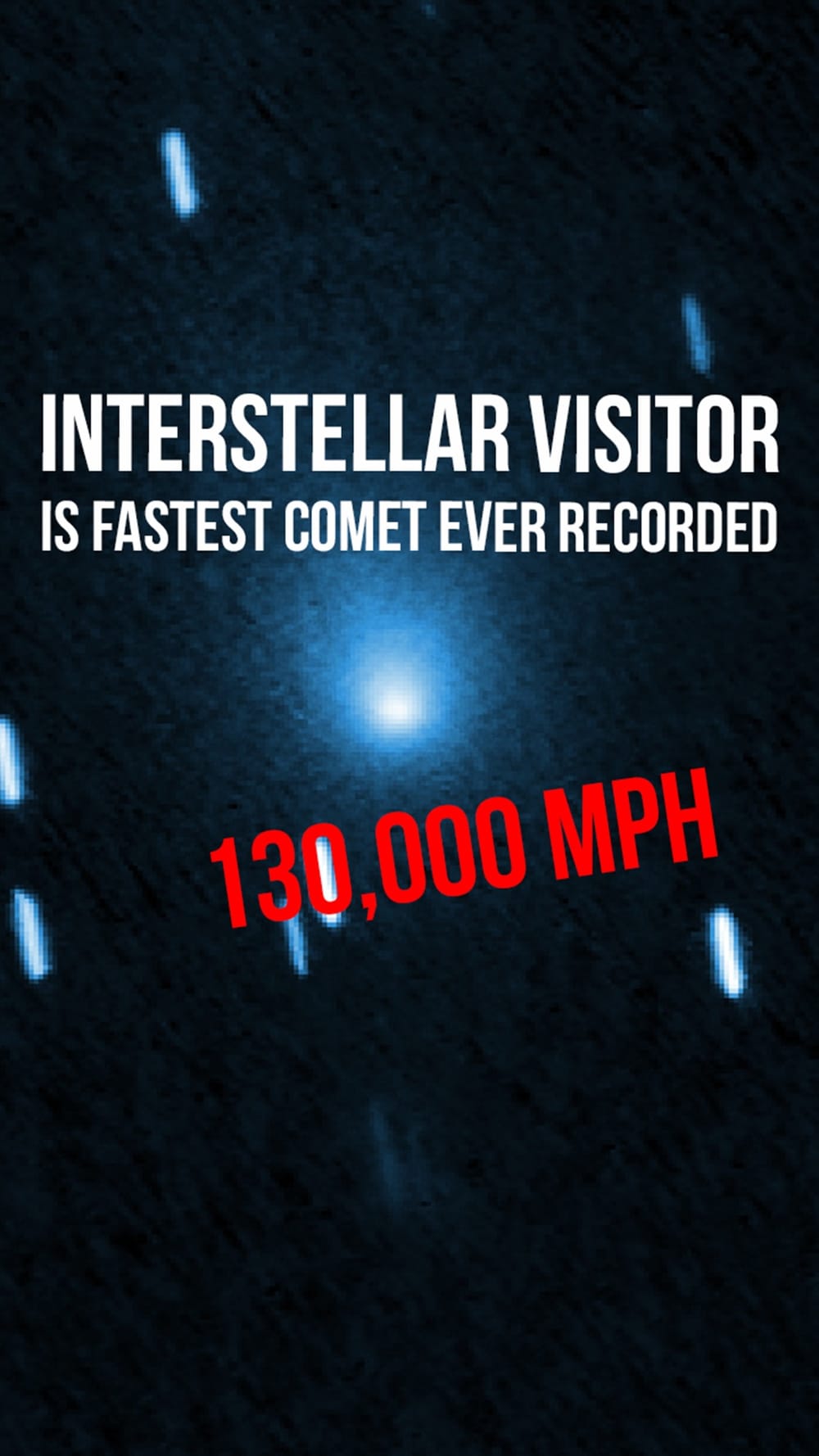
That is what the designation "3I" means: third confirmed interstellar object. Its approach speed — roughly 58 km/s in heliocentric terms, or around 221,000 km/h — is sometimes quoted as evidence of strangeness. It is consistent with interstellar origin, but speed alone depends on where in the trajectory you measure it. The eccentricity is the proof. Everything else is commentary.
This matters more than it might seem. Because the orbit is settled, astronomers can treat 3I's chemistry with unusual confidence: whatever they measure is not contaminated by a long history inside our solar system. Its ice and dust were assembled somewhere else, under conditions we can only read from what it tells us as it passes.
Three visitors, no law
The sample is still only three objects, and that is itself the important fact.
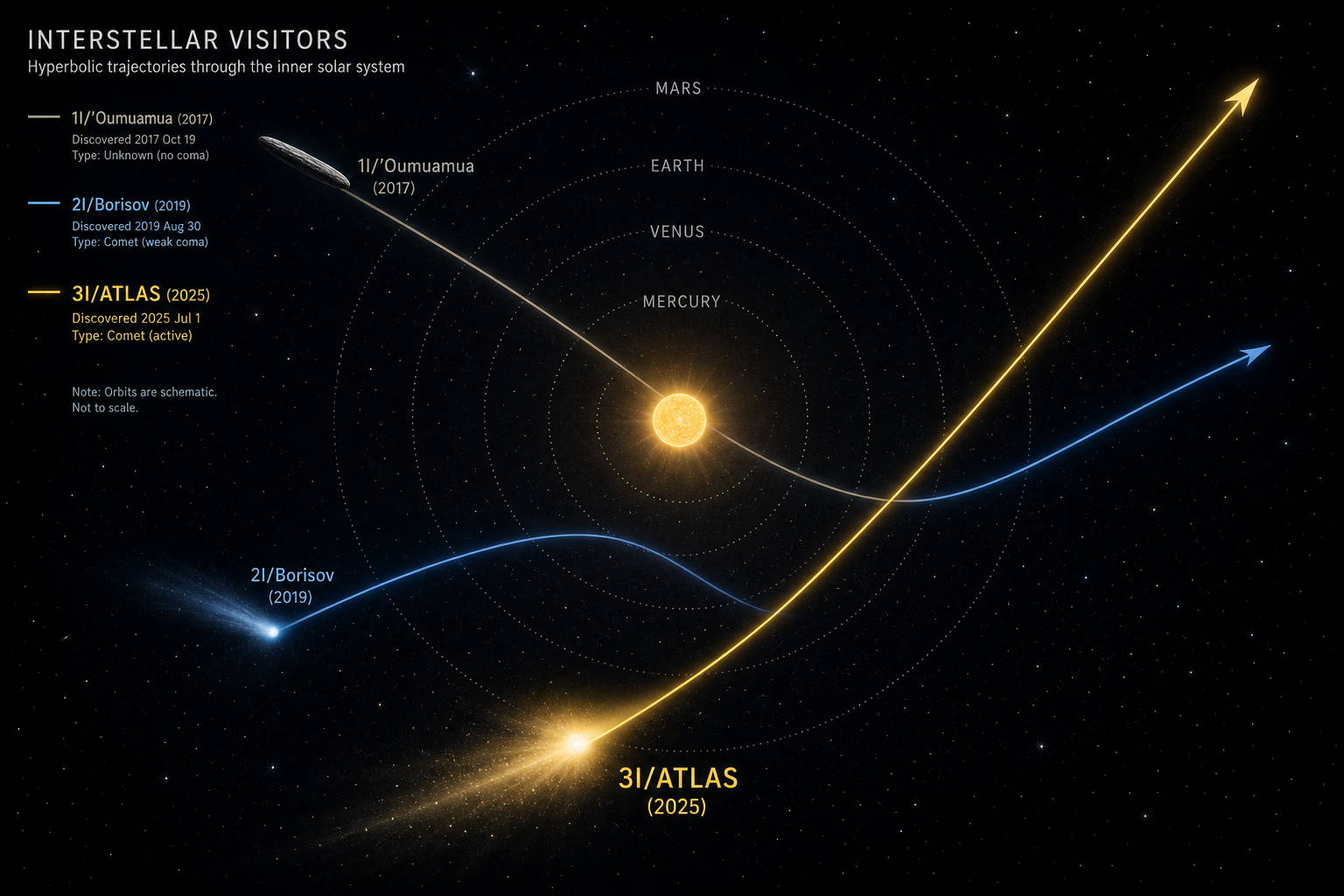
1I/'Oumuamua, discovered in 2017, was already receding when found. It appeared as an unresolved, inactive point of light with a brightness variation suggesting an extremely elongated or flat rotating body — cigar-shaped in some models, pancake-shaped in others. It had a measurable non-gravitational acceleration, meaning something was pushing it beyond what solar gravity and radiation pressure could explain. The leading hypotheses ran from outgassing too faint to detect, to hydrogen ice, to thin-film pressure from absorbed radiation. None achieved consensus. Without a coma, the chemical inventory was largely inaccessible. 'Oumuamua left behind debate.
2I/Borisov, found in 2019, looked much more familiar: an active comet with a visible coma and tail. Its chemical fingerprints were measurable, and what they measured was surprising — an unusually high carbon-monoxide abundance, pointing to icy material preserved in a very cold formation environment. It behaved like a comet while carrying a different chemical history. Comforting and strange simultaneously.
3I/ATLAS is active, bright enough for an extraordinary multi-observatory campaign over many months, and chemically accessible at multiple wavelengths. It is more informative than its predecessors. Whether it is more "alien" in any culturally loaded sense is the wrong question. What the three objects offer, taken together, is not a law of interstellar visitors but a demonstration of diversity. One ambiguous inactive object, one CO-rich comet, one evolving CO2-rich comet. Three data points define no population. They do prove that interstellar objects come in at least several distinct types — which, for a field that until 2017 had zero confirmed examples, is a remarkable thing to be able to say.
Chemistry as imperfect testimony
When the James Webb Space Telescope caught 3I inbound at 3.32 astronomical units — about the distance of the asteroid belt, on the approach — its NIRSpec instrument read the comet's coma and found CO2, water, CO, water ice, dust, and tentative signals of OCS. The headline number was the CO2-to-water mixing ratio: 7.6 ± 0.3, among the highest ever measured in a comet and well above the distance-adjusted trend for typical solar-system comets.
That result earns its excitement. A high CO2 abundance can reflect material formed near the CO2 ice line in the parent protoplanetary disk — the region where CO2 first condenses — or it can reflect ice chemically altered by long exposure to interstellar radiation. Either interpretation says something useful about where and how 3I formed.
But the phrase "3I has an alien CO2-to-water ratio" turns a time-stamped photograph into a permanent identity.
A comet's coma is not a direct sample of the nucleus. It is whatever is currently sublimating, shaped by depth, thermal history, illumination geometry, dust reprocessing, and potentially distributed sources in the coma itself. As 3I moved closer to the sun and solar heating increased, the volatile balance shifted. Water became increasingly prominent. The early ratio was real and significant at that specific observation geometry and distance; it was not a complete chemical biography of the body.
The more durable recent signal is isotopic. Isotope ratios are less susceptible to the surface evolution problem because they reflect the nuclear building blocks rather than which molecules happen to be sublimating this week. Water's deuterium-to-hydrogen ratio came back at approximately 0.98% — more than an order of magnitude above any known solar-system comet, which cluster in the range of 0.01 to 0.06%. Carbon and nitrogen isotope measurements were consistent with formation in the cold outskirts of an old, low-metallicity stellar system. One model-based interpretation places its isotopic "age" — meaning the inferred chemical environment rather than a direct clock reading — at around 11 to 12 billion years.
That inference is contingent on models of galactic chemical evolution. It is not a date engraved on the nucleus. And even if it were, orbital backtracking cannot name the parent star after billions of years of galactic encounters, stellar drift, and gravitational perturbations. 3I carries conditions and history — evidence of cold formation, unusual volatile processing, possibly remarkable age — without handing us a return address.
That is the intellectually honest wonder of it. Not "we know where it came from" but "we can read the conditions under which it formed, and they are different from anything in our solar system."
What Mars added
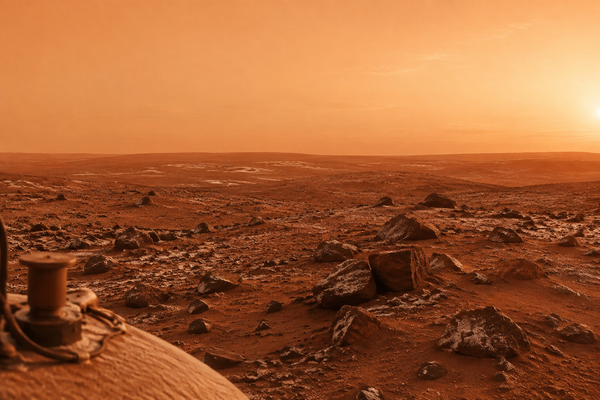
On 30 September 2025, China's Tianwen-1 Mars orbiter turned its high-resolution camera toward a comet. This was not the mission it was designed for, but 3I was passing Mars at about 0.194 astronomical units — roughly 29 to 30 million kilometres — and the geometry was unique.
Earth-based observers see interstellar objects from Earth's vantage point, constrained to a narrow band near the ecliptic plane. Tianwen-1, in orbit around Mars, was positioned 35 to 45 degrees south of 3I's orbital plane. Over three observation sessions from 30 September to 3 October, that offset let the team watch the comet's visible tail change from a fan-shaped structure to a narrow, curved feature as the perspective shifted. They could test whether the apparent structure followed changing geometry and solar radiation pressure. It did.
From the model fit, the team extracted constraints on dust grain sizes — dominated by particles of hundreds of micrometres, much larger than typical solar-system comet dust. Outflow speeds were 3 to 10 metres per second, and the mass-loss rate was roughly one tonne of dust per second. These are constraints on dust physics and grain properties, not resolved images of the nucleus. Tianwen-1's images did not show jet structures that had been reported elsewhere in the observing campaign. Whether that reflects a real absence or an instrumental difference in spatial resolution remains an open question.
What the Mars result demonstrates is structural. A spacecraft positioned elsewhere in the solar system can provide viewing geometry that Earth telescopes cannot reproduce. For a transient visitor moving at tens of kilometres per second, that geometry window is short. Tianwen-1 used it. The result is a preview: what a future deliberately-targeted interceptor mission — one sent to pace an interstellar object — could accomplish at much closer range over a sustained period.
Were we blind, or are they rare?
The detection record — 'Oumuamua in 2017, Borisov in 2019, 3I in 2025 — might tempt a reading of roughly one interstellar visitor per few years. That reading is almost certainly wrong.
The record reflects what our instruments were capable of detecting, not the actual population of interstellar objects passing through the solar system. Faint objects moving at high speed with inconvenient solar elongations simply disappeared in historical survey data. 3I itself is a useful example of how much is in plain sight once you know to look: Rubin Observatory pre-discovery images from June 2025 recovered the comet more than a month before the ATLAS formal detection on 1 July. The object was already in the data. The survey system improved while the object was passing through.
Rubin's wide-field, cadenced sky survey is expected to find roughly one interstellar object per year under some population forecasts. Treat that as an order-of-magnitude estimate rather than a delivery schedule. The central change is not in how many objects pass through, but in our ability to detect them, characterise them early, and co-ordinate observations. Large automated surveys transform what once appeared to be unique events into a detectable class. Early warning converts emergency telescope time — a few nights of scrambling when an unusual trajectory is flagged — into months of co-ordinated spectroscopy across multiple observatories. That is what 3I received. 'Oumuamua did not.
Astrobiology without the leap
Interstellar visitors arrive with a question attached: could they carry something biological?
The physics of interstellar panspermia are discussable. Icy bodies ejected from one planetary system can in principle reach another. The transit times across typical stellar separations range from millions to billions of years, but ejection velocities, the density of the interstellar medium, and the properties of ice as radiation shielding have all been modelled. Panspermia is not obviously ruled out by physics.
The chain from physics to biology is where the chain breaks. A molecule surviving ejection is not a molecule surviving millions of years of cosmic-ray bombardment. A surviving molecule is not a living organism. A living organism arriving at another planetary system still needs atmospheric entry, liquid water, and a compatible biochemical environment. None of these steps is demonstrated by 3I's chemistry. The object's CO2 excess and unusual D/H ratio are evidence of specific formation conditions in another stellar environment — not evidence that anything biological crossed the interstellar gap.
The genuinely compelling astrobiological point is subtler. If planetary systems regularly exchange icy material through gravitational ejection — and the three interstellar detections suggest this is a real process, not a theoretical curiosity — then the chemistry of that exchanged material matters. 3I exposes the raw molecular inventory from which worlds form under conditions outside our solar system. Whether those conditions could support the emergence of prebiotic chemistry, and whether the same chemistry that occurs here also occurs around old, low-metallicity stars, are questions that become newly tractable when you have a sample.
That is not "a message from aliens." It is more consequential, and more testable.
Hearing traffic
Three interstellar objects are not enough to prove the Galaxy is crowded with worlds. They are too few to define a population, too diverse to establish a pattern, and too briefly observed to answer the deepest questions about where each one came from.
But they are proof of something else. For most of human history, the idea that material flows between planetary systems was theoretical. It was plausible, perhaps inevitable, but unverifiable. Now astronomers have watched three such objects react to our sunlight, measured their chemistry, tracked their dust, and mapped their trajectories backward through galactic space.
The instruments have finally started hearing traffic.
That traffic carried no manifest, no return address, and certainly no deliberate message. What it carried was ice formed around another star, carbon and nitrogen and deuterium in ratios our solar system does not produce, and a D/H ratio that suggests something extraordinarily cold and extraordinarily old. The letter arrived. We cannot write back. But we can read it — imperfectly, conditionally, one spectral line at a time — and that, for now, is enough.
Sources
Discovery & orbital data
- 3I/ATLAS facts and FAQs — NASA overview including orbital parameters and discovery timeline. NASA, 2025.
- Pre-discovery observations of 3I — Rubin Observatory recovery of 3I in archival June 2025 data, a month before the formal ATLAS detection. arXiv, 2025.
Chemistry & spectroscopy
- JWST detection of a CO2-dominated coma — Early NIRSpec measurements at 3.32 AU, including the 7.6 ± 0.3 CO2/H2O ratio. NASA Technical Reports Server, 2025.
- Webb finds clues to ancient, distant origin of comet 3I/ATLAS — NASA summary of JWST isotopic and chemical findings. NASA, 2025.
- Isotopic evidence for a cold and distant origin — Carbon, nitrogen, and oxygen isotope ratios from 3I's coma, placing formation in a low-metallicity stellar environment. Nature, 2026.
- Water D/H as a formation probe — Deuterium-to-hydrogen ratio of ~0.98%, pointing to a cold and ancient formation environment. Nature Astronomy, 2026.
Interstellar objects in context
- 2I/Borisov's chemistry — CO-rich chemical profile of the second interstellar visitor. NASA, 2020.
- 1I/'Oumuamua — Summary of the first confirmed interstellar object and its anomalous non-gravitational acceleration. NASA, 2019.
- The interstellar interlopers — Jewitt & Seligman review of the three known interstellar objects and detection prospects. Annual Review of Astronomy and Astrophysics, 2023.
Mars observations
- Tianwen-1 observations of dust activity — Dust grain sizes, outflow speed, and mass-loss constraints from the unique 35–45° south-of-plane Mars vantage point. CNSA, 2025.
Astrobiology
- Interstellar panspermia analysis — Desch & Jackson on the physical plausibility and limits of biological material transfer between planetary systems. Astrobiology, 2021.