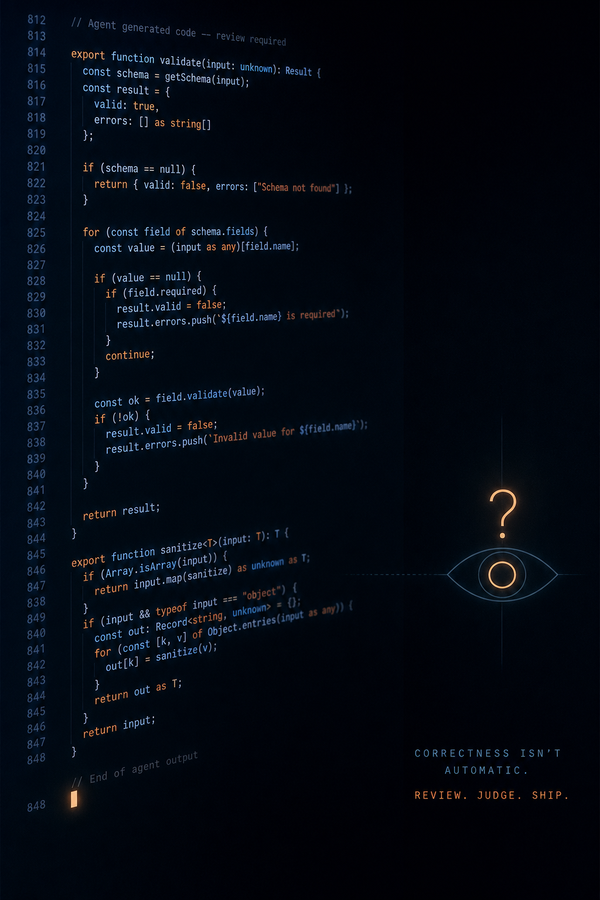
What the Robots Demanded
How making your codebase agent-ready became a bill for twenty years of shortcuts
It was supposed to take thirty minutes.
Sarah — a senior engineer at a mid-sized fintech, six years into the codebase — sat down on a Tuesday afternoon to add an `AGENTS.md` file to the repository. The new AI coding tools her team had adopted required it: a single Markdown file in the root of the repo, explaining what the project does, how to build it, how to run the tests. Simple stuff. A morning task, maybe less.
Three hours later, she was still at her desk. Not because the file was technically complex, but because she kept running into gaps. What are the naming conventions? She'd always known them implicitly — but when she tried to write them down for a system that would apply them literally, she discovered they'd never been explicit anywhere. What's the preferred way to handle authentication errors? Three different patterns existed in the codebase, all reasonable, none documented. Which one should the agent follow?
By the time she finished, the AGENTS.md file was 380 lines long. And she'd realized something uncomfortable: she hadn't written documentation for the AI. She'd written the onboarding guide she should have written three years ago, when the team hired its last junior developer.
The Fastest Standardization in Software History
AGENTS.md is not a product. It's not sold by any company. It is, in the most literal sense, a file format — a community convention for how to tell an AI coding agent about your project.
Eighteen months ago, the landscape was fragmented. Claude Code read `CLAUDE.md`. Cursor had `.cursorrules`. Aider had its own format. Teams juggling multiple tools maintained multiple files that drifted out of sync, contradicted each other, and caused agents to behave inconsistently depending on which tool happened to be running.
Then, over the course of about six months in 2025, something unusual happened: a spontaneous standardization. OpenAI, Google, Anthropic, Sourcegraph, Cursor, Factory, JetBrains, and others converged on a single open format. Today, AGENTS.md is automatically loaded by Claude Code, Codex CLI, Cursor, Aider, Devin, Sourcegraph Amp, Google Jules, Zed AI, Roo Code, GitHub Copilot, Gemini CLI, Windsurf, Amazon Q, and Factory Droids. Fourteen major tools, one file. More than 28,000 open-source repositories had adopted it within months of its launch.
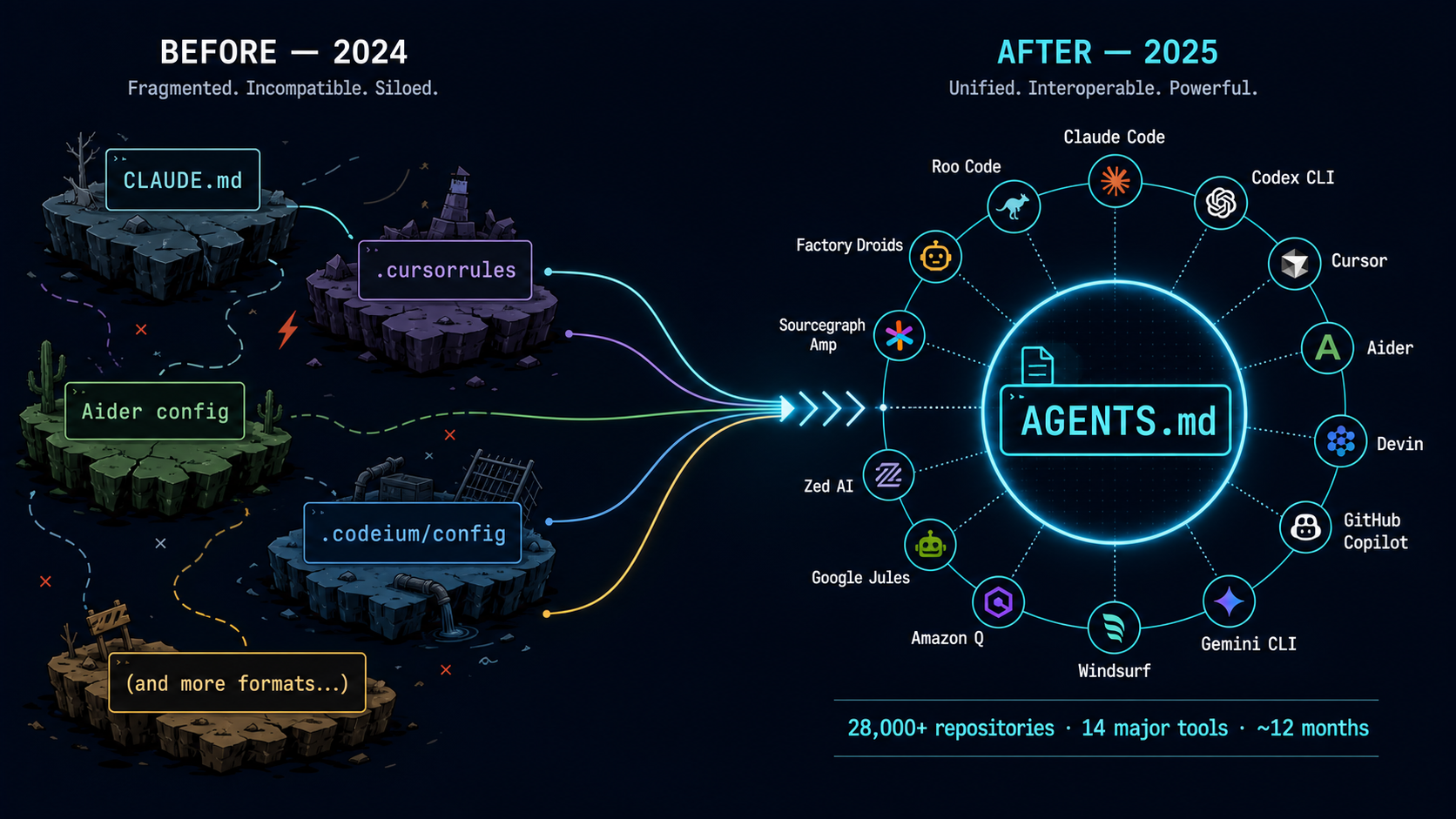
That pace is remarkable. Software standards usually take years to settle — sometimes decades. TCP/IP took the better part of the 1980s. The debate over REST vs. SOAP ran into the 2010s. AGENTS.md went from fragmented per-tool experiment to cross-industry open standard in roughly a year.
Part of the explanation is economic pressure. AI coding tools proliferated so fast that fragmentation became immediately painful, and the cost of coordination was low — it's just a Markdown file. But part of it is something more interesting: the format worked. Teams that added a well-written AGENTS.md saw fewer agent mistakes, fewer wasted context windows, fewer sessions where the agent confidently built the wrong thing.
What Agents Actually Need (and Why It's Expensive Not to Give Them)
To understand why AGENTS.md matters, it helps to understand how a coding agent approaches your repository.
It begins every session from scratch. No memory of yesterday's conversation, no instinct about why the authentication module was refactored in 2023, no sense that `utils/legacy/` is a graveyard nobody touches. When it starts, it reads files. Every file it reads to understand your project's structure consumes context — the finite working memory that determines how much code the agent can hold in mind simultaneously. Every orientation task — "how does this project build?", "what's the test command?", "where does the API client live?" — shrinks the space available for actual work.
BuildBetter.ai studied a hundred engineering teams and found the highest-ROI documentation is the simplest: build commands. Installation. How to run tests. "Agents waste enormous amounts of context guessing how to build and test," their report concluded. The fix is five lines of shell commands.
An effective AGENTS.md, according to the accumulated practice of the community, looks like this: two or three sentences about what the project does; the tech stack with explicit version pins; exact shell commands for installation, build, test, run; naming conventions stated imperatively ("Use pnpm, not npm" works; "We prefer pnpm" does not); architecture constraints and module boundaries; and — this one matters more than it sounds — negative examples. What not to do is more actionable than abstract rules about what to aim for.
One hard limit: keep it under 400 to 500 lines. An AGENTS.md that grows beyond that starts displacing the actual code from the agent's context window. The goal is orientation, not comprehensive documentation of the entire codebase.
Code SEO: Designing for a New Kind of Reader
Beyond AGENTS.md, a broader set of architecture principles has emerged under the label "Code SEO" — a term coined by François Zaninotto of Marmelab in January 2026, who catalogued forty-plus Agent Experience best practices.
The analogy is deliberate. Search engine optimization makes web content legible to algorithms so they can surface it accurately. Code SEO makes source code legible to AI agents so they can navigate it correctly. The underlying logic is identical: you're designing for a reader that's fast, literal, and unforgiving of ambiguity.
Concrete measures: include synonyms in comments if a function is called one thing in the code and another thing in the UI. Never let two files share the same name in different directories — when an agent encounters two `utils.ts` files, it reads both to figure out which one it needs. Use full words instead of abbreviations; `getUserByEmail` is processed more reliably than `getUsrByMail`. Add a one-line `README.md` to each directory explaining what it does. Remove dead code — every unused function is a false lead.
And then there's the observation from a Hacker News thread in August 2025 that generated 382 comments and apparently struck a nerve: "People were too lazy to write docs for other people, but for robots they apparently do it."
The comment, by a user named spawarotti, landed with the precision of a barb thrown from exactly the right distance. It's a joke, but it isn't only a joke. It describes a real phenomenon: engineers who hadn't added comments to their functions in years started writing detailed inline explanations when they adopted AI coding tools. Developers who'd never written onboarding documentation sat down and wrote it — not for the next junior hire, but to prevent the agent from making mistakes in a pull request they'd have to review.
The robots demanded what the managers couldn't get.
The Paradox Nobody Wanted to Talk About
Here is where the story turns uncomfortable.
While the software community has spent the past year building better codebases for AI agents — cleaner code, richer documentation, more explicit architecture — researchers have been measuring what AI agents build when given the chance to write code. The results don't flatter the technology.
The Mining Software Repositories 2026 paper analyzed AI-generated commits specifically for readability. Of commits focused on readability improvements, 56.1 percent actually lowered the Maintainability Index. Cyclomatic complexity increased in 42.7 percent of cases. Line count grew in 71.5 percent — code bloat as a default mode of operation.
CodeRabbit analyzed 470 open-source GitHub repositories and found that AI produces 1.7 times as many bugs as human developers, three times as many readability errors, and 75 percent more logic errors. Their summary: "AI generates more surrounding harness code and few inline comments. There is simply much more to read."
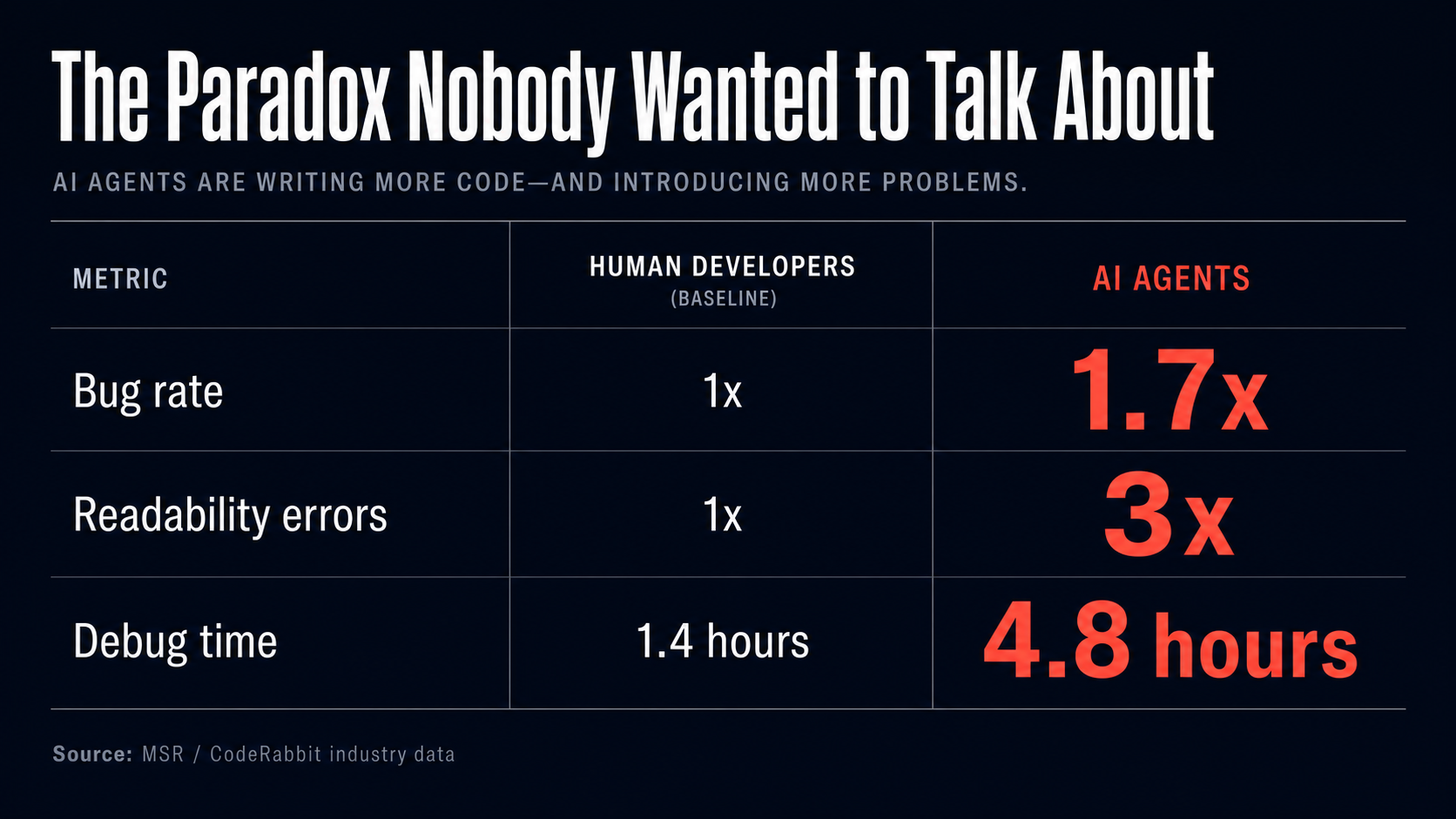
AgamiSoft introduced the term "Comprehension Debt" — "the cognitive burden when engineers must maintain code they didn't write and don't fully understand." The numbers attached to it are specific: new engineers take 3.2 times longer to understand AI-written modules. Debugging takes 4.8 hours versus 1.4 hours for reviewed code. The estimated quality tax: $58,000 per engineer per year under unmanaged AI tool use.
This creates a dynamic that Arize AI describes with uncomfortable clarity: "If the code is not readable to your agents, they will globally corrupt it with locally reasonable changes." The quality of the codebase determines the quality of what agents produce — and what agents produce degrades the codebase. A negative spiral that only human review can interrupt.
The paradox, then: you spend weeks making your codebase readable enough for agents to navigate. The agents navigate it, make changes, and make it less readable. You add documentation to compensate. The agents add more code. When the output starts to degrade, the instinct to blame the model is usually wrong.
What Actually Works
The benchmark evidence for AGENTS.md is more modest than its adoption rate might suggest. A paper that circulated on Hacker News in early 2026 evaluated effectiveness directly: a human-written AGENTS.md produced a 4 percent improvement in task completion rates compared to no instructions at all. An LLM-generated AGENTS.md produced a negative 3 percent — it made things slightly worse. On Claude Sonnet 4.5, results were even less encouraging.
The author was clear about the fragility of these numbers: model-dependent, statistically marginal.
The Hacker News community pushed back, usefully. "My use of CLAUDE.md is to prevent Claude from making stupid mistakes," wrote user vidarh. "Performance is not a consideration." This reframe matters. The value of AGENTS.md isn't measured in benchmark points but in preventing category errors: the agent that installs the wrong dependency because the README didn't specify versions; the agent that skips tests because it doesn't know the test command; the agent that invents a new authentication pattern because the existing one wasn't documented.
ObviousWorks makes the most operationally useful observation: documentation alone achieves 25 to 40 percent compliance with project conventions. The same rules enforced as runtime hooks — pre-commit checks, CI/CD gates that reject non-compliant code before it merges — push closer to 95 percent. The instruction file is a starting point, not an enforcement mechanism.
There's also a leverage argument that changes the economics. HN user nicklo: "When I write to CLAUDE.md once, it gets read by thousands of agents in a week." That's qualitatively different from documentation that a human reads once during onboarding and never again. The return on the hour spent writing a good AGENTS.md compound in a way that traditional documentation never did.
Temporary Inconvenience or Permanent Discipline?
Every technology creates a transition period. When IDEs replaced text editors, developers had to learn new workflows. When version control became standard, the habits of the pre-Git era had to change. The question about agent-readiness is whether it's an adjustment phase that dissolves as agents improve, or a new permanent layer of software practice.
The honest answer is: probably both, but the structural argument is stronger.
The temporary case: context windows are expanding. Hybrid code indexing — combining AST and code graphs with vector search — gives agents more structural understanding of large codebases without requiring explicit documentation. The next generation of agents builds its own map — the premise that agents will keep self-improving until documentation becomes unnecessary is not new. The need for hand-curated instruction files will diminish.
But AGENTS.md is already an institutional standard. More than 28,000 repositories don't remove a file that's working. Fourteen major tools don't drop support for a format they just agreed to implement. The standard will evolve, but the practice of explicitly instructing your agents about your project is not going away.
More fundamentally: the principles that make a codebase agent-ready are not principles invented for agents. They are the principles that software engineers have been recommending for thirty years — small focused functions, clear names, explicit conventions, comprehensive tests, ruthless deletion of dead code — and that the industry has been consistently ignoring for exactly as long.
Agents don't create new requirements. They make the cost of ignoring old ones immediate.
Marmelab puts it concisely: "Coding agents are modeled after developers, so most good Developer Experience principles also apply to Agent Experience." Agent Experience is the next layer of Developer Experience. Same discipline, new audience. The developers who built readable, well-documented, consistently structured codebases in 2018 — not because it was trendy but because they understood the compounding cost of not doing so — have an AI tooling advantage today that their shortcuts-prone peers are now paying to close.
The Bill
Back to Sarah, still at her desk.
When she finally finished the AGENTS.md, her team lead asked how it went. She said it went fine, but she'd found some things. The three authentication patterns, for instance — she'd documented the correct one, but probably they should clean up the other two before agents started using them as reference. And the naming conventions should probably be in the project wiki as well, not just in the agent instruction file. And while she was at it, there were a few modules in `utils/legacy/` that hadn't been touched in two years and were creating confusion—
"How long is that going to take?" the team lead asked.
Sarah did the mental math. "A week? Maybe two, if we do it properly."
The team lead looked at his calendar. "We were supposed to start using the agent tools next sprint."
This is the conversation happening in engineering organizations everywhere in 2026. Not "should we adopt AI coding tools?" — that decision is mostly made — but "what do we owe the tools before we hand them our codebase?" And the answer, it turns out, is not a new kind of work. It's old work, deferred.
The documentation that wasn't written when the team was three people and everyone just knew things. The cleanup that was always "next quarter." The onboarding guide that never got finished because the person who was supposed to write it left, and the person who replaced them figured it out by asking around. The architecture decision records that would have explained, to anyone who read them in 2026, why the authentication module was designed the way it was in 2023.
None of that was written for AI agents. All of it is exactly what AI agents need.
The question "how do you make your codebase agent-ready?" turns out to have a disarmingly simple answer: make it good. The harder question it exposes is why it wasn't already.
Sources
AGENTS.md & Tooling Standards
- Make Your Codebase Agent Ready — Damián Le Nouaille's overview of the principles behind agent-ready codebases, January 2026
- AGENTS.md Complete Guide for Engineering Teams (2026) — BuildBetter / Spencer Shulem; includes the adoption data (28,000+ repos) and ROI research on documentation types, May 2026
- AGENTS.md – Open format for guiding coding agents — Hacker News thread, August 2025 (382 comments), includes the spawarotti quote about writing docs for robots
- Evaluating AGENTS.md: are they helpful for coding agents? — Hacker News thread discussing the benchmark paper on AGENTS.md effectiveness (4% improvement, LLM-generated negative)
- Writing a good CLAUDE.md — HumanLayer practical guide with the vidarh quote on preventing category errors, 2026
Agent Experience & Architecture
- Agent Experience: Best Practices for Coding Agent Productivity — François Zaninotto / Marmelab; coined "Code SEO" and catalogued 40+ Agent Experience best practices, January 2026
- Designing CLAUDE.md correctly: The 2026 architecture — ObviousWorks; documentation alone achieves 25-40%, runtime hooks push to 95%
- How to Design Agent-Ready Architecture for AI Coding in 2026 — Overview of architectural principles for agent-readable codebases
- Building shared coding guidelines for AI (and people too) — Stack Overflow Blog on shared conventions benefiting both humans and AI, March 2026
- AI Coding Assistants for Large Codebases — Kilo.ai on orientation speed and context as a scarce resource, 2026
Research: Code Quality & Technical Debt
- Do AI Agents Really Improve Code Readability? — MSR 2026 paper; 56.1% of AI readability commits lower the Maintainability Index
- Are bugs and incidents inevitable with AI coding agents? — CodeRabbit / Stack Overflow Blog; AI produces 1.7× more bugs and 3× more readability errors, January 2026
- Code is free, technical debt isn't — Arize AI / RL Nabors; "globally corrupt with locally reasonable changes" quote, April 2026
- The Hidden Cost of Technical Debt in 2026 — Comprehension Debt — AgamiSoft; introduces Comprehension Debt concept with $58K/engineer/year figure
- The AI Coding Technical Debt Crisis: What 2026-2027 Holds — Lloyd Pilapil / Pixelmojo on the compounding effect of AI-generated code debt, January 2026
- Some uncomfortable truths about AI coding agents — Hacker News discussion on the paradox of agents degrading the codebases they rely on, 2026
- Hear your agent suffer through your code — Hacker News thread on observable agent confusion in poorly structured codebases, 2026