AI learned the organ. The builder wasn't asked.
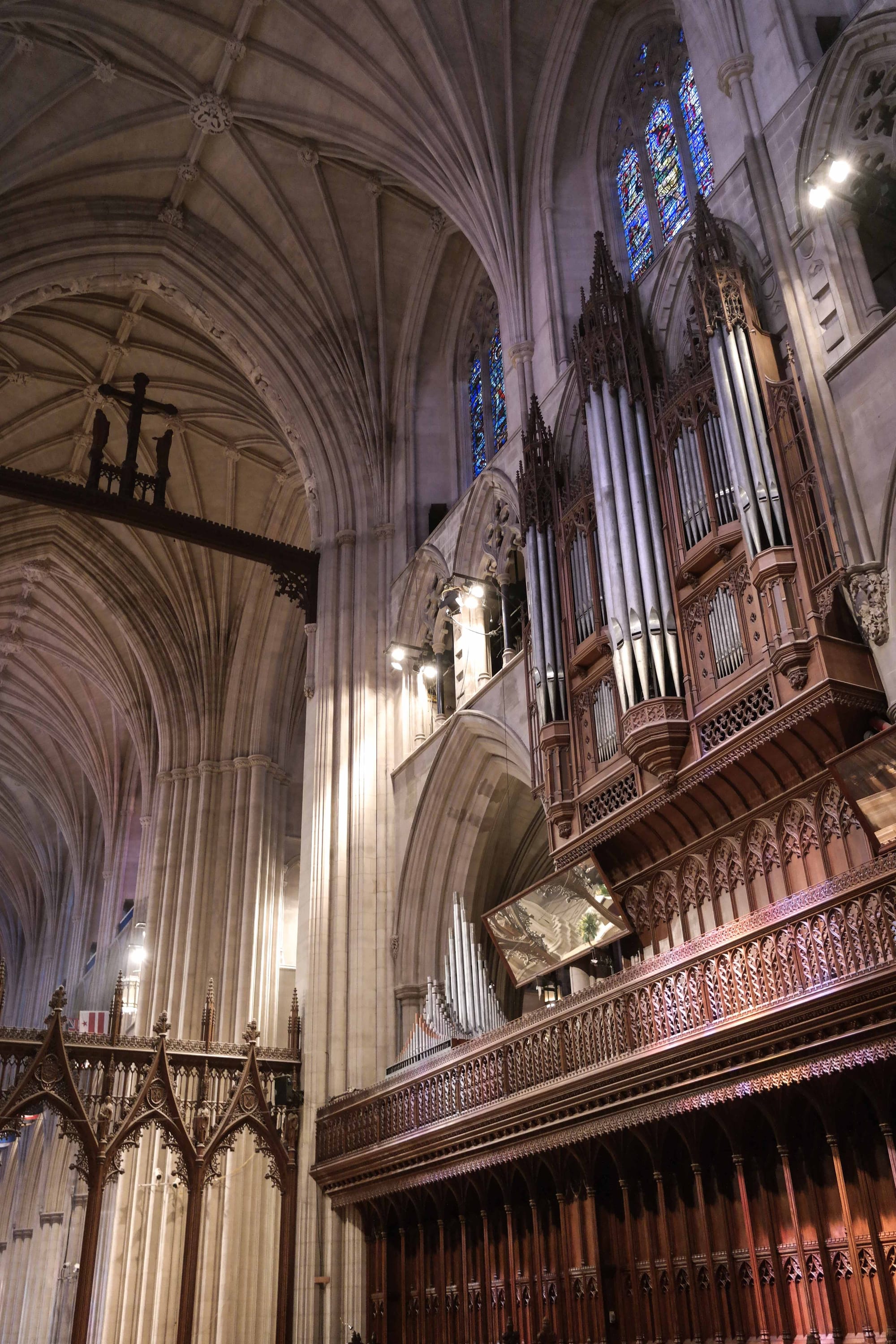
Tom Sheehan had spent most of his career looking at screens. Not because he wanted to — the instrument demanded it. The Great Organ at Washington National Cathedral sat in the Great Choir, separated from the nave by the full length of a Gothic crossing. To play for Sunday morning services, the organist relied on TV monitors and a speaker feed. You played for a congregation you could not see.
In 2024, the cathedral dismantled the organ for a $14.5 million restoration. A temporary instrument went in: sixty speakers, a bank of amplifiers, and a console that looks, to most visitors, like any other pipe organ console — four rows of keys, wooden foot pedals, drawknobs and buttons. The music comes from computers.
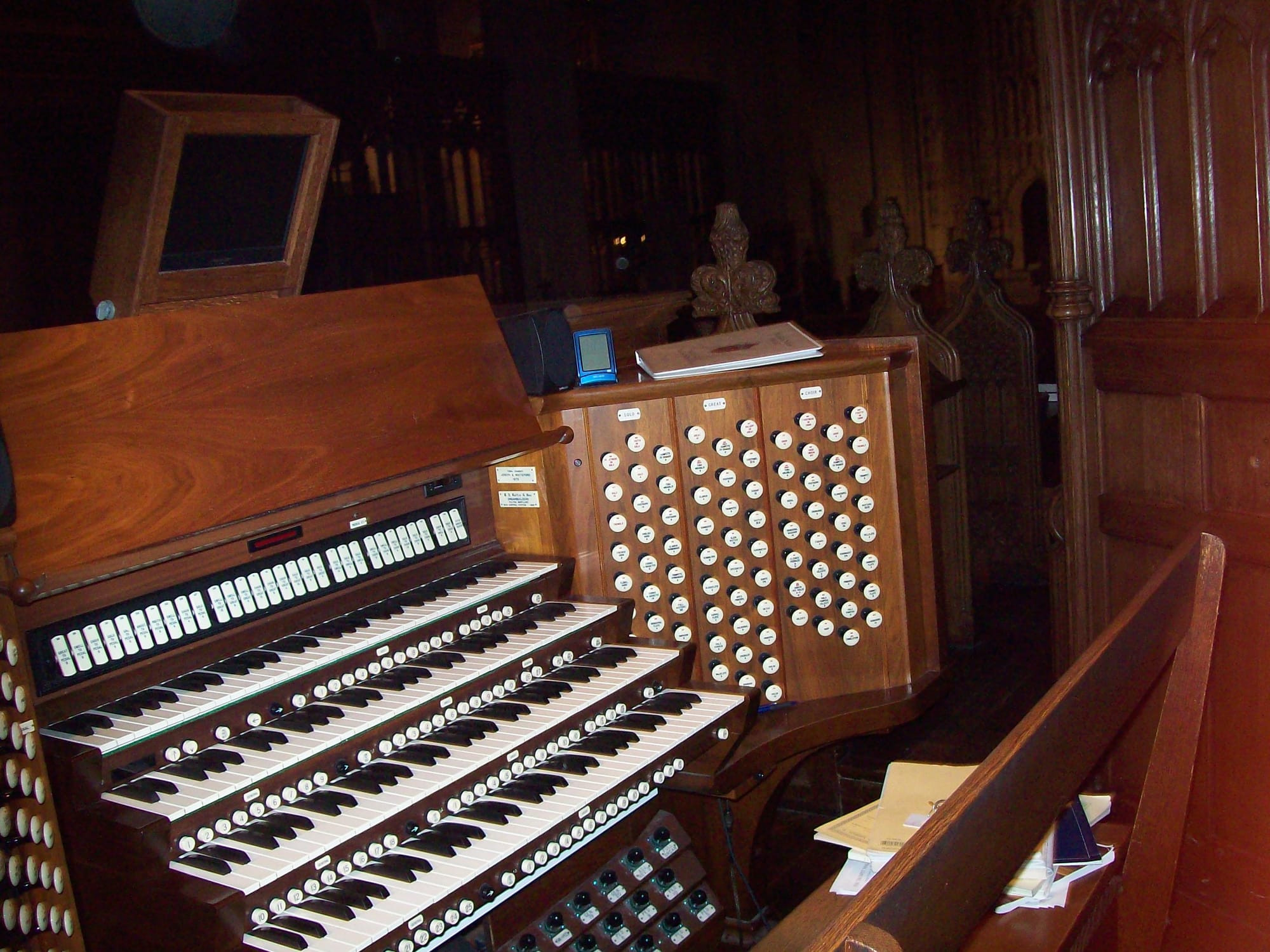
And Sheehan noticed something unexpected. The digital console sits in the nave, close to the altar, surrounded by the congregation at Sunday services. "Already," he wrote, "the experience of playing for a Sunday morning has been transformed by the fact that the organist is physically in the same room with the liturgy and the congregation."
The pipes are gone. The room, somehow, got closer.
Two technologies, one label
The term "digital organ" has become imprecise to the point of uselessness. Applied to Viscount's Physis+ instruments and to Walker Technical's interim solution at Washington National Cathedral, it names two things that share almost nothing except the absence of wind-powered pipes.
Walker Technical Company, founded in 1973 and based in Zionsville, Pennsylvania, works with sampling: recordings of real pipes, played back through high-quality digital systems and integrated with existing instruments via proprietary CLASSIC and Maestro control software. A church adds Walker voices to a pipe organ through a standard serial cable, regardless of how many voices or divisions the instrument has. The approach is mature and deeply integrated into American church organ culture — installations at the Mormon Tabernacle, Lincoln Center, and the US Naval Academy Chapel (522 stop knobs) testify to its reach. The Washington cathedral project, an entire instrument built from samples and speakers rather than wind and metal, is Walker operating at the outer edge of its usual territory.
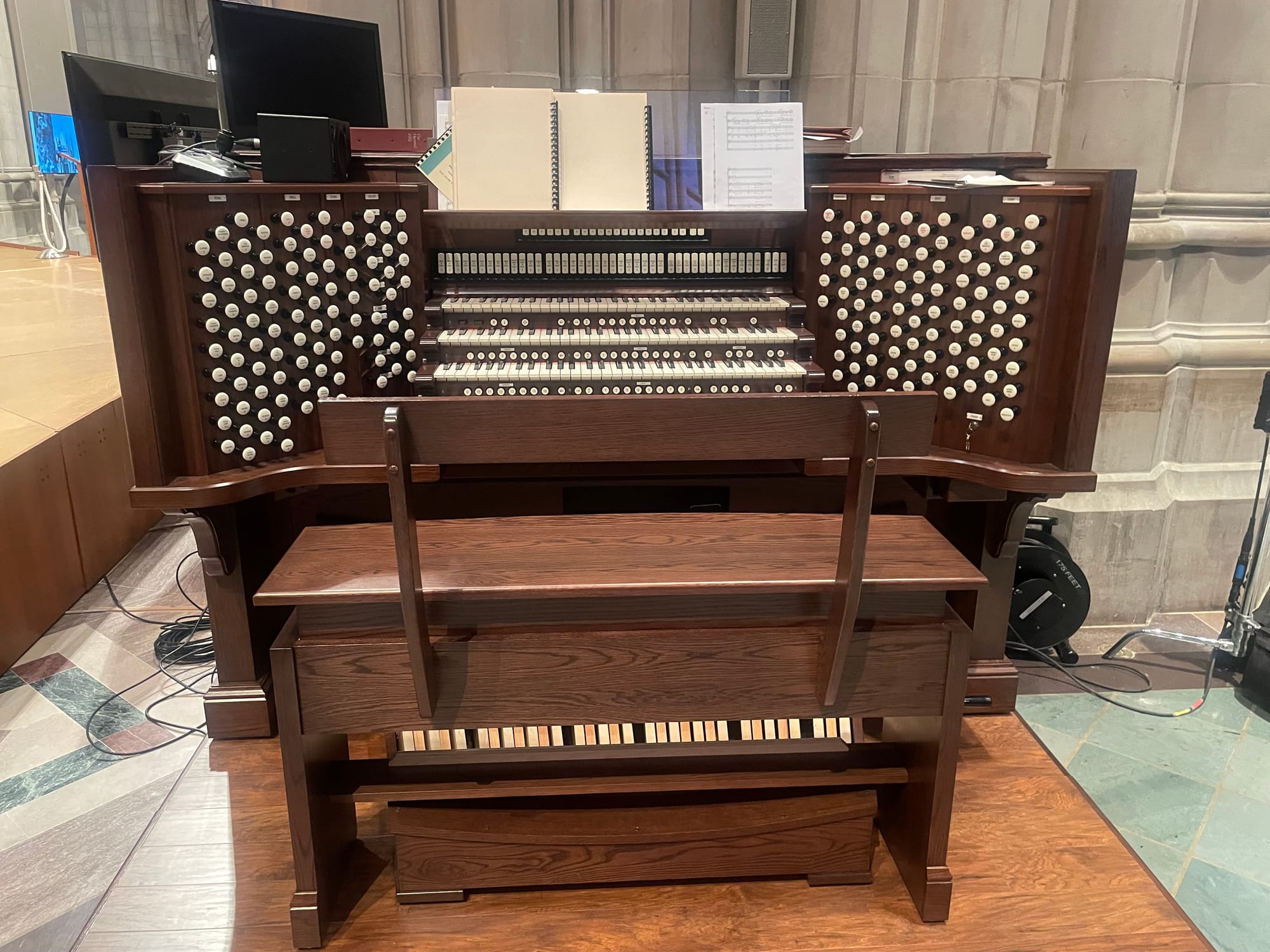
Viscount, an Italian manufacturer, does something categorically different. Its Physis technology models the physics of each pipe as a three-dimensional acoustic object: bore dimensions, mouth geometry, material, wind chest pressure, the interaction between neighboring pipes, and the acoustic properties of the room itself — its materials, its humidity. A Physis organ does not play back recordings. It calculates, in real time, how air moves through each pipe, using processors that Viscount says run over twelve billion instructions per second. The result responds dynamically to touch and registration, the way a real pipe does. A sample does not.
The distinction matters more than most conversations about "digital organs" acknowledge. Describing Walker as a physical-modeling company is simply wrong. The difference between the two approaches captures something essential: sampling copies a sound; modeling attempts to reconstruct the process that made it. The gap between those two things is where most of the interesting arguments live.
The algorithm that builds a voice in an hour
Viscount's newest generation, Physis+, adds another layer to the physical model. The company calls it MORIS — Multi-Objective Random Iterative Search — and describes it in its own materials as "a Viscount Deep Learning complex procedure." MORIS listens to recordings of a homogeneous set of real pipes (a single register), analyzes the acoustic characteristics, and iterates randomly through the parameters of the physical model until the digital reconstruction matches the original closely enough. Where that tuning of a model would otherwise take days or weeks by hand, Viscount says MORIS does it "in about an hour."
"Deep learning" is Viscount's marketing language, not a technical description. The name — Random Iterative Search — signals what the algorithm actually is: a stochastic, heuristic optimization routine that hunts for the parameter values that make the model sound right. That is not a neural network in any standard machine-learning sense. It is closer to a sophisticated guessing loop than to the processes behind image generators or language models.
But the underlying logic is the same, and that is where the trouble starts.
MORIS learns by listening to recordings of pipes. Those pipes were made by someone — designed, voiced, and finished by an organ builder whose craft is, in every meaningful sense, the input to the algorithm. Viscount's physical model may reconstruct the acoustic process rather than copy the recording directly, but the recordings are still where the model gets its targets. The builder's work is the data. The builder may or may not know their instrument was recorded. They are almost certainly not credited. They are not paid.
This is exactly the pattern that runs through every other corner of the AI debate: a language model that learns writing style by reading millions of texts, an image generator that learns composition by studying paintings. MORIS does the same with the acoustic signature of a pipe maker. The difference from sampling is technically real — no fragment is copied; a model is trained. But the question that gets asked first about AI art and AI text presents itself here in exactly the same way: whose work did the system learn from, and has anything been given in return?
"Let's call this what it is, theft"
Robert Coulter builds pipe organs. He has put his position on record, and his language is precise.
"Sampling others work without credit or permission is at least plagiarism and some could argue stealing."
"I believe it is heinous that an unknowing musician may allow a digital builder to come to an instrument we recently built for the purpose of taking our hand crafted sounds and then selling them as their own."
"Let's call this what it is, theft."
"To allow another to profit from their work without regard to the legacy they built is criminal."
Coulter is not describing an abstract principle. He is describing a practice: digital manufacturers, with or without the knowledge of pipe organ builders, record the sound of instruments those builders made, then sell products that reproduce or learn from those sounds. The builders receive no credit and no compensation.
He adds a detail that sharpens the critique: the source pipes are sometimes "out of regulation or even out of tune" when sampled. The digital product then captures not the ideal of an instrument but whatever condition it happened to be in the day someone came with a microphone.
The critique applies differently to Walker and to Viscount. Walker samples directly — the recorded sound is the product. Viscount trains its model on recordings, which is one step removed, but the dependency on the builder's original work remains. In both cases, the starting point is someone else's craftsmanship. The AI discussion that has consumed attention in other creative industries — who owns the work that trained the model? — has been running in the organ world, more quietly, for longer.
What the cathedral actually says
Washington National Cathedral has no interest in overselling the interim solution. The institution's own description of the Walker digital organ is measured: it "produces such rich sound that it rivals the sound of the old organ," but "the sound of speakers will never be the same as the sound of pipes, it is in all ways an emulation of the experience of both playing and listening to a pipe organ."
That honesty is more useful than the bolder claim, common in digital organ marketing, that audiences cannot tell the difference. The cathedral does not say that. What it says is: rich, impressive, and still an emulation.
A detail worth preserving: the Aeolian-Skinner instrument the cathedral is restoring, originally built in 1938 by Ernest M. Skinner and substantially rebuilt since, "contains some digital components." The boundary between acoustic and digital has never been as clean as the argument sometimes implies. What looks like rupture is partly continuation.
The restoration itself is extensive. Foley-Baker Organ Co. — a Connecticut firm that has worked on the organs of Duke University Chapel and Boston Symphony Hall — is doing the work. Disassembly ran from April 2023 to August 2024; reinstallation is scheduled from 2026 to 2028, with the completed instrument expected in 2029. Replacement parts are coming from England, Germany, Pennsylvania, Ohio, and California. The organ is drawing on the same global supply chains as most complex instruments.
The approximately sixty Walker speakers occupy multiple levels of the cathedral's nave. The largest cabinets run about 1.2 by 0.6 by 0.6 meters, carried in sections to triforium height — forty feet above the nave floor — during installation.
And then there is Sheehan, in the room with his congregation for the first time, via a digital instrument that his church will describe, without embarrassment, as an emulation.
The sensor that follows the pipes
A hybrid instrument — pipes and digital voices in the same cabinet — introduces a problem neither approach has alone: the digital side is stable while the pipe side drifts. Real pipes go sharp when the room warms and flat when it cools. Digital samples and physical models do not. In a church without climate control, the two can drift apart across the course of a single service.
At Assumption Cathedral in Bangkok, the answer was a temperature sensor. Johannus, the Dutch manufacturer based in Ede, built a hybrid there alongside Consoli Pipe Organs: 80 digital voices and 24 pipe voices in the same instrument. Project manager Vincent van Os had a sensor built in. "The sensor measures temperature change very precisely," he explained. "The software automatically converts this to a pitch adjustment, ensuring that both organs are precisely attuned to each other."
The sensor does not protect the digital sound from anything — digital stops need no tuning and are unaffected by temperature. Its job is to make the digital component follow the pipes. The acoustic side sets the reference; the digital side moves to match it.
This is the relationship most well-built hybrid instruments aim for: technology in service of acoustic tradition rather than in competition with it. Rodgers Instruments' Pipe Integration Manager offers something similar — automatic tuning and voicing tools designed to make digital additions feel continuous with the pipe ranks they accompany. Johannus operates in roughly a hundred countries. The practical case for hybrids — supplementing incomplete or aging pipe work while a congregation saves for a full restoration — is unglamorous and, in most instances, it works. It works because someone set the sensor right and voiced the digital registers carefully.
The question that stays open
Jurjen de Vries, writing for the Dutch organ journal Orgelnieuws in 2018, argued that sampled organs bypass essential qualities of the instrument, and that respected organists who perform on digital substitutes legitimize those substitutes without intending to — with the downstream risk that students learn technique and style through speakers and touchscreens rather than through a physical instrument. The responses to his piece were more varied than he might have expected. Hauptwerk software, which allows organists to play historical instruments through digital recordings at home, has given students and amateurs access to sounds that would otherwise require travel and keys to locked buildings. The argument is not settled.
OrganForum carries a thread titled "Pipe organ purists are guaranteeing the demise of the pipe organ," which makes the counter-case: that instrumental purism discourages pragmatic choices that keep organs funded and used. A church that can afford neither a full restoration nor a new pipe instrument, but can manage a Viscount or a Walker hybrid, keeps an organist, a repertoire, a liturgical tradition. The alternative, in too many buildings, is no organ at all.
Both positions are defensible. Neither resolves what Coulter raises.
His question is not really about whether digital organs sound convincing. On their best day, they sound very good. The question is whose work enabled that. When an Italian company runs a parameter-optimization algorithm on recordings of an American builder's pipes, and sells instruments that reproduce what that algorithm learned — is the builder a contributor? A source? A subject of something that has no clean legal name yet?
An AI algorithm listens to the craftsmanship of an organ builder and learns from it how to calibrate a physical model to reconstruct that sound — without the builder ever being asked, credited, or paid. Set that sentence beside a conversation about text generators trained on copyrighted books, or image models that reproduce the styles of living illustrators, and the difference is surprisingly small. The only thing that changes is the medium: here it is not language or image, but the sound of a pipe that a craftsman once, with patience and a trained ear, tuned to exactly that pitch.
The organ Sheehan is playing at Washington National Cathedral will come down in 2028 when the restored instrument is ready. The sixty speakers will go back to Walker. Foley-Baker's work will take its place, with components from three countries and two continents. The question of who owns the sound of the digital interim will not come up. Nobody will litigate it.
But the same question, in harder forms, is active across music, the visual arts, and publishing. The pipe organ world arrived there first, with less noise and less funding, and has not yet found an answer.
Sources
The instrument and the technology
- Viscount Physis technology overview — Viscount's explanation of physical modeling: real-time aerodynamic simulation, no sampling
- Viscount Physis+ and MORIS — Physis+ with MORIS parameter-learning; "in about an hour"
- MORIS confirmation — speed claim and "deep learning" framing
- Viscount Physis explained — additional manufacturer documentation
- OrganForum: Physis+ thread — user confirmation: "no samples" (Physis+)
- Walker Technical Company — company background and sampling approach
- Walker CLASSIC system — CLASSIC/Maestro integration documentation
- Buch-Walker hybrid, Westminster Presbyterian (2006) — sampling of "most noted organs of the twentieth century"
Washington National Cathedral
- Cathedral organ page — project overview and 2029 completion date
- Cathedral digital organ page — Walker console placement, speaker configuration, "2023 Walker digital organ"
- Cathedral blog: "One Pipe Organ Leaves, Another (Digital) Organ Arrives" — Sheehan quote, cathedral's self-assessment as emulation
- Cathedral press: dismantling announcement — $14.5M project, campaign context
- Foley-Baker Organ Co.: Washington project — restoration details, company credentials
- WTOP: renovation timeline — April 2023 start, international parts sourcing
- Washingtonian (June 2024) — photo documentation, speaker installation
- Washington Post (June 26, 2024) — broader coverage
Hybrid instruments and sensors
- Johannus Bangkok hybrid — temperature sensor installation, Van Os quote
- Rodgers hybrid organs — Pipe Integration Manager, auto-tuning
- Popplers Music: digital and hybrid guide — "Digital stops require no tuning and are unaffected by temperature or humidity"
- Reddit r/organ: hybrid installation — practitioner's thermometer account
- MusicaSacra forum: hybrid organs — installation quality, practitioner discussion
Criticism and the ownership debate
- Robert Coulter: digital organ critique — verbatim ownership critique; sampling without permission
- MusicaSacra forum: purists thread — counter-argument: purism hastens decline
- Jurjen de Vries, Orgelnieuws.nl — Dutch purist argument and pedagogical concerns