How the Eagle actually landed
The distributed system behind a celebrated sentence
If you are European and you celebrated Apollo 11 yesterday — on 20 July — you celebrated the landing. Not the first step. Neil Armstrong's left boot touched lunar soil at 02:56 UTC on 21 July 1969, which is 04:56 in central European summer time. By then it was already the 21st.
The distinction matters for more than calendar pedantry. In the roughly six hours between touchdown and that first footfall, Armstrong rested inside a vehicle that had arrived by a narrower margin than "The Eagle has landed" suggests. The famous sentence is true. It is also a compression. What it compresses is worth understanding — not to diminish the achievement, but because the uncompressed version is more interesting.
The number Armstrong called out
At 102 hours, 45 minutes, and 40 seconds into the mission, Neil Armstrong called up to Mission Control: "Program alarm. It's a 1202."
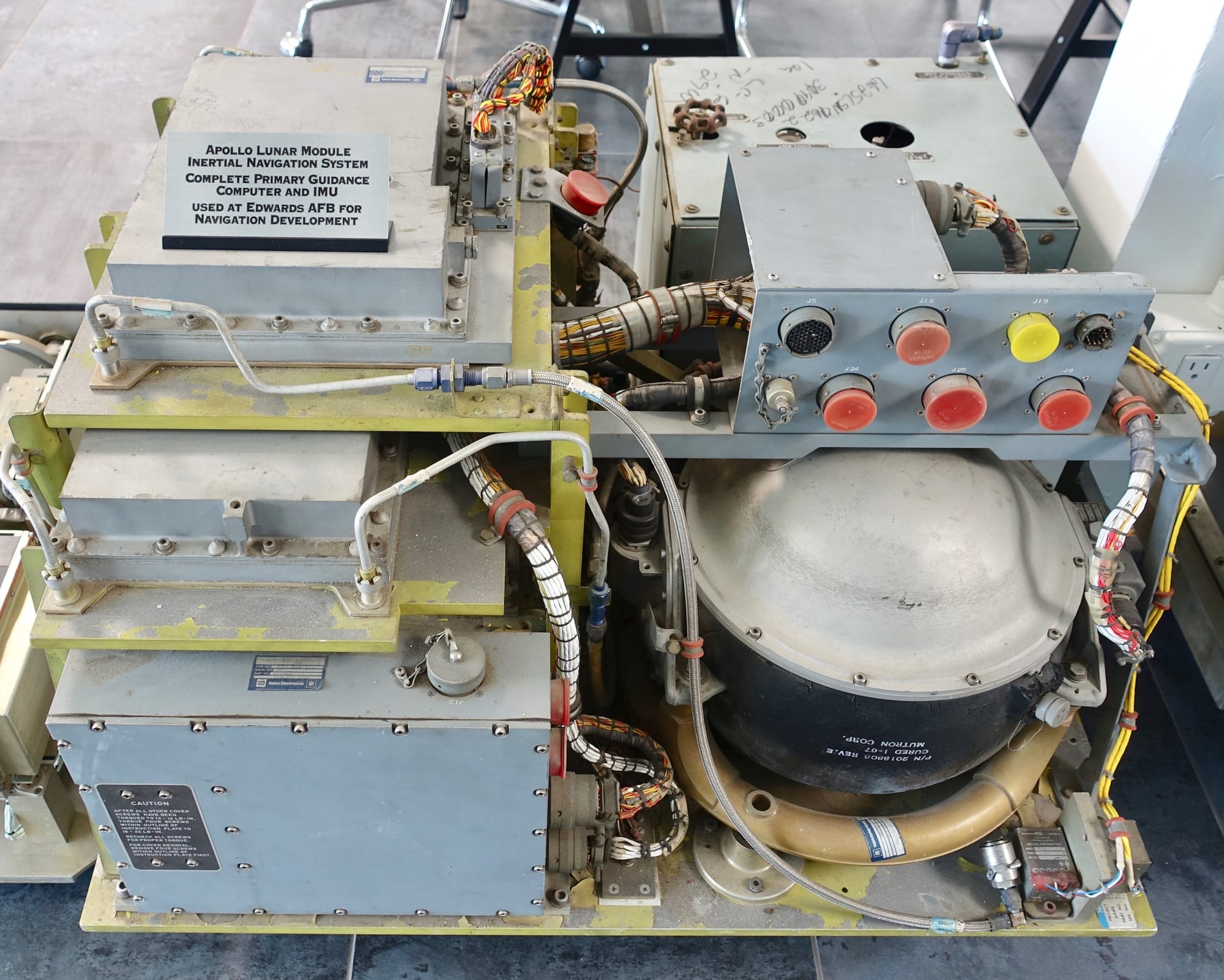
A 1202 was not a navigation error. It was not a signal that the guidance computer had decided to abort. The Apollo Guidance Computer's executive scheduler was reporting that it could not serve all the tasks currently queued: there were no available core sets. In plain terms — the computer was being asked to do more than its scheduling resources could handle at that moment.
The alarm appeared four more times during the final minutes of descent. Each time, the decision to continue had to be made in near-real time, by people who did not yet know what was causing it.
The decision chain worked like this. From Eagle, Armstrong and Aldrin called the alarm to Mission Control. Guidance Officer Steve Bales passed the question to Jack Garman, a 24-year-old engineer in the support room who had prepared a handwritten list of alarm codes and their GO/NO-GO status. Garman recognized the 1202 as an overload warning, assessed that the computer's critical guidance work was still being performed, and advised Bales to continue. Bales accepted the advice. CapCom Charlie Duke relayed "GO" to the crew in one word.
What made that GO defensible was a design choice made years before the flight. The AGC's restart architecture assigned different priorities to different tasks: engine steering and the crew display could resume after a restart, while lower-priority work was discarded. The computer was not failing. It was shedding load according to plan, and doing so repeatedly, and the result was that the functions actually needed for a safe landing kept running.
The discomfort, which NASA's historical documentation preserves honestly, is that the root cause was not established in the moment. Post-flight analysis traced the overload to rendezvous-radar data being processed by an unfortunate switch configuration — but that understanding came afterward. Garman's GO was a judgment under bounded uncertainty: the system appeared to preserve what mattered, and a prepared specialist knew enough to say so.
Don Eyles, who worked on the AGC software at MIT and later wrote about the program in Sunburst and Luminary, noted something worth sitting with: a 1202 during a landing approach had not been rehearsed as a condition under which a landing would proceed. The assessment was correct. It was also improvised, in the best sense of that word.
West Crater, and what "manual" actually meant
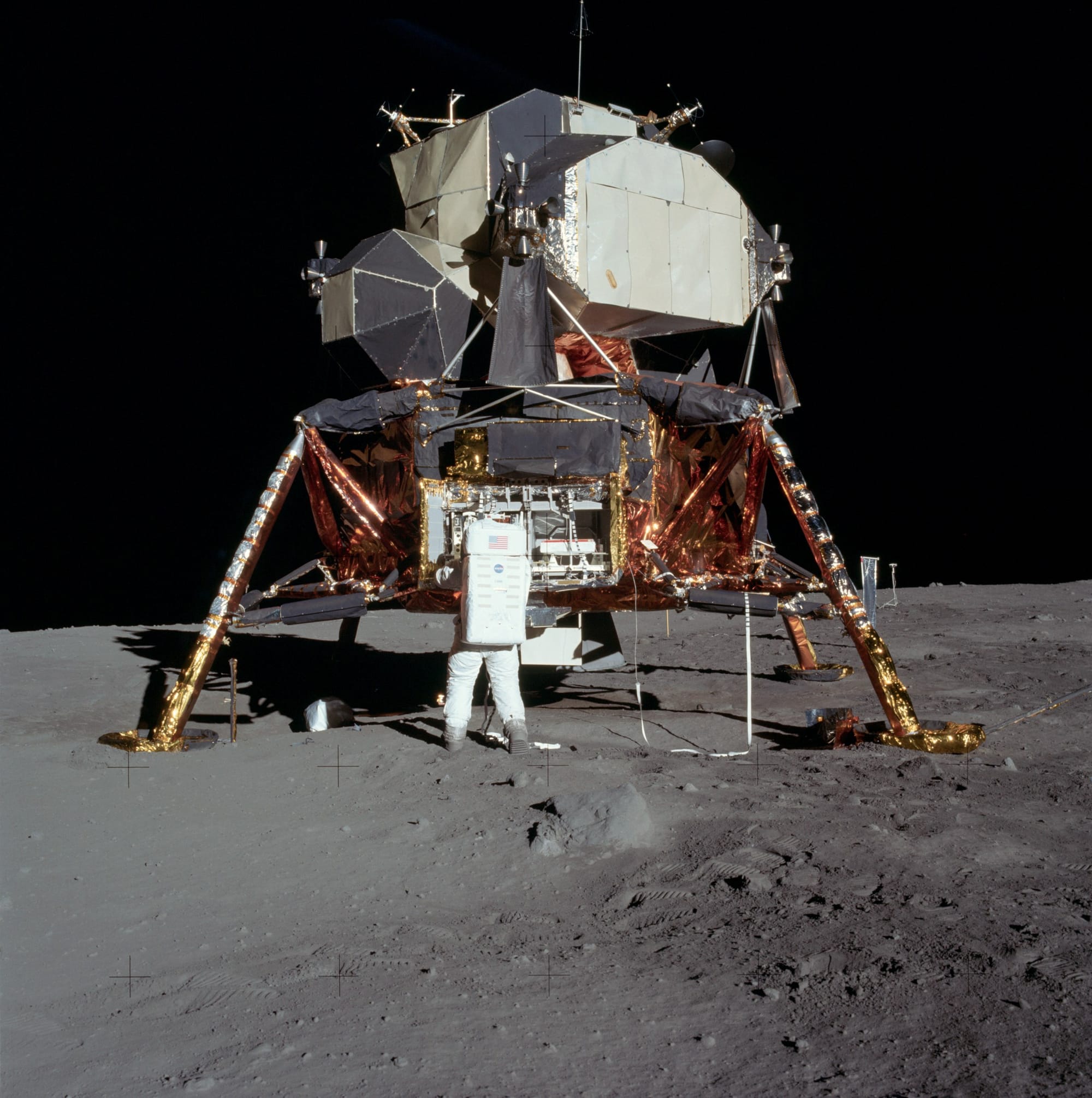
The alarms were not the only problem in those final minutes. As Eagle descended toward the planned landing zone, Armstrong looked out the window and saw terrain he did not want to land on. West Crater lay ahead, surrounded by a boulder field. The zone was unacceptable.
Armstrong entered P66, a mode that gave him command of horizontal translation and descent rate while the AGC continued to provide attitude stabilization and control assistance. The shorthand version — "Armstrong took over manually and flew it to safety" — is accurate in spirit. It is misleading in detail. The landing was not fully hand-flown; the computer remained in the loop throughout.
NASA's mission overview records that the powered descent ran approximately 40 seconds longer than nominal because of the translation manoeuvres used to clear the crater. That added time directly intensified the propellant situation. It also makes the causal story more complicated than it appears. Fuel was not consumed primarily because a pilot improvised, and not primarily because of the computer alarms. A landing site identified too late from the window, the designed descent profile, the geometry needed for a safe touchdown, and the crew's real-time decisions interacted in ways that no single element fully explains.
The famous calm in Armstrong's voice is sometimes read as evidence that the situation was under control. It is better read as evidence of disciplined task division. He was doing one job. Aldrin was monitoring instruments and reading data aloud. Houston was tracking telemetry and issuing fuel calls. None of them had the complete picture. Each was accountable for their piece of it.
What "60 seconds" meant
Shortly before touchdown, Mission Control called "60 seconds." Then "30 seconds." These calls are real, and they are part of the record for a reason: they mark a genuine constraint.
They were not, however, a precise countdown to engine cutoff.
Houston's calls were operational estimates based on the telemetry available in the moment, at a point when the low-level propellant warning had already sounded and the margin for a safe powered flight was shrinking rapidly. NASA's Lunar Surface Journal notes that both tank measurements and estimates derived from engine telemetry introduced an uncertainty of roughly 20 seconds in either direction. What the real-time team believed, based on what they could see, was that about 25 seconds remained before a no-touchdown abort would no longer be safely executable.
Post-flight reconstruction gave a different, somewhat less cinematic number. About 770 pounds of descent propellant remained at touchdown; roughly 100 pounds of that was unusable. NASA commentary calculates this as approximately 45 seconds of powered flight — of which about 20 seconds was the abort reserve. Not 30 seconds of fuel. Not fumes. But not comfortable either: a landing and a viable abort demand different fuel thresholds, and the instrumentation in 1969 could not produce a single exact number in real time.
NASA's own mission report, published in November 1969, uses the rounded phrase "30 seconds." That is where the popular number came from. It is not wrong exactly — it was the call Houston made — but it describes an estimate, not a measurement.
The most accurate way to put it is this: Houston had already called 60 seconds, then 30. The actual margin was uncertain. The real-time team believed a no-touchdown abort would soon become unsafe; post-flight analysis found roughly 45 seconds of usable powered time, with about 20 seconds of that reserved for abort. The situation was narrow. The exact number is not the point.
Why the memory is cleaner than the record
None of the information above was hidden. The alarms were on the air-to-ground audio, which was broadcast. The fuel calls were audible to anyone following the mission. NASA's mission report was published four months after splashdown. The post-flight press conference was recorded and transcribed.
What happened instead is something more ordinary, and more interesting, than a cover-up.
A listener hearing "1202" in 1969 had no basis to diagnose the condition. The word "alarm" was audible; the significance of executive overload versus navigation failure was not. A viewer hearing "60 seconds" could feel the urgency without knowing the abort threshold, the measurement uncertainty, or the distinction between a landing reserve and a hard engine cutoff. When Armstrong said "The Eagle has landed," those listeners had a sentence they could use. Everything before it — the code numbers, the fuel calls, the manual override, the one-word GO given four times over — collapsed into a before.
Over the following decades, anniversary narratives sharpened the story in a direction that felt coherent. Either the mission was executed to plan by a flawless organisation, or a lone pilot saved it at the last second. Both versions are cleaner than the actual record. Both drop the network of partial information, designed recovery, and accountable judgment that the record actually shows.
This is not a failure of journalism or of memory. It is how successful technical events tend to be remembered. The more completely something works, the less visible its working becomes. The alarm that the computer was trained to handle, the support engineer with the prepared code list, the guidance officer who accepted the assessment and said GO — these are not the stuff of a single sentence. But they are the mechanism.
What the 1202 is actually good for
The AGC did not silently stop working under load. It declared its overload, shed what could be shed, preserved what could not, and kept running. That behaviour was not incidental. It was designed. The engineers who wrote the restart architecture made a deliberate choice: a computer that fails noisily, in a recoverable way, is more useful than one that fails silently.
Garman's prepared code list made the alarm interpretable. Bales's flight authority meant the interpretation could become a decision. Duke's concise relay meant the decision reached the crew in time to matter. Armstrong and Aldrin, trained to keep flying unless they were told otherwise, kept flying.
Resilience, in this account, is not the absence of failure. It is the capacity to handle failures that were not specifically anticipated, by a system designed to declare what it knows and doesn't know, operated by people with enough preparation and authority to act on incomplete information before certainty arrives.
That is still a useful description. Automated systems that fail silently — that degrade without signaling, that continue without priority management, that give operators no basis for a GO decision — are a different class of problem. The 1202 alarm was, paradoxically, one of the better things to happen during the powered descent. It told the people who could act exactly what they needed to hear, at the moment when it still made a difference.
The famous sentence is still a good sentence. What the record adds, if you go looking, is the mechanism that made it possible — a mechanism designed to fail visibly, staffed by people prepared to act on what the failure revealed.
Sources
NASA primary material
- Apollo 11 Mission Report — comprehensive post-flight report (November 1969); primary source for propellant data and mission timeline
- Apollo 11 Mission Report, HTML edition — PAO version with accessible formatting
- Apollo 11 Mission Overview — NASA summary including powered descent timeline and the 40-second extended descent
- Apollo 11 Lunar Surface Journal: Program Alarms — annotated transcript of the 1202 alarm sequence with engineering commentary
- Apollo 11 Lunar Surface Journal: Landing commentary — real-time transcript of the powered descent and touchdown
- Apollo 11 Lunar Surface Journal: Mission Summary — mission overview with fuel consumption figures
- Apollo 11 Technical Air-to-Ground Voice Transcription — full verbatim transcription of all air-to-ground communications
- Apollo 11 Post-Flight Press Conference — Armstrong, Aldrin and Collins on the alarm and the landing
- Apollo era hero John "Jack" Garman dies — NASA obituary describing Garman's role in the 1202 GO decision
Archives
- Apollo 11 Flight Plan — US National Archives; the official flight plan showing the nominal descent timeline
Contextual
- Landing Apollo via Cambridge — MIT News interview with Don Eyles, author of Sunburst and Luminary, on the 1202 alarm as an unrehearsed continuation condition