From Tool to Co-Creator: AI Music's Identity Crisis
When machines compose, who gets the credit?
April 2026. A bedroom producer uploads a melancholic piano ballad to MiniMax Music 2.6's new AI Cover mode. Twenty seconds later, the same melody returns—transformed. The piano is now a pulsing synthesizer. The gentle vocals have become a gritty electronic growl. The tempo has doubled. But the melodic DNA—the note sequence, the emotional arc—remains intact.
This isn't pitch-shifting. It's not a remix. MiniMax's AI rebuilt the song from scratch, preserving only the melodic skeleton while reinventing everything around it: genre, instrumentation, vocal character, production aesthetic. The user gave direction. The AI composed.
Welcome to 2026, where AI has crossed from utility tool to creative partner—and the music industry is wrestling with a question it can't ignore: If the AI chooses the chords, shapes the arrangement, and generates the vocals, who is the songwriter?
The Spectrum: From Utility to Co-Creator
AI music tools exist on a spectrum of creative agency. At one end sit utility tools—stem separators, auto-mastering engines, sample browsers—that optimize technical tasks but make no creative decisions. At the other end, a theoretical autonomous composer that generates finished songs without human input (which doesn't yet exist at production quality).
In between lies the explosive growth zone: co-creative tools that generate complete compositional proposals while humans curate, refine, and iterate.
Suno v5 (2026) exemplifies this shift. Feed it a text prompt—"indie folk ballad about lost summers"—and it returns a four-minute song with coherent verse-chorus structure, emotionally resonant lyrics, and vocal performances with "opvallende helderheid" (striking clarity), according to comprehensive tool testing. This isn't suggestion; it's creation with human curation.
ProducerAI (Google Labs, powered by Lyria 3) goes further, understanding musicality—rhythm, harmony, arrangement logic. It functions as a co-producer with granular control over tempo, lyric timing, and structural elements. Not a tool that executes your vision, but a partner that proposes one.
Wondera scored #1 in three of Meta's four aesthetic metrics, outperforming open-source rivals—proof that AI-powered co-producers can make esthetic judgments competitive with human taste.
The numbers tell the story: 87% of creators now use AI somewhere in their workflow (2026 survey, 1,100+ producers). The AI music generation market exploded to $2.8 billion in 2026. This is no longer a fringe experiment. It's the new normal.
But normal doesn't mean resolved. If Suno generates the chord progression, melody, lyrics, instrumentation, arrangement, and mixing—what did the human create? The prompt? The idea? And does that make them a songwriter, or a curator?
Industry Pivot: From Panic to Partnership
Two years ago, the discourse was existential dread. AI music platforms trained on unlicensed data. Major labels sued. Musicians feared replacement. The narrative was defensive: "AI threatens our livelihoods."
2026 looks different.
In April, Udio closed a licensing deal with Kobalt Music Group, joining agreements already in place with Merlin Network (independent labels), Universal Music Group, and Warner Music Group. Notably absent: Sony Music, still litigating. But the direction is clear—opt-in models where artists choose participation and earn per-generation royalties when AI references their work.
ElevenLabs + Kobalt took it further: a 50/50 publishing/master royalty split. Traditionally, publishing royalties lagged behind master rights. AI platforms are establishing parity—unprecedented economic recognition for songwriters.
The discourse shifted from "AI destroys music" to "AI is a new production layer"—comparable to the synthesizer revolution. Not replacement. Augmentation.
But tensions remain. After Udio's settlement with Universal Music Group, the platform disabled all downloads—songs stay locked in the Udio app, creating platform lock-in. Sony's ongoing litigation signals that ownership remains contested terrain. The pivot is real, but fragile.
The Ownership Question: Three Models Coexist
If a producer types "jazz fusion instrumental, 120 BPM, melancholic" into Suno and receives a complete track, who owns it?
The producer's input: Conceptual direction, genre, emotional tone. Suno's output: Chord progression, melody, harmony, instrumentation, arrangement, mixing.
Is the producer a songwriter or a curator?
Three ownership models are emerging:
1. User-Led Ownership
The user owns the final track—the tool ownership model. Just as a photographer owns photos made with a camera, a producer owns music made with AI. The tool facilitated; the human directed.
2. Shared Attribution
Rights split between platform and user. The platform gets a royalty percentage because their AI generated the content. This mirrors stock music licensing—usage rights, not authorship claims.
3. Dataset-Driven Attribution
Platforms distribute royalties to rights-holders whose work influenced the AI model. ElevenLabs + Kobalt exemplify this: opt-in artists earn per-generation fees when their sonic signatures appear in outputs.
The legal consensus (still forming): Substantive human contribution = co-writer credit. Significant arrangement, lyric editing, structural reworking—that's authorship. Minimal prompting = curation credit. Discovery, not creation.
This parallels stock photography licensing. You use the work. You don't claim you made it.
The Producer as Conductor
The producer's role is evolving—from technical executor to creative director.
Was: Playing every instrument. Setting EQ curves manually. Tweaking compressor attack times by ear.
Now: High-level decisions (emotional direction, story arc), conducting AI systems that handle execution.
But what remains irreplaceably human?
Lived experience. AI can't replicate personal trauma, joy, cultural context. It can generate lyrics about heartbreak—it can't write from heartbreak.
Authentic storytelling. Fans follow artists, not algorithms. Concert experiences are irreplaceable human moments. Backstories create emotional investment. AI can replicate sound. It can't replicate story.
Fan connection. Successful artists build relationships and cultural impact—human identity + community. Those bonds can't be automated.
The workflow reflects this shift. A 2026 producer might:
1. Use Suno to generate an initial beat/melody from a text prompt 2. Export stems (vocals, drums, bass) to a DAW 3. Manually rearrange sections, add transitions, adjust dynamics 4. Use AI mixing assist (Neutron suggests EQ/compression settings) 5. Apply human mastering oversight—final judgment on tone, cohesion, emotional impact
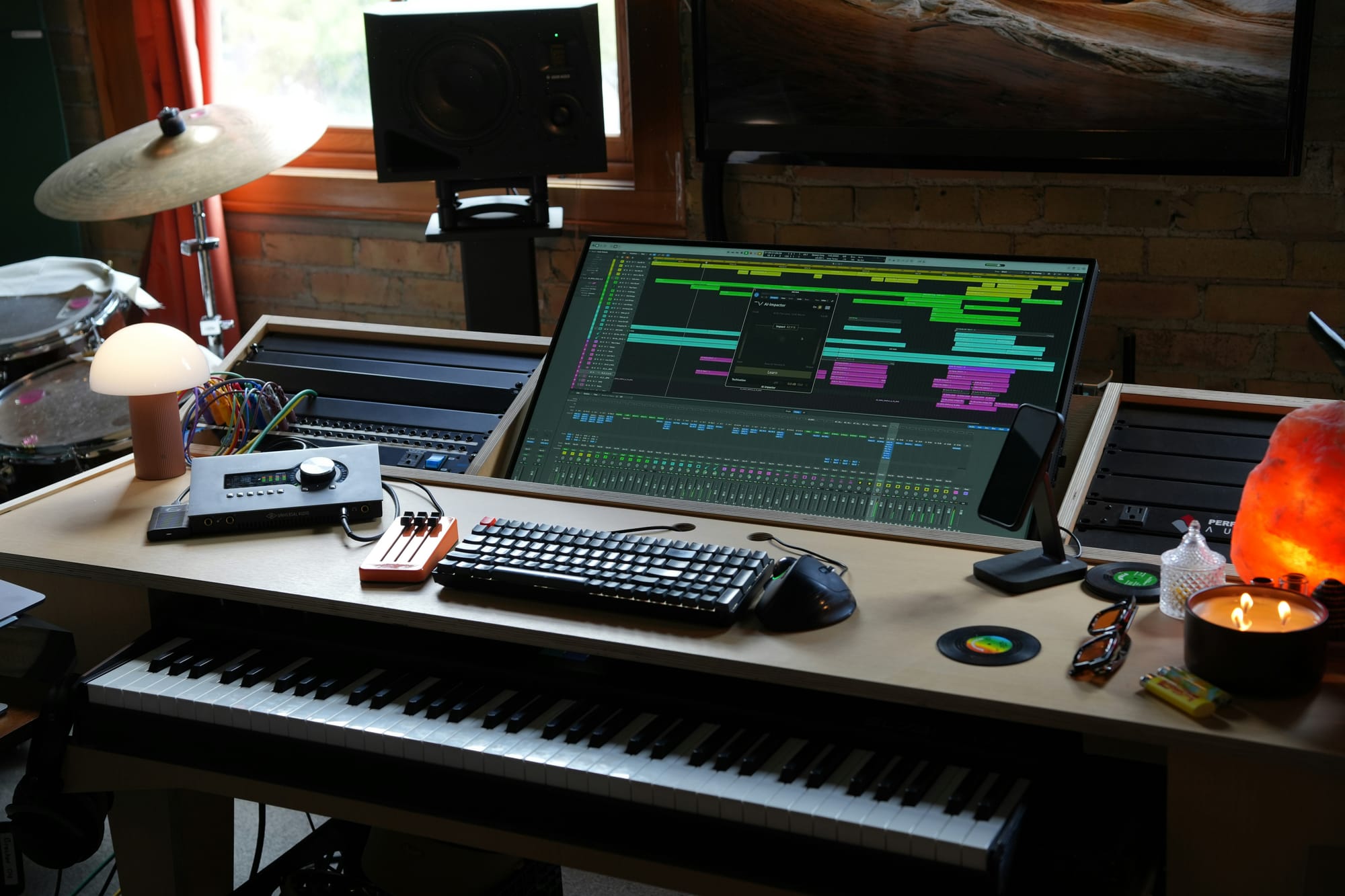
Smart gear—hardware with embedded AI—accelerated this in 2026. MIDI controllers suggest chord progressions. Synthesizers morph presets with AI-powered interpolation. Audio interfaces apply real-time vocal tuning. The studio is now a collaborative ecosystem where producers orchestrate AI systems alongside human musicians.
The Authenticity Paradox
Here's the uncomfortable question: If a song emotionally resonates, does authorship matter?
Three camps have emerged:
Purists: "Real music requires a human soul." AI-generated work is simulacrum, not art.
Pragmatists: "Good music is good music." Authorship is irrelevant. Emotional impact is the only metric.
Transparentists: "Label it clearly." Listeners deserve informed choice—the right to know what they're consuming.
Streaming platforms sided with the transparentists. By 2026, disclosure is mandatory—tracks must carry AI-generated or AI-assisted labels. Not to shame, but to inform.
This spawned a countermovement: human music certification. Verification systems emerged to prove genuine human-made compositions, using:
- DAW session files (timestamps, manual editing proof)
- Video documentation (recording sessions, live performance footage)
- Blockchain attestation (cryptographic proof of authorship)
Why the need? In an AI-saturated market, "100% human-made" becomes a quality signal—a way for musicians to differentiate their craft.
But the paradox persists. AI can replicate sound—timbre, genre conventions, production polish. It can't replicate story. Fans don't follow algorithms. They follow people. The artist's lived experience, their journey, their vulnerability—that's what creates connection.
A perfectly produced AI track might go viral. But will anyone show up to its "concert"? Will anyone buy its merch, tattoo its lyrics, form a parasocial bond with the algorithm?
Not yet. Maybe never.
Solo Creators: Democratization's Double Edge
AI promised democratization: one person can now achieve professional output across the entire production chain.
- Composition: Suno/Udio generate tracks
- Production: AI mixing/mastering tools
- Distribution: DistroKid, TuneCore (instant global reach)
- Marketing: AI-generated social content
No expensive studio required. Barrier to entry: obliterated.
But democratization has a shadow side.
Oversaturation. Platforms are flooded with AI-generated content. Spotify receives tens of thousands of new tracks daily. How do listeners find quality amid noise?
Discovery crisis. If everyone can make music, curation becomes the bottleneck. Algorithmic playlists favor engagement metrics over artistry. Human tastemakers (DJs, critics, curators) can't keep pace.
Economic pressure. Supply explodes. Demand doesn't. Royalties per stream were already microscopic—now they're shrinking further. More music competing for the same listener attention.
Devaluation. When creation is commodified, what happens to value? If AI generates a song in 20 seconds, why would anyone pay $0.99 for a download?
> "AI amplifies capability but dilutes scarcity. Value shifts from creation to curation, storytelling, and community."
The solo creator paradox: you can now make professional music alone. But you can't market, promote, and build a fanbase alone—not effectively. Creation was democratized. Attention wasn't.
The New Scarcity
MiniMax's style transfer, Suno's prompt-to-song, ProducerAI's musicality—these aren't incremental improvements. They're a phase change. AI crossed from assistant to co-creator. The music industry adapted faster than expected: licensing deals, opt-in models, consent frameworks, disclosure mandates.
But the fundamental tension remains unresolved.
2024's question: "Can I make this?" (Technical capability.) 2026's question: "Why would anyone listen?" (Human connection.)
AI didn't replace musicians. It commodified creation. In a world where a machine generates a polished track in 20 seconds, making music is no longer the bottleneck. Finding an audience that cares—that's the challenge.
What can't be commodified? Lived experience. Authentic storytelling. Fan relationships. Cultural impact. Concert moments where 10,000 people sing your lyrics back to you. Backstories that make listeners emotionally invested in your success.
AI can compose. It can't connect.
The producer of 2026 isn't a threatened species. They're a creative director conducting AI systems, weaving human experience into outputs, telling stories algorithms can't. Creation is abundant. Story is scarce.
The music industry survived synthesizers, drum machines, Auto-Tune, and now AI. Not by resisting technology, but by recognizing what technology can't replace: the messy, irrational, deeply human act of making art that means something to someone.
MiniMax can transform a ballad into a techno anthem in 20 seconds. Impressive. But it can't tell you why the ballad mattered in the first place. That's still your job.
Sources:
- MiniMax Music 2.6 Official — Style transfer capability announcement
- KAD8 MiniMax Breakthrough — Technical analysis
- Superprompt Best AI Music Generators — 2026 tool comparison
- Soundverse Suno Comparison — Suno vs competitors
- Google Labs ProducerAI — Lyria 3 musicality features
- Wondera AI Co-Producer — Meta aesthetic metrics
- Music Business Worldwide Udio Kobalt — Licensing agreements
- Digital Music News Udio Kobalt — Opt-in model details
- Music Business Worldwide Kobalt ElevenLabs — 50/50 royalty split
- Soundverse AI Music Ownership — Three ownership models
- Sonarworks Producer Survey 2026 — 87% adoption rate
- Soundverse AI Music Authenticity — Consent frameworks
- Soundverse Human Certification — Verification methods
- Playlist Push AI vs Human Artists — Fan connection analysis
- DLK Music Pro Smart Gear — Hardware-AI hybridization
- Soundverse Solo Creators — Democratization analysis
- Soundverse Streaming Platforms — Disclosure requirements
- Soundverse AI Music Revenue — Economic models
- Soundverse AI Workflow Integration — Multi-tool orchestration