
Jeff Bezos Is Betting on AI With Hands, Not Just a Brain
Prometheus is not promising another chatbot. It is promising something stranger, and potentially more consequential: a machine that compresses the time it takes to invent physical things.
Jeff Bezos's Prometheus has just announced a $12 billion round at roughly a $41 billion valuation for a startup with roughly 150 employees, no public demo, no public customers and no product you can try. In most corners of tech, that would read as a punchline before it read as a strategy.
But Prometheus is not pitching itself as another entrant in the now-familiar contest over who can build the smartest model. Bezos and co-CEO Vik Bajaj are aiming at a different target: what they call an Artificial General Engineer, or AGE. The phrase sounds engineered to echo Artificial General Intelligence, and that is exactly the point. While OpenAI, Google and Anthropic are trying to build systems that reason over language and knowledge, Prometheus is betting on AI that helps humans design and manufacture things in the physical world.
That distinction is what makes the company interesting. It is also what makes the current hype hard to settle. The industrial pain Prometheus wants to attack is real. Engineering cycles for chips, aircraft components, materials and drugs are still painfully slow, expensive and failure-prone. But the proof that Prometheus can do anything meaningfully beyond existing engineering AI remains absent. Right now, the company sits in a peculiar position: too substantial to dismiss as vapor, too unproven to accept on rhetoric alone.
A different kind of AI ambition
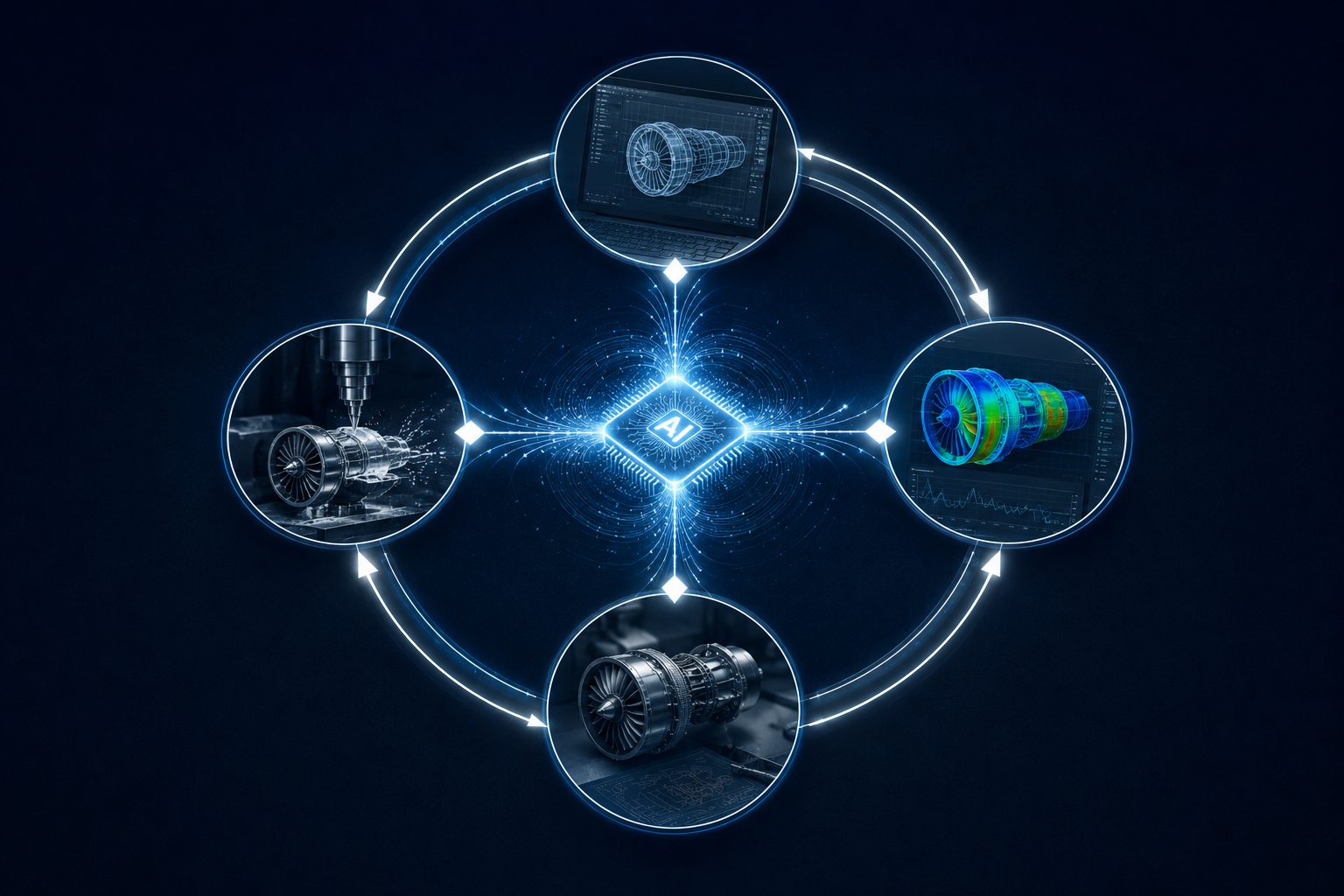
The easiest way to misunderstand Prometheus is to hear "general" and assume it belongs in the AGI conversation. It does not, or at least not in the usual sense. Prometheus is not mainly interested in an AI that can answer questions, write prose or argue its way through a benchmark. It is pursuing a system that can move through the engineering loop itself: propose a design, simulate its behavior against physical constraints, revise it, compare alternatives and keep iterating toward something manufacturable.
Bezos described the ambition in practical rather than philosophical terms. If a project that currently needs 100 engineers for 10 years could be reduced to 10 engineers for one year, he argued, the result would simply be that more things get built. That is the cleanest version of the thesis. Prometheus is not being sold as a synthetic Edison. It is being sold as a force multiplier for real engineering teams.
There is a useful historical rhythm here. Software has spent decades making information easier to move, copy, search and recombine. The physical world has remained slower, not because engineers are unimaginative, but because atoms are less forgiving than text. A language model can hallucinate and embarrass you. An engineering model that gets an aircraft part, a chip layout or a molecular interaction wrong can waste months, burn capital or, in the worst cases, hurt people. That makes the entire problem harder. It also makes success more valuable.
This is why the AGE framing matters. Bezos is effectively arguing that AI's next important frontier may not be the mind at all. It may be the hand.
From CAD tool to design loop
To see what Prometheus is claiming, it helps to look at the engineering process it wants to compress. In most advanced industries, the loop is still recognizably human-led. Engineers define a concept in CAD software, send it through simulation tools, inspect the results, adjust the design, build a prototype, test again and then prepare it for manufacturing. For a consumer gadget, that cycle can be long. For a chip, aircraft system or drug candidate, it can stretch into years.
Existing software already does part of this work well. Autodesk's generative design tools can optimize geometry inside human-defined constraints. Siemens NX and related systems use AI to streamline workflows. NVIDIA and Ansys accelerate simulation. In semiconductors, Google's AlphaChip showed that machine learning can materially compress a specific subtask, namely chip floorplanning. None of this is trivial, and none of it justifies pretending the space is empty.
Prometheus is claiming something broader. The company says it is training models on physical laws and real manufacturing data, then using them to run iterative design cycles with less dependence on the traditional stop-start rhythm between designer, simulation environment and manufacturing team. In Bezos' own framing, it is a modern version of CAD only in the sense that CAD once redefined the design desk. Prometheus wants to redefine the entire path from concept to pre-production.
That is a bolder claim than "our software makes engineers faster." It implies a system that reasons over consequences rather than merely drawing shapes or speeding up existing solvers. The attraction is obvious. In industries where every extra simulation cycle costs weeks, every wrong turn is expensive, and every prototype is a small gamble, the ability to test and revise far more aggressively could create real economic leverage.
The problem is that the technical distinction is still easier to describe than to verify.
The case for belief, and the case for restraint
There are good reasons not to laugh Prometheus out of the room. The first is that the need is genuine. Semiconductor design is brutally expensive. Drug discovery still runs on timelines that make venture investors old. Aerospace and advanced manufacturing remain hostage to slow iteration loops. Even partial compression of those timelines would be valuable.
The second reason is that relevant precedent exists. AlphaChip proved that AI can dramatically accelerate a narrow but important piece of chip design. AlphaFold showed that a system trained on the right structure can crack a problem in the life sciences that once looked intractable. Isomorphic Labs is now trying to convert that kind of scientific intelligence into actual drug design programs with partners such as Eli Lilly and Novartis. PhysicsX has already built a business around compressing engineering simulation for sectors like aerospace, automotive and semiconductors.
Those examples matter because they show that "AI for the physical world" is not fantasy. They also show why Prometheus has a burden of proof. Each of those companies has either a benchmark, customers, measurable outputs or all three. Prometheus, by contrast, has scale without the public evidence normally used to defend it. No public product. No public benchmark. No public case study demonstrating that its system can outperform conventional engineering workflows on a concrete task.
That gap does not mean the company is fraudulent. It does mean that the current case for Prometheus is built less on demonstrated differentiation than on the credibility of the people around it, the size of the opportunity and the belief that compute-heavy, physics-grounded models will eventually form a new industrial platform.
This is why the AlphaFold comparison is both flattering and unforgiving. AlphaFold worked because it attacked a specific problem with a clear public benchmark. Prometheus is aiming at something much wider: a horizontal engineering intelligence for multiple industries at once. The upside of that ambition is enormous. So is the risk. Broad systems often sound profound long before they become useful.

Why Bezos is the person making this bet
Prometheus also makes sense as a Bezos project in a way it would not for many other tech founders. Since leaving the CEO role at Amazon in 2021, he has not lacked options. But this is his first serious return to an operational CEO position, and the domain he has chosen is revealing.
Amazon taught Bezos that software becomes powerful when it collides with logistics, warehouses and the stubbornness of physical execution. Blue Origin has spent a quarter century teaching the same lesson at far higher stakes. Rockets are not a domain in which eloquent software demos count for much. Either the thing works in the physical world or it does not.
That perspective makes Prometheus feel less like a random moonshot and more like a continuation of a worldview: intelligence is valuable, but bottlenecks matter more. If the real constraint on progress is not ideas but the speed at which ideas can be turned into reliable artifacts, then the best AI business may not be the one that writes the cleanest paragraph. It may be the one that helps a small engineering team move through years of trial and error in a fraction of the time.
Blue Origin sharpens that logic as a strategic fit, even without any reported customer relationship. Bezos has already said tools like Prometheus could help companies like Blue immensely. In other words, he is not merely funding a category from a distance. He is building around exactly the kind of high-cost, high-complexity engineering environment Prometheus is supposed to improve.
The co-CEO pairing with Vik Bajaj supports the same story. Bajaj is not a celebrity AI founder drafted in to keep investors calm. He comes from science and life sciences, which helps explain why Prometheus talks less like a consumer AI company and more like a lab trying to industrialize design.
Frontier company or beautifully financed question mark?
The most sober reading of Prometheus is that it is neither an obvious bubble nor an earned triumph. It is an unusually expensive question.
The funding alone distorts the frame. A newly announced $12 billion round at a roughly $41 billion valuation for a company this young, at this size and this level of public proof, is extreme even by recent AI standards. It invites the obvious criticism that the company's current moat may be its balance sheet more than its technical uniqueness. Built In's skeptical framing points in the same direction: so far, the clearest visible advantage is the sheer scale of Prometheus's financing, not a publicly demonstrated technical lead over adjacent competitors.
That critique lands because there are already serious players in neighboring lanes. PhysicsX has customers. Isomorphic has programs with major pharmaceutical companies. Google demonstrated AlphaChip publicly. Prometheus has a grander thesis, but a grander thesis is not the same thing as a stronger product.
Still, dismissing the company as pure bubble would also be lazy. The investors are not betting on an obviously fake problem. They are betting that AI's next durable moat may emerge where data is expensive, expertise is scarce, validation is hard and the physical consequences of better design are large. That is a coherent thesis. The existence of coherent competition does not weaken it; if anything, it shows the category is real.
The real question is timing. Prometheus can plausibly argue that no one should expect a public demo after only a few months if the ambition truly is to build engineering systems across chips, aerospace and drug discovery. But that excuse has a short shelf life. Over the next 18 to 24 months, the company will need to show at least one unmistakable proof point: a customer deployment, a benchmark, a design outcome, something concrete enough that outsiders can compare it with the existing state of the art.
That is what an AGE moment would look like. Not a manifesto. Not another financing round. A physical object, component or molecular result that is meaningfully better, faster or cheaper because Prometheus designed part of it.
The real promise
The most persuasive version of the Prometheus story is not that AI will replace inventors. It is that invention itself may be bottlenecked by tools that no longer match the complexity of the systems humans are trying to build. In that reading, the company is not trying to automate genius. It is trying to upgrade the workshop.
That is an attractive idea, and it is one reason this company is worth watching more carefully than the usual stealth-startup spectacle. If Prometheus works, it could matter well beyond Silicon Valley's status games. Better tools for the design of chips, aircraft systems, drugs and industrial infrastructure would reshape real sectors, not just software workflows.
But awe is premature. Right now, Prometheus is compelling not because it has proven the future, but because it has named a plausible future before it has earned belief in it. Bezos is betting that the next great AI company will not just think faster. It will help the rest of us build faster.
That is a serious thesis. It is not yet a demonstrated one.
Sources
Announcement & funding
- TechCrunch: Jeff Bezos's Prometheus raises $12B to build an artificial general engineer for the physical world — funding details, positioning, and investor framing for the $12B round
- Semafor: Jeff Bezos raises $12B for AI that builds things — Bezos quotes and the AGE framing in his own words
Market context & competition
- Design Engineering: The new $8 billion bet on AI for MCAD — technical skepticism and the landscape of incumbent CAD and AI tools
- Built In: What is Project Prometheus? — competitive framing and skeptical analysis of Prometheus's positioning
- TechFundingNews: PhysicsX raises Series B — evidence of engineering simulation compression delivering results in practice
Physical-world AI precedents
- Isomorphic Labs: The Drug Design Engine — benchmark for domain-specific physical AI in pharma, with real drug-design programs
- Fierce Biotech: Isomorphic Labs bags $2.1B Series B — funding context and pharma partnerships with Eli Lilly and Novartis
Company background
- Wikipedia: Project Prometheus (company)?ref=schrijfhuis.jongbloed.net) — company formation, offices and personnel summary