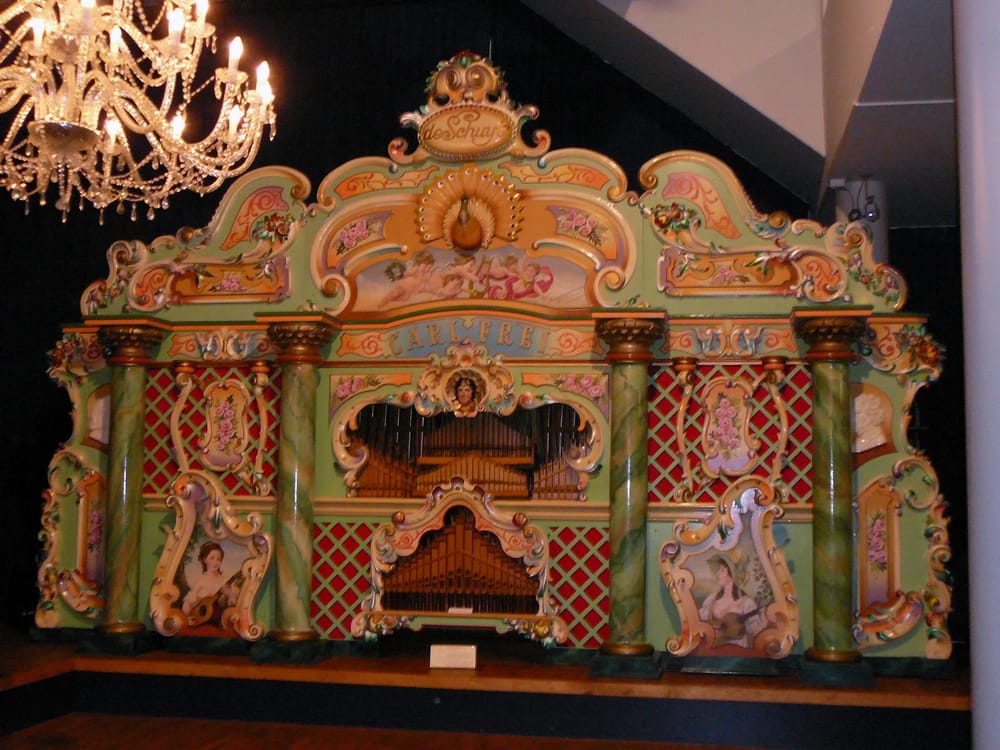
The Mechanical Muse: How Organ Automation Invented Computing
Spoiler: it didn't. But the real story is better.
Listen. Somewhere in a Viennese parlour, a small cabinet begins to turn. Pins on a bronze cylinder catch and release, one after another, and a set of organ pipes speaks. The music is flawless — the same four bars, repeated, exact. Nobody is sitting at the keyboard. Nobody needs to. The instructions are already there, pinned into the metal, waiting only for the cylinder to rotate.
That cabinet is one of three Mozart wrote for. The pieces survive. The technology behind them — the barrel organ, the musical clock, the orchestrion — went on to become a fixture of European bourgeois life. And then it is supposed to have done something more: to have given us computing.
The title of this piece makes that claim. It is a tease. Barrel organs did not invent computing. But they belong to a family of technologies that kept asking the same question, in increasingly general terms: how do you separate the instructions from the machine that executes them? When that question finally received a general answer, the answer became a computer. The path from pinned barrel to Analytical Engine to laptop is not a straight line, and pretending it is would obscure what actually happened, which is stranger and more interesting.
A score made solid
To understand what a barrel organ does, you have to feel how strange it is. A conventional musical score is marks on paper. It does nothing. A performer reads it, interprets it, and produces sound — a translation across two minds, two sets of trained hands. The barrel organ cuts out one of those steps. The score is no longer a request; it is a mechanism. Each pin is a note at a specific moment. The cylinder's rotation is the beat. The instrument is already playing before anyone has decided to play it.
This matters because it makes the music object-like in a new sense. You can copy the barrel and send the copy to another city. You can lock up the instrument and let it play for a century with no musicians in the room. The player piano extended this same logic by replacing the engraved cylinder with a paper roll — cheaper to produce, easier to distribute, capable of representing denser and faster passages than any hand could engrave or any finger could play.
And yet: for all its mechanical elegance, the barrel is not computation. It does not calculate. It does not branch — choosing between possibilities based on current conditions. It cannot play a different piece unless someone physically replaces it. The instruction sequence is fixed, literally, in metal. The barrel can execute its score with perfect fidelity; it cannot decide anything.
That distinction matters because it is exactly what would have to change.
Jacquard's portable instructions
In the first years of the nineteenth century, Joseph Marie Jacquard improved a loom in a way that most people today would not immediately call revolutionary. He introduced a chain of punched cards that passed over a reading head. Depending on which holes were present, which warp threads were selected, and in which sequence — the loom could produce intricate, arbitrary textile patterns.
The crucial word is arbitrary. Earlier looms also produced patterns. What Jacquard's improvement made possible was that the same loom could produce an entirely different pattern simply by receiving a different card sequence. The mechanism was no longer committed to one encoded output. Instructions had become detachable, swappable, chainable. To change what the machine would do, you did not rebuild the machine. You changed the cards.
This is a deeper advance than it sounds, and it is not about music. The barrel organ already separated the score from the performer. Jacquard's loom separated the instruction from the mechanism that followed it. Those sound similar; they are not. A barrel still is its encoded performance — you cannot give it different instructions without making a different barrel. A Jacquard card sequence is a recipe, and the loom is a general-purpose reader of recipes for textiles.
The connection runs deeper than coincidence — though its arrow points the opposite way from the one we might expect. Basile Bouchon, who introduced perforated-paper control to Lyon's silk looms in 1725, was the son of an organ maker. Whether he carried the mental model of the pinned cylinder into his workshop, or simply recognised a structural kinship, historians note the resemblance without establishing a precise documentary chain. His colleague Jean-Baptiste Falcon replaced the paper strip with linked rectangular cards in 1728 — the modular form that Jacquard would later make commercially formidable.
Music returned the favour, but a century later. Claude-Félix Seytre patented pierced-cardboard control for organs and pianos in 1842, and Anselmo Gavioli's 1892 concertina-folded organ book finally gave fair organs what the loom had possessed for decades: a repertoire that could be swapped, copied and extended without rebuilding the instrument. Where a barrel still was its encoded performance, the organ book was a recipe — playable on any compatible organ, interchangeable, effectively open. The exchangeable programme had come full circle: from mechanical music to silk, and back to music again.
By the early nineteenth century, that design principle — store instructions separately, feed them to a general mechanism — had become available in at least two industrial domains.
One of them was about to become the conceptual foundation of something much larger.
“Weave algebraical patterns”
In 1843, Ada Lovelace published a set of Notes appended to an Italian engineer's description of Charles Babbage's proposed Analytical Engine. The Notes are long and technical; they include what is generally recognised as the first published algorithm intended for a computing machine. But they also contain something else: a precise articulation of where the Analytical Engine's power came from.
Lovelace was not writing for posterity. She was writing for readers who knew what a Jacquard loom was, which in 1843 most educated Europeans did. She identified the Engine's distinctive principle as exactly Jacquard's: the use of punched cards to regulate elaborate sequences of operations. And then she named the consequence:
> “We may say most aptly, that the Analytical Engine weaves algebraical patterns just as the Jacquard-loom weaves flowers and leaves.”
This is not a modern journalist reaching for a clever metaphor. It is the contemporary conceptual language of the project. Lovelace saw the Jacquard card as the hinge that made general-purpose computation imaginable: if instructions could be separated from a loom, they could be separated from any calculating mechanism. And if the symbols being manipulated need not stand only for threads, they could stand for numbers, or for anything else that could be formally represented.
Lovelace was careful about what followed from this. Her Notes insist that the Engine could not originate ideas of its own — that it could only do what we knew how to order it to perform. But within those bounds, the space she was pointing at was enormous. A machine that could manipulate symbols in formally specified ways could, in principle, operate on music, graphics, or any domain that could be expressed as a formal relation. The Engine was never built in its full design. The program she described for Bernoulli numbers was never executed. But the insight — separate instruction from mechanism, generalise the mechanism — was planted, published, and eventually germinated.
Composing into the machine
A century later, a composer named Conlon Nancarrow was living in Mexico City, trying to write music that no human ensemble could perform. His rhythmic ideas required multiple independent tempo streams, simultaneous layers at ratios like three against four against five against seven, at speeds that would leave any pianist far behind. He did not abandon the ideas. He bought a roll-punching machine.
Working through the 1950s and beyond, Nancarrow composed directly into the player piano roll — not transcribing from a conventional score, but writing into the executable medium itself. The notation was not a request to a musician who would interpret it; the perforated roll was the object that caused the sound. His Studies for Player Piano can be heard today: dense, inhuman, meticulous, often beautiful in ways that feel engineered rather than performed, which is precisely what they are.
Calling this “the first programmable musical computer” is evocative but loose. Nancarrow's roll is still an explicit instruction stream; the piano is still a dedicated interpreter with no capacity for calculation or branching. There is no general-purpose machine here. But something else is true: Nancarrow discovered that the constraint of the medium was also a compositional freedom. He could specify temporal relationships that no body could reproduce. The machine did not replace his imagination; it became the surface on which imagination could specify what ordinary notation and ordinary hands could not.
Anyone who has used a digital audio workstation and scrolled through its piano-roll editor — selecting, nudging, quantising events on a horizontal grid — is looking at a direct descendant of that logic. The visual lineage is not metaphor. It is workflow.
A standard for events
Between Nancarrow's rolls and the present, not every development moved in the same direction. Léon Theremin's 1920 electronic instrument — controlled by a player's hands passing through electromagnetic fields — was almost the inverse of the barrel organ: continuous, expressive in real time, and impossible to preset. No instruction was stored; the performer shaped the sound moment to moment. That branch is worth noting because the history of music technology is not a single march toward greater automation.
Robert Moog's voltage-controlled modular synthesizer, introduced in 1964, made timbre configurable by routing. Modules for oscillators, filters, envelopes and amplifiers could be connected in different configurations by patch cords, producing different tonal qualities from the same raw signal. You were not changing the notes; you were changing what kind of sound would produce them. The signal path itself became something you could arrange.
Then, in 1983, the Musical Instrument Digital Interface — MIDI — made something different possible again. MIDI separated musical events from any particular sound generator. A MIDI message says: note-on, this pitch, at this velocity, now. The receiving device decides what sound to produce. A MIDI file is not a recording; it is closer to a piano roll than to audio. But unlike a roll, it travels over a standardised protocol, and the same sequence of events can be sent to an electronic piano, a software synthesizer, a drum machine, or a stage lighting rig.
MIDI is not intelligence. It is a vocabulary for events. It extends the barrel organ's basic logic — discrete timed instructions — into a networked, interoperable protocol. The event description and the sound it produces have been fully separated.
Where the sequence comes from
Modern AI music systems do something that none of their predecessors did.
Systems such as AudioLM and MusicLM convert audio into learned, compressed representations — discrete tokens derived from training on large amounts of music — and generate new sequences by sampling from statistical patterns in those representations. MusicLM adds textual conditioning: you describe music in words, and the model generates audio that matches the description. The output is not a retrieved recording. It is not a pre-authored sequence being replayed. It is a new event stream, assembled at the moment of inference from the model's learned parameters, conditioned on the prompt, shaped by the random sampling.
The family resemblance to the barrel organ is real but narrow. Both involve encoding and timed output. In both cases, something is represented, and then reproduced as sound. That is where the resemblance ends. A barrel carries an explicit, human-authored event list: every pin represents a decision made by the composer or the barrel-maker. A generative model contains learned statistical relationships. At inference, it samples a trajectory through the learned space. No single person authored the sequence it produces. The prompt, the weights, the random seed and the decoder all contribute; none of them is a readable score.
This is the sharpest discontinuity in the whole story. Every medium before this one — barrel, roll, card, MIDI file — was legible. You could, in principle, read the instructions back. You could look at a Nancarrow roll and trace which perforation caused which note. You could play a MIDI file back through a score editor and read it as notation. The parameters of a large neural model are not legible in this sense. The relationship between training data and generated output passes through billions of learned weights. What the model “knows” about music is distributed across that parameter space in a form that does not resolve into a human-readable instruction.
Lovelace's caveat — written in 1843, before any of this existed — turns out to apply with unexpected precision. She said the Engine could only do what we knew how to order it to perform. A generative model does something Lovelace could not have foreseen: it learns a procedural knowledge of how music goes from data, rather than receiving explicit orders about what to play. Whether this constitutes the model “composing” depends on what you mean by composing. It does not mean originating musical ideas in the way a human does. It means sampling from a very large, very compressed model of what music has been.
The question that kept recurring
Music is not the cause of computing. Barrel organs did not produce punched cards, at least not in any documented straight line. The title of this piece is wrong in exactly the way it promised to be wrong.
But music kept asking a question that turned out to be foundational: what is the relationship between a score, a machine that executes it, and the sound that results? Every era in this story found a different answer. The barrel made the score physical and the performer optional. Jacquard made the instructions detachable. Lovelace made the mechanism general. Nancarrow made the roll a compositional medium. MIDI made the events abstract and portable. Generative AI dissolved the score into a probability distribution and made the output a sample from it rather than a readout of it.
These are not the same answer. The through-line is not technological progress in a single direction but the same question, recurring, posed to each generation's best understanding of what mechanism can do. A barrel is an answer. A generative model is also an answer. They are not the same answer.
In the Viennese parlour, the cylinder is still turning. The pins still catch, note after note, exactly as they were made to. The music has not changed in two hundred years. Somewhere else, a language model is generating something that resembles music from a text prompt, note by probabilistic note, and no one entirely understands why it sounds the way it does.
Both of these things are happening, and they are not the same thing.