The guardrail and the abyss
Why learning to love mountains required more than changing your mind
Every year, millions of people pay for the privilege of feeling small. A gondola carries them above the treeline; a viewing platform cantilevered over a cliff organises the encounter; a railing separates them from the drop. They stand at the edge and feel something like vertigo mixed with pleasure. Then they take a photograph and descend.
This is managed wildness, engineered to the point where the sensation of danger is available without its substance. What is less obvious is that this arrangement is not a dilution of an older, purer relationship with mountains. It is the relationship, or very close to its historical origin. The feeling of awe that tourists seek is a product of a specific philosophical tradition, a handful of literary texts, and a civil engineering programme — all assembled in Europe across roughly the period 1730 to 1830.
The question of how this happened is often framed as a reversal: once, Europeans feared mountains; then, they admired them. The real story is less symmetrical and more interesting.
What Marjorie Hope Nicolson got right, and what she simplified
The before-and-after narrative originates largely with a single book. Marjorie Hope Nicolson's Mountain Gloom and Mountain Glory (1959) traced a transformation in European literary culture: mountains shifted, in her account, from deformities in a divinely ordered world to grand evidence of nature's scale and power. The book is indispensable — her command of seventeenth- and eighteenth-century texts is extraordinary, and her binary of gloom and glory is a memorable map of what changed.
Later historians have introduced a needed brake. Nicolson was charting a transformation in a selective body of chiefly British and Northern European literary sources. Earlier texts do not show simple disgust; Renaissance travel poetry can describe a pass as ordeal and a peak as remarkable sight in the same breath. A traverse could be terrible and spectacular at once. What changed was not that Europeans suddenly saw what had always been there but that an influential public language of admiration spread through European print culture. The distinction matters. It moves the question from individual perception — did they think mountains were ugly? — to cultural repertoire: what vocabulary was available for making sense of what you saw? The more defensible and still surprising claim is that, by the mid-eighteenth century, that vocabulary was newly prestigious, widely translated, and socially aspirational.
Burke: the pleasure in managed terror
The conceptual hinge is Edmund Burke's Philosophical Enquiry into the Origin of Our Ideas of the Sublime and Beautiful (1757). Burke distinguishes the beautiful from the sublime with unusual sharpness. The beautiful is associated with delicacy, smoothness and gentle proportion — qualities apt to inspire affection. The sublime is tied to vastness, obscurity, power, darkness and the infinite. And to terror.
Burke does not, however, praise actual catastrophe. His key psychological mechanism is what he calls "delight": a pleasure-like response to pain or danger when those things are contemplated at sufficient remove. He is explicit about the required distance. The sight of a great precipice is not pleasurable because the precipice has become less frightening. It is pleasurable because the observer occupies a position from which fear can be felt without being overwhelmed by it.
This is a more precise formulation than the common summary allows. The shift was not from ugly to beautiful — a jagged peak in a storm can be the opposite of conventionally pretty and yet be aesthetically compelling, perhaps more so. Burke's contribution is a vocabulary for turning the discomfort into the point. The Alps become interesting not when they cease to be forbidding, but when forbiddingness can be experienced as an emotion worth seeking. The guardrail, in this framework, is not a concession that ruins the experience. It is the condition that makes the experience possible.
Kant: the mountain doesn't become sublime; you do
Immanuel Kant's Critique of the Power of Judgment (1790) develops this idea further and, for understanding how taste is made, more radically.
Kant divides the sublime into two forms. The mathematical sublime arises when we face a magnitude too large to grasp as a whole — a mountain range that exceeds imagination's capacity to take it in as a unified percept. At this point, reason steps in: it can think totality or infinity that imagination cannot sensibly present. The initial failure of comprehension becomes a form of elevation.
The dynamical sublime concerns natural force: volcanic eruption, violent weather, breaking waves, the sheer scale of a cliff. These make our physical vulnerability palpable. Kant requires the spectator's actual safety — not theatrical safety, but the genuine absence of immediate danger. The viewer may feel small as a natural creature but can recognise in themselves a rational and moral independence from nature's brute power. The mountain's force occasions the experience. It is not the experience.
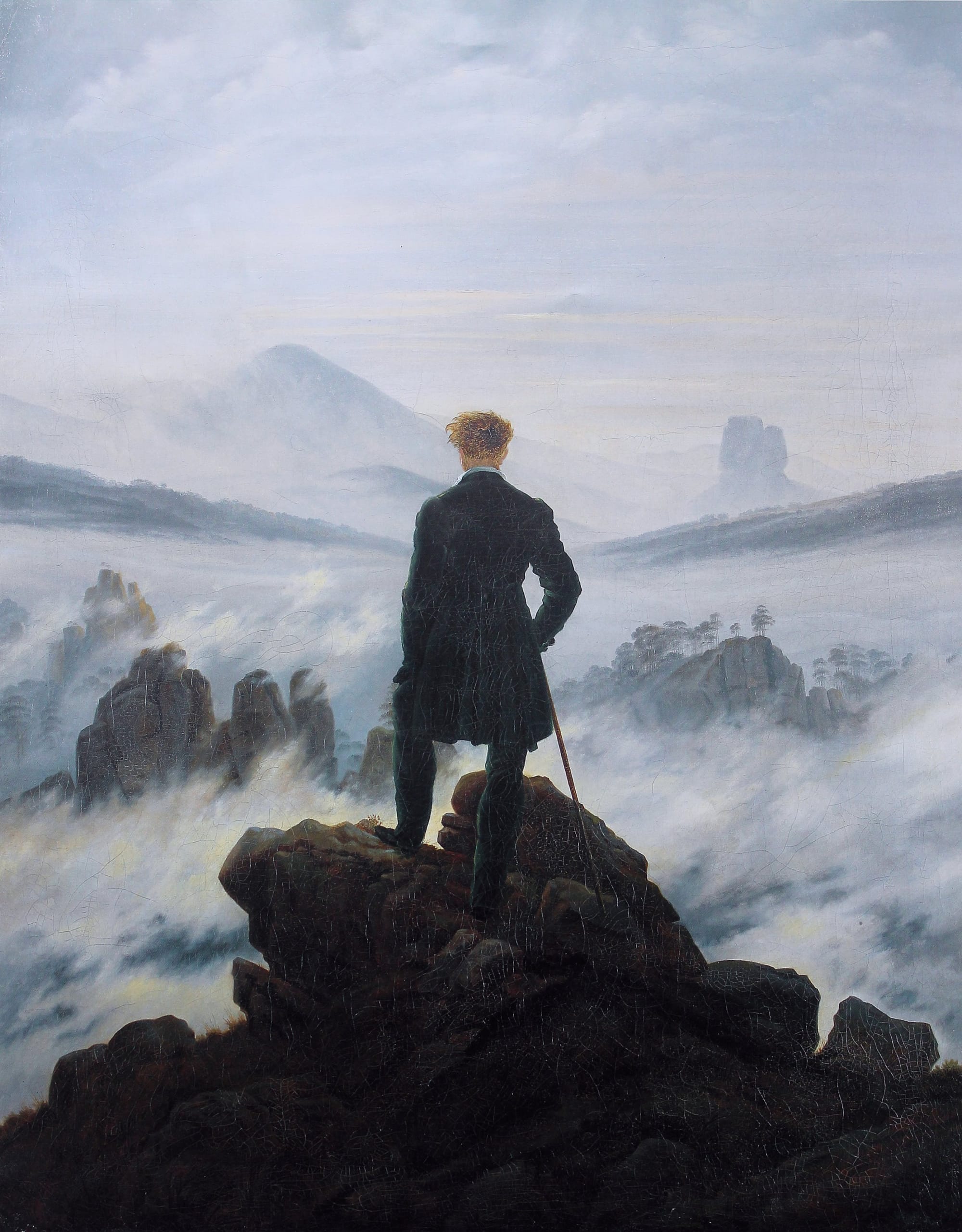
This is not a philosophy sidebar. It is where the cultural construction becomes visible. A tourist on a secure viewing platform, a traveller in a coach, and a person caught in an avalanche do not have interchangeable aesthetic relations to the same landscape. The sublime depends on distance, on security, and on a learned capacity for reflection. A person too frightened to think is not having a Kantian sublime experience — they are simply frightened. What aesthetic discourse teaches is how to hold that fright in a frame where it becomes meaningful rather than merely overwhelming.
Literature made the Alps desirable before infrastructure made them easy
Two writers crystallise the cultural mechanism. Albrecht von Haller published Die Alpen in 1732, a poem that extended pastoral and Golden Age conventions into high Alpine terrain. Haller's mountains are not merely scenery; they host a morally uncorrupted population, set against the vanity and artifice of urban life. This was not a neutral description of what was there. It was a claim about what mountains meant. The poem was translated into French, English, Italian and Latin. For readers who had never set foot on a glacier, the Alps became an available imaginary — a place where virtue, simplicity and something resembling authenticity might be encountered.
Rousseau's Julie, ou la Nouvelle Héloïse (1761) extended this further. Its Alpine and Lake Geneva settings are not landscape paintings. They are emotional architectures: terrain joined to feeling, virtue, health and inner life, positioned against a critique of civilised corruption. The novel did not document a pre-existing tourist gaze. It helped produce one. Readers who encountered those Alpine passages came to want the landscape they had read about — to feel, in the presence of the actual terrain, something like what Julie and Saint-Preux had felt in the novel.
This is the most important anti-determinist point in the story. The Alps became a desired destination in print before they became a comfortable destination in practice. A place is never only a physical location. It is also a set of stories that tell potential visitors why the expense, exertion and risk are worth something.
Roads, texts, and the feedback loop
The safety hypothesis — that Alpine enthusiasm rose as Alpine travel became less dangerous — is substantially right. Research on Grand Tour itineraries shows a shift, broadly between the 1750s and 1830s, away from routes that merely passed through mountain terrain toward travel where the terrain itself was the destination. Improved roads, more reliable inns, professional guides and a developing commercial infrastructure in Swiss and Savoyard towns all reduced the practical costs of spending time in places that had previously been obstacles.
The causal chain is not, however, "roads improved; therefore mountains became beautiful." Difficulty remained part of the attraction — Burke and Kant had made that conceptually precise. Infrastructure appeared at different speeds in different regions; aesthetic attitudes did not shift uniformly. More importantly, aesthetic categories change what infrastructure is for. A pass road is a commercial artery, a military route, an inconvenience en route to Italy, or a scenic itinerary. The last of those meanings requires writers, artists, scientific observers, guidebooks and status-conscious travellers before it can attach itself to a road.
The stronger formulation is reciprocal. Infrastructure supplied the conditions for repeated, less desperate contact with Alpine terrain. Texts and philosophy supplied a vocabulary — sublime, picturesque, healthful, morally improving, authentic — that gave that contact meaning. Those values then created demand for more infrastructure and a more organised tourist economy. By the early nineteenth century, the Alpine industry could package the very wildness that earlier travellers had sought to survive. The danger was real enough; it was also, increasingly, managed, choreographed and sold.
What the tourists are buying
Stand at the edge of any major Alpine viewpoint today and the layering is visible if you look for it. The platform is engineered for the encounter: the angle of approach, the absence of intermediate obstacles, the placement of the railing. You are positioned to feel something specific — something like what Burke described and Kant dissected. The vertigo is genuine. So is the steel cable preventing your fall.
This is not a cynical observation. The experience is real, and the rock is genuinely enormous. But the habit of treating that sensation as a direct encounter with nature — unmediated, pre-cultural, simply what it is like to stand before something vast — is itself historically produced. What Haller's readers imagined before they arrived, what Rousseau's readers hoped to feel, what Burke taught them to call delight and Kant taught them to call the sublime: those inherited scripts are running in the background of every photograph taken at a mountain viewpoint.
Our taste for managed wildness is not a corruption of an older, purer feeling. It is the feeling, assembled across a century of philosophy, literature and road-building. The guardrail at the edge of the platform is not the enemy of the abyss. In the tradition that built this experience, it was always its precondition.
Sources
- Edmund Burke, A Philosophical Enquiry into the Origin of Our Ideas of the Sublime and Beautiful (1757) — The foundational text connecting terror, distance and aesthetic pleasure; establishes the concept of "delight" from contemplated danger.
- Immanuel Kant, Critique of the Power of Judgment (1790), §§25–28 — Mathematical and dynamical sublime; the spectator's actual safety as a philosophical requirement, not a convenience.
- Jean-Jacques Rousseau, Julie, ou la Nouvelle Héloïse (1761) — Alpine and Lake Geneva settings as emotional architectures; the novel that helped produce the tourist gaze.
- Dawn Hollis, "Mountain Gloom and Mountain Glory: The Genealogy of an Idea" — Revisits and complicates Nicolson's before-and-after binary with a more nuanced reading of the sources.
- Thomas Hallock, "Nicolson's Mountain Gloom and Mountain Glory Reconsidered," ISLE (2009) — Reassessment of Nicolson's selective literary evidence and its implications for the standard narrative.
- "Why Mountains Matter: Early Modern Roots of a Modern Notion," Renaissance Quarterly — Pre-eighteenth-century attitudes to mountains in European culture; complicates the "fear to admiration" arc.
- Caroline Schaumann, "From Meadows to Mountaintops: Albrecht von Haller's Die Alpen" (Cambridge University Press) — Haller's poem and the construction of Alpine virtue as a moral and aesthetic category.
- Dawn Hollis, Travel in the Alps: the construction of a transnational space (St Andrews) — Infrastructure, itineraries and the Grand Tour shift between 1750 and 1830.