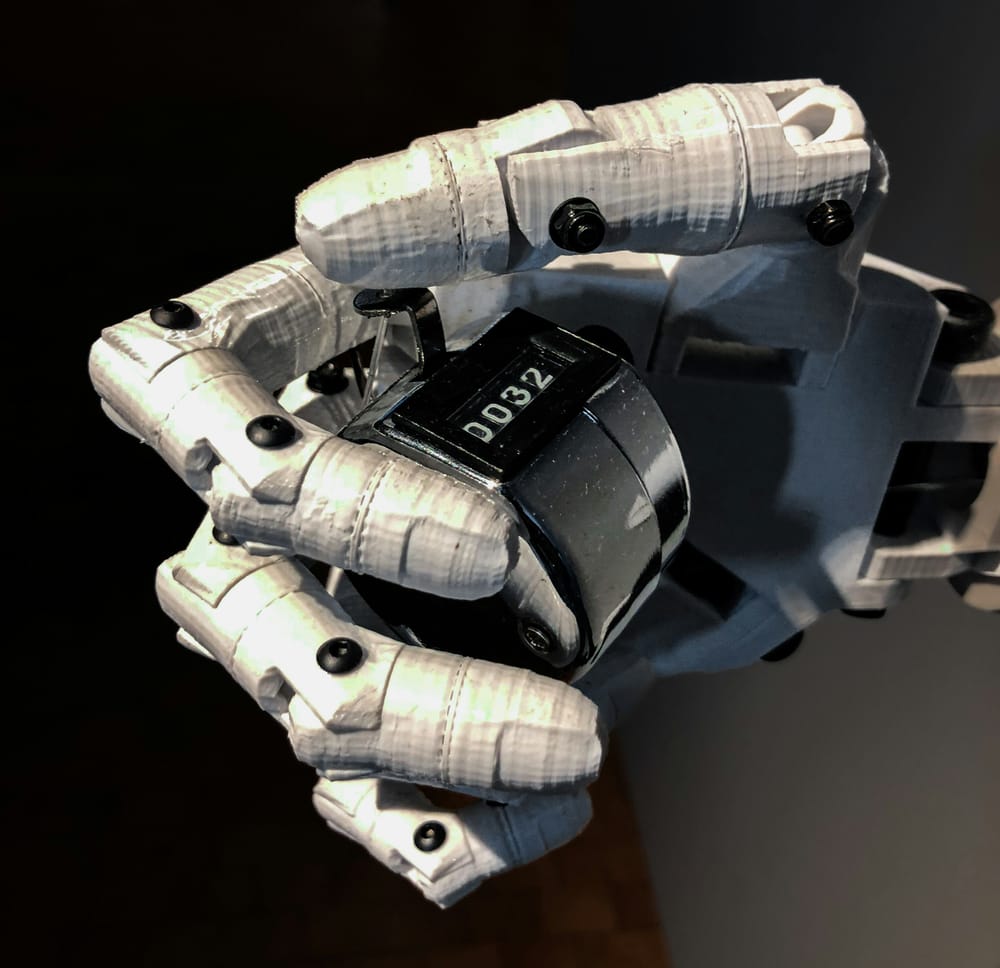
The Hand That Holds the Future — Tesla's Strategic Bet on Dexterity Over Strength
October 10, 2024. The "We, Robot" event in Hollywood. Elon Musk unveils the Optimus Gen 3 humanoid robot. On stage, the robots demonstrate their capabilities: cracking eggs without breaking the yolk, catching thrown objects mid-air, folding laundry with precision. The crowd is enthusiastic. The demos are impressive.
Eighteen months later, in April 2026, Tesla publishes four international patents revealing the mechanical architecture of that Gen 3 hand — a tendon-driven, biomimetic design with 22 degrees of freedom and 25 linear actuators per forearm. The engineering is production-mature. The hand is arguably best-in-class for dexterity.
But where are the deployments?
Boston Dynamics' Atlas has committed all its 2026 units to Hyundai and Google DeepMind. Figure AI, despite its $39 billion valuation, has hundreds of robots in controlled trials at BMW's Spartanburg plant. Even mid-tier players like Agility Robotics have productive deployments — Amazon's warehouses run Digit robots moving 60 totes per hour with over 90% pick success rates.
Tesla Optimus? Still in "R&D phase." No productive factory tasks outside Tesla's own facilities. Demonstrations remain controlled, staged. The most advanced hand in the humanoid market is sidelined while competitors with less capable hardware are actually deploying.
The paradox demands an explanation. Why would Tesla build the best hand and not use it?
The answer: They're playing a different game.
The Hand That Matters: What Makes V3 Superior
Tesla's V3 hand patent isn't a research paper. It's the as-built design of robots rolling off the Fremont production line since January 2026. Publicizing it now serves dual purposes: IP protection and a signal to the market that the technology is production-mature, not experimental.
The patent reveals a manufacturing-first philosophy. Every design choice — from actuator placement to joint mechanisms — prioritizes scalability over absolute performance. This is Tesla's moat: "good enough" dexterity at radically lower costs.

Forearm-Centric Design: Rethinking Weight Distribution
The core innovation: 25 linear actuators per forearm. Twenty-three control the hand's fingers, two control the wrist. They're arranged in concentric rings around a central rotary actuator. This represents a 4.5x increase from Gen 2's 11 actuators.
Each actuator uses a custom planetary gearbox and ball-screw mechanism to convert motor rotation into linear tendon pull. By concentrating all heavy components in the forearm — not in the fingers — the hand stays light and nimble. Weight sits closer to the elbow, reducing torque on the shoulder joint. The payoff: better energy efficiency and longer battery life.
This matters for industrial adoption. An 8-hour factory shift demands endurance, not just capability. Atlas can perform backflips, but can it maintain productive output through an entire shift without recharge? Tesla's forearm-centric design is engineered for exactly that: sustained operation in structured environments where humans currently work.
The trade-off: complexity. Twenty-five actuators require real-time coordination via neural networks. Tesla's AI must manage 25 concurrent control signals to produce natural grip patterns — a significant compute burden. But if you're betting on AI maturity, that's a solvable problem. Hardware constraints are harder to fix after the fact.
22 Degrees of Freedom: Doubling Down on Dexterity
Gen 3 brings 22 degrees of freedom — double Gen 2's count. For comparison: Figure 03 has 16 DoF. Atlas doesn't publicly disclose its specs, but demonstrations emphasize industrial strength over delicate manipulation.
Each Optimus finger has four segments connected by rolling joints — contact surfaces that roll against each other like human knuckles, rather than rotating around fixed pins. This biomimetic approach simplifies manufacturing while maintaining human-like motion.
Per finger: 4 DoF (metacarpophalangeal, proximal interphalangeal, distal interphalangeal joints, plus abduction/adduction) Wrist: 2 DoF (pitch and yaw)
Three thin, flexible control cables per finger run from forearm actuators, pass through the wrist, and connect to finger segments. This enables independent finger flexion without crosstalk — each finger can move without unintended influence on neighbors.
Why does DoF count matter beyond spec-sheet bragging? Because each additional degree of freedom unlocks new task categories.
At 16 DoF, you can wipe, sweep, mop — tasks requiring whole-hand motion with basic grip variation. At 22 DoF, you can manipulate tools in confined spaces, crack eggs without breaking yolks, perform precision assembly with fragile components. The difference between "adequate for cleaning" and "adequate for manufacturing."
> "Each extra degree of freedom unlocks a new category of tasks. At 16, you can wipe. At 22, you can hold a wrench in a confined space."
The human hand has approximately 27 DoF as a benchmark. Optimus isn't there yet, but 22 is closer than any production humanoid competitor. Tesla is betting that proximity to human capability matters long-term — when AI matures enough for autonomous task planning, the robot with more DoF will learn faster and adapt better.
The Wrist Problem: Cable Transition Mechanism
The wrist is the technical crown jewel. The problem: when the wrist moves (yaw + pitch), cable paths change. Cables stretch, friction builds up, and torque coupling creates crosstalk between intended motion and unintended side effects.
Tesla's solution: a cable transition mechanism that shifts cables from a lateral stack (on the forearm side) to a vertical stack (on the hand side). This minimizes cable path changes during wrist rotation.
The patent claims "significantly reduced cable stretch, torque, friction, and crosstalk during combined yaw+pitch movements." Exact figures aren't published, but the mechanism is essential for tasks requiring awkward angles — reaching into a cupboard's bottom shelf, threading a bolt from underneath, gripping an object while simultaneously rotating the wrist.
This is where Optimus differentiates from competitors who rely on simpler cable routing. The transition mechanism adds manufacturing complexity, but it future-proofs the design. When AI can plan multi-step manipulation tasks, the hardware won't be the bottleneck.
Biomimetic Tendon System: Compliance Matters
The cable system is inspired by biological hands. Compared to alternative designs (motors embedded in fingers, hydraulic actuators), tendons offer distinct trade-offs:
Advantages:
- Lightweight fingers: No heavy components in the hand itself
- Compliant grip: Cables can stretch slightly, absorbing shocks during impact
- Backdriveable: Fingers can be passively moved without damaging motors — crucial for safety in human-robot interaction
Disadvantages:
- Cable stretch: Heavy loads reduce precision
- Friction accumulation: Cables pass through multiple guide tubes
- Lifecycle concern: Cables wear and must eventually be replaced
The patent acknowledges these trade-offs but doesn't publish lifecycle data. How many duty cycles before cable replacement? Unknown. What's the maximum grip force per finger? Undisclosed. These questions are critical for industrial adoption, but Tesla hasn't answered them publicly.
Still, the design philosophy is clear: biomimetic compliance beats rigid precision for versatility. A tendon-driven hand can adapt to objects of varying shapes and fragility. A motor-per-joint design offers repeatability but lacks forgiveness. Tesla chose adaptability, betting that AI will compensate for the precision loss.
Manufacturing Philosophy: Rolling Joints & Modular Assembly
The V3 hand is optimized for mass production, not R&D uniqueness. Consider the design choices:
- Concentric actuator rings: Modular assembly, compatible with automated production lines
- Rolling joints: No complex bearings, simpler fabrication
- Standardized cable routing: Reproducible across units
Contrast this with Shadow Robot's Dexterous Hand: 24+ DoF, hydraulic actuators, >$100K per unit. It's technically superior in absolute terms but not mass-producible. Tesla chose "good enough" dexterity at a price point compatible with democratization.
Musk's stated target: less than $20K per robot at volume. Current production costs are likely well above $50K, but the manufacturing philosophy — forearm-centric, modular, rolling joints — is designed to hit that target as production scales.
This is Tesla's competitive moat. Not the best technology, but the most scalable economics. The EV playbook applied to humanoids: battery costs were prohibitive in 2008, dominant by 2026 through learning curves and volume. Humanoid hands follow the same trajectory.
The Deployment Gap: Tech Leadership ≠ Market Leadership (Yet)
If the hand is so good, why isn't it deployed?
The answer reveals the fundamental tension in the 2026 humanoid market: hardware is solved, software is not. Demonstrations are controlled environments with scripted tasks. Productive deployment requires autonomous task planning in unstructured environments. That's an AI problem, not a mechanical engineering problem.
Let's examine the competitive landscape.
Boston Dynamics Atlas: Ahead in Execution
Boston Dynamics launched Atlas for production at CES 2026. All 2026 units are committed to two customers: Hyundai's RMAC (Robotics Manufacturing Assembly Center) and Google DeepMind. Commercial availability begins in 2027.
Atlas specifications:
- Lift capacity: 50 kg
- Agility: Backflips, parkour, dynamic balancing
- Ruggedness: Water-resistant, extreme temperature tolerance
- Deployment status: Verified industrial customers performing productive tasks
Atlas doesn't compete on hand dexterity — Boston Dynamics hasn't disclosed DoF specs. Demonstrations emphasize industrial strength and operational reliability. The message: "We can do the work now, not when AI matures."
That's a credible strategy. Factories need robots that can handle heavy components, navigate uneven surfaces, and operate reliably over multi-year timescales. Atlas delivers that. Optimus promises more versatility eventually.
Tesla Optimus: Ahead in Hardware, Behind in Deployment
Tesla started mass production in January 2026 at the Fremont facility. By April 2026, the company published patents revealing the Gen 3 hand architecture. But Q1 2026 status reports describe Optimus as "still in R&D phase" — no productive factory deployments outside Tesla's own facilities.
The demonstrations are impressive:
- Egg cracking without yolk damage (force control test)
- Catching thrown objects (real-time vision + motor integration)
- Laundry folding (multi-step manipulation of flexible materials)
But impressive demos ≠ productive deployments. Controlled environments don't prove reliability. Scripted tasks don't prove autonomous planning. Tesla has built the hardware foundation without the software maturity to make it useful beyond staged presentations.
This isn't failure — it's strategic patience. Tesla is building production capacity while waiting for AI to catch up. The bet: when autonomous task planning matures (2027-2030 timeline), Optimus will have a hardware advantage competitors can't quickly replicate.
The risk: Atlas takes market share in the meantime.
Figure AI: Hype Outpaces Execution
Figure AI achieved a $39 billion valuation in early 2026 — a staggering number for a company with hundreds of units deployed (not thousands). The market is pricing in future potential, not current capability.
Figure 03 specifications:
- Hand DoF: 16 (vs Optimus 22, Atlas unknown)
- Demonstrated tasks: 8 autonomous cleaning skills (wiping, sweeping, mopping)
- Deployments: BMW Spartanburg plant (parts handling + quality inspection)
Figure's strength is speed-to-market. They're deploying now with "good enough" hardware. Their 16 DoF hands can't match Optimus for versatility, but they're sufficient for the tasks BMW needs. That's revenue today, not promises for tomorrow.
The valuation paradox: investor appetite outpaces operational reality. The market prices in millions of humanoids serving households, hospitals, and construction sites. The 2026 reality is thousands of units in pilot programs performing narrow industrial tasks.
> "Investor appetite outpaces operational reality — the market prices in millions of humanoids, but 2026 delivers thousands of pilots."
Comparative Landscape: Three Strategies, Three Timelines
| Metric | Optimus Gen 3 | Atlas | Figure 03 |
|---|---|---|---|
| Hand DoF | 22 | Unknown | 16 |
| Actuators (total) | 50 (25/arm) | Unknown | Unknown |
| Lift capacity | Unknown | 50 kg | Unknown |
| Demonstrations | Egg cracking, laundry | Industrial tasks | 8 cleaning skills |
| Deployment status | Staged demos | Production | Controlled trials |
| Pricing | $20K-$30K (target) | $140K+ (estimated) | Unknown |
Atlas: Best-in-class for industrial tasks now. Superior agility, proven strength, verified customers. Strategy: serve enterprise niche profitably while others chase mass-market dreams.
Optimus: Best-in-class hand hardware waiting for AI maturity later. Superior dexterity, manufacturing scalability, no deployments yet. Strategy: build production capacity, accumulate training data, wait for software breakthrough.
Figure: "Good enough" hardware deployed quickly. Adequate dexterity for narrow tasks, revenue generation from pilots, valuation reflecting future potential. Strategy: grab market share with working products while competitors perfect technology.
Three different games. Only one can be right about timing.
The Strategic Bet: Dexterity + AI Maturity > Agility + Strength
Tesla isn't racing for 2026 deployments. They're positioning for 2027-2030, when AI autonomous planning matures. The V3 hand patent reveals this strategy clearly: build hardware that's ready for a future software breakthrough.
This is the same playbook Tesla used for electric vehicles.
The Two Races
There are two competitions happening simultaneously in the humanoid market:
Race 1 (Current): Industrial strength, ruggedness, operational reliability
- Winner so far: Boston Dynamics Atlas
- Criteria: 50 kg lift capacity, extreme environment tolerance, verified deployments
- Market: Enterprise customers willing to pay $140K+ for proven capability
Race 2 (Future): Versatility via AI + hardware dexterity
- Positioned leader: Tesla Optimus
- Criteria: Superior DoF, tool-agnostic manipulation, training data accumulation
- Market: Mass-market consumers + broad industrial applications ($20K-$30K price point)
Race 1 is well-defined. Atlas performs industrial tasks today. Race 2's timeline is uncertain — it depends on AI maturity, which is notoriously hard to predict.
Tesla is betting that Race 2 matters more long-term, even if it concedes Race 1 to competitors. But timing is everything. If AI maturity arrives in 2027, Tesla wins. If it takes until 2032, Atlas may have built an unassailable market position by then.
Why Hand DoF Matters Long-Term
Imagine two scenarios five years from now:
Scenario A: AI improves from "controlled demos" to "autonomous task chaining." A robot can observe a human perform a new task once, then replicate it without explicit programming. This is the vision — autonomous learning, not scripted routines.
At that point, a robot with 22 DoF can learn tool use (wrenches, screwdrivers, hammers), adaptive grips (fragile vs. rigid objects), and novel object manipulation (items it's never encountered). The platform effect unlocks: one hardware design serves manufacturing, logistics, household tasks, and more.
A robot with 16 DoF hits a ceiling sooner. Tasks requiring fine motor control or confined-space manipulation are impossible without hardware upgrades. Deployment requires custom end-effectors per task category — fragmentation that increases costs and development cycles.
Scenario B: AI maturity stalls. Autonomous task planning remains elusive through 2030. Humanoids continue performing narrow, pre-programmed industrial tasks — essentially bipedal collaborative robots (cobots) with hands.
In this scenario, Atlas's current advantages (strength, agility, ruggedness) are sufficient. Hand dexterity beyond 16 DoF offers marginal value. Figure's "good enough" approach wins on economics. Optimus's superior hand is over-engineered for the market's actual needs.
Tesla is betting on Scenario A. The risk is Scenario B.
The EV Parallel: Tesla's Proven Playbook
This isn't Tesla's first bet on long-term technological convergence.
2008: Tesla launches the Roadster. Battery costs are ~$1,000/kWh. Range is 245 miles. Charging infrastructure barely exists. The automotive industry is skeptical. "EVs are niche toys for environmentalists. Real consumers need 500-mile range and 5-minute refueling."
Competitors invest in incremental improvements to internal combustion engines (ICE): hybrid systems, direct injection, turbocharging. Marginal efficiency gains year-over-year.
Tesla's bet: Battery costs will decline (learning curve effects from consumer electronics manufacturing scaling). Charging infrastructure will grow (Supercharger network investment). Consumers will adapt (range anxiety diminishes with familiarity).
2026 outcome: Battery costs have fallen 75% in 16 years (~$250/kWh). EVs are cost-competitive with ICE vehicles before subsidies. Charging infrastructure is ubiquitous in major markets. Global EV sales exceed 10 million units annually.
The competitors who bet on ICE improvements were right about incremental progress — engines got more efficient. But they lost the race because the entire battleground shifted. Batteries didn't just improve; they crossed an economic threshold that made EVs mass-market viable.
> "Tesla bet on batteries when nobody believed. Now they're betting on dexterity while competitors chase backflips."
2026: Same playbook for humanoids
Competitors (Boston Dynamics, Figure AI) are betting on current capabilities: industrial strength, agility, rapid deployment. Incremental improvements to today's best-in-class.
Tesla is betting on future convergence: AI maturity + superior hand hardware. The assumption: AI autonomous planning will improve (analogous to battery cost declines). When it does, the robot with more DoF wins (analogous to EV's platform effect once infrastructure existed).
The risk: AI maturity timeline is uncertain. Battery cost curves were predictable (learning rates from semiconductor manufacturing). AI breakthroughs are not. If autonomous task planning takes another decade, Atlas may have locked in market dominance through deployed units, ecosystem partnerships, and operational experience.
But if Tesla is right — if AI maturity arrives in the 2027-2030 window — Optimus's 22 DoF hand will be the moat competitors can't quickly replicate. Manufacturing dexterity-at-scale is hard. It took Tesla 18 months from patent priority (October 2024) to mass production (January 2026). Competitors starting now won't catch up until 2028-2029, by which point Tesla will have accumulated years of training data and deployment experience.
Timing is everything.
The AI Bottleneck: Where Optimus Needs to Catch Up
The V3 hand is solved. Twenty-two degrees of freedom, tendon-driven compliance, cable transition mechanism — the mechanical engineering is production-mature. But the hand is only as useful as the AI controlling it.
And that's where the gap lies.
Demonstrations vs. Deployments: The egg-cracking, object-catching, laundry-folding demos are impressive. They prove the hand can execute fine motor tasks. But they're scripted. A human operator defines the task parameters, the object's position, the grip force required. The robot executes a pre-programmed sequence.
Productive deployment requires autonomous task planning: recognize an unfamiliar object, infer its properties (weight, fragility, grip points), plan a manipulation sequence, execute it, and adapt if something goes wrong. That's not mechanical engineering — that's AI/vision/planning stack maturity.
Unstructured environments: Factories are relatively structured. Objects arrive at predictable locations. Lighting is controlled. Task sequences repeat. Even there, Optimus remains in "R&D phase" while Atlas has productive deployments.
Households are exponentially harder. Laundry isn't always folded the same way. Kitchen tools are stored haphazardly. Lighting varies by time of day. Floors have clutter. Children leave toys in unexpected places. Autonomous operation in unstructured environments demands real-time adaptation, not scripted routines.
Current state (2026): The AI can handle controlled demos. It cannot handle autonomous household operation. The gap between "performs task when told exactly what to do" and "figures out what needs doing and does it" is vast.
Timeline uncertainty: When does AI cross that threshold? Optimistic estimates: 2027-2028 for narrow industrial tasks, 2029-2030 for household versatility. Pessimistic estimates: never without breakthroughs in few-shot learning, common-sense reasoning, and real-time adaptation that aren't on the horizon.
Tesla's bet assumes the optimistic timeline. If they're wrong, Atlas's "inferior" hand is good enough — because good enough + deployed beats superior + waiting.
What Tesla Must Prove
Three unanswered questions determine whether Optimus's hand advantage materializes:
1. Cable lifespan: The patent acknowledges cable wear but provides no duty cycle data. How many grip cycles before replacement? Industrial adoption requires predictable maintenance intervals. "Unknown" isn't acceptable at scale.
2. Grip force: No published specs for maximum force per finger. Can Optimus handle 50 kg objects like Atlas, or is the tendon system limited to lighter loads? This determines task applicability.
3. 24/7 reliability: Demonstrations last minutes. Industrial shifts last 8+ hours. Household robots need years of uptime. Actuator lifespan, calibration stability after cable replacement, downtime for maintenance — none of this data is public.
Demonstrations prove capability. Deployments require reliability. Tesla hasn't bridged that gap publicly. They may have internal data, but until verified customers operate Optimus in productive environments, the question remains open.
Patent Timing as Competitive Signal
The V3 hand patents weren't filed in April 2026. The priority date is October 10, 2024 — the exact day of the "We, Robot" event in Hollywood. Tesla kept the design secret for 18 months while moving from prototype to mass production. Publication in April 2026 wasn't accidental timing. It was strategic.
18 Months of Secrecy: Competitive Intelligence
From October 2024 to April 2026, competitors couldn't reverse-engineer Tesla's actuator architecture, cable transition mechanism, or forearm-centric design. That's a critical window. In those 18 months, Tesla went from unveiling Gen 3 on stage to starting mass production in Fremont.
Boston Dynamics, Figure AI, and other competitors were developing their own hands during this period. Without access to Tesla's design choices, they couldn't copy the innovations. They had to develop independently — or wait for Tesla to publish and then redesign.
By the time the patents became public in April 2026, Tesla's production line was operational. Competitors now face a choice: design around the patents (which adds development time and engineering complexity) or wait until the patents expire (20 years from priority date, i.e., 2044).
This is classic IP strategy: keep innovations secret during the critical development phase, then publish once you've built production capacity. It protects the moat without sacrificing first-mover advantage.
Production Signal: Tech Is Ready
Patent publication in April 2026 sends a message to the market: this is not experimental technology. The design isn't speculative. It's the as-built architecture of robots rolling off the Fremont line.
Tesla could have waited longer to publish — patents can remain unpublished for years if the applicant requests delays. The decision to publish now signals confidence. The technology works at scale. Mass production is operational. The hand design is mature enough to withstand public scrutiny and competitive analysis.
For investors, customers, and competitors, this is a flex. Tesla is saying: "We solved dexterity at scale. The hardware is ours. If you want to compete, you'll have to invent around our IP."
IP Protection: Blocking Copycats
Now that production is live, Tesla must block copycats. Competitors who see the published patents and attempt direct replication risk litigation. Tesla's legal team can enforce the IP through injunctions, licensing demands, or patent infringement lawsuits.
The effect: competitors must design around Tesla's patents. That means avoiding:
- Forearm-centric actuator placement in concentric rings
- Cable transition mechanisms that shift from lateral to vertical stacks at the wrist
- Rolling joint designs with specific geometry described in the patent claims
Each constraint adds development time and engineering complexity. Competitors who would have copied Tesla's design now face 12-24 months of additional R&D to invent non-infringing alternatives.
This raises the barrier to entry. It's not enough to observe that Tesla has 22 DoF and build something similar. You have to achieve similar performance through different means — and that's harder than it sounds.
The Confidence Play
The timeline reveals Tesla's confidence:
- October 2024: Priority date (tech mature enough to patent)
- January 2026: Mass production starts (15 months later)
- April 2026: Patents publish (18 months after priority)
Fifteen months from patent filing to mass production is fast. For comparison, Boston Dynamics' Atlas underwent years of R&D before production launch. Tesla's timeline suggests the Gen 3 hand was already highly developed by October 2024 — the "We, Robot" event wasn't a concept reveal, it was a near-production prototype.
Publishing in April 2026, just three months after production started, signals that Tesla isn't worried about competitors catching up quickly. The manufacturing moat — forearm-centric assembly, modular rolling joints, standardized cable routing — is designed for scale. Even with the patents public, replicating Tesla's production efficiency takes years.
This is the long game: patent publication protects IP, signals production maturity, and raises barriers to entry. Competitors know what Tesla built. They can't easily copy it legally, and they can't replicate the manufacturing efficiency quickly. By the time they catch up (2028-2029), Tesla will have accumulated deployment data, training datasets, and ecosystem partnerships that further widen the moat.
Lessons From the Hand: What It Teaches Us About Humanoid Economics
The V3 hand patent is more than a mechanical blueprint. It reveals Tesla's assumptions about the future of humanoid robotics — assumptions that may or may not prove correct. Let's extract the lessons.
Hardware Is Solved, Software Is Not
The mechanical engineering problem is done. Twenty-two degrees of freedom, tendon-driven compliance, cable transition mechanisms, rolling joints optimized for mass production — these are solved problems. Tesla proved it by starting mass production in January 2026.
The AI/vision/planning stack is unfinished. Demonstrations are scripted. Autonomous task planning in unstructured environments remains out of reach. Real-time adaptation to novel objects and unexpected situations is not yet robust.
Implication: The bottleneck in humanoid robotics isn't mechanical engineering. It's AI maturity. Companies that solve autonomous task planning first will unlock the value of their hardware — regardless of whether that hardware is best-in-class.
This is why Atlas's strategy (deploy "good enough" hardware now) is credible. If AI maturity stalls, superior hand dexterity offers marginal value. But if AI improves rapidly, Tesla's superior hardware becomes the differentiator.
Manufacturing Moat > Performance Moat
Atlas has superior agility today: backflips, parkour, 50 kg lift capacity, extreme environment tolerance. But that performance comes at a cost — estimated $140K+ per unit.
Tesla's manufacturing moat (forearm-centric design, modular assembly, rolling joints) is designed for cost reduction at volume. Target price: $20K-$30K. If achieved, that's one-fifth the price of Atlas.
Long-term implication: Democratization comes from price, not performance. Atlas can serve high-value enterprise niches profitably (automotive manufacturing, aerospace, logistics for Fortune 500 companies). But mass-market adoption — households, small businesses, service industries — requires sub-$30K pricing.
> "Democratization comes from price, not performance. Tesla's $20K target unlocks mass markets Atlas' $140K can't reach."
Short-term reality check: Tesla's $20K-$30K pricing is aspirational, not verified. Current production costs are likely well above $50K. Whether they achieve the target depends on volume scaling, supply chain maturation, and manufacturing optimization — all uncertain.
But the design philosophy prioritizes cost reduction. Every choice (concentric actuators, rolling joints, standardized cables) is compatible with high-volume manufacturing. Atlas's design prioritizes performance and ruggedness, which inherently limits cost reduction potential.
Tesla is betting that price elasticity matters more than performance leadership. History (EVs, solar panels, consumer electronics) suggests they're right. Premium products serve niches profitably. Low-cost products capture mass markets.
The Platform Effect: Versatility > Specialization
One hand design for warehouse, manufacturing, and household tasks = platform economics. Once the hardware is amortized across millions of units, software improvements benefit the entire installed base. A training breakthrough that improves laundry folding also improves parts handling and tool use.
Custom end-effectors per task category = fragmentation. Every new task requires hardware iteration, manufacturing setup, supply chain coordination. Development cycles are longer. Costs stay high.
Tesla's bet: 22 DoF + AI maturity unlocks platform economics. One hardware design, endlessly retrainable for new tasks via software updates. The same robot does warehouse work during the day, household chores at night (hypothetically).
Constraint: This only works if AI reaches autonomous task planning maturity. If tasks remain scripted and narrow, specialized hardware (grippers optimized for totes, arms optimized for heavy lifting) may outperform generalist humanoids.
The platform bet assumes AI improves. The specialization bet assumes AI stalls. Only one can be right.
Deployment Beats Demos
Investor hype (Figure AI's $39 billion valuation) outpaces operational reality (hundreds of units deployed, not thousands). The market prices in future potential — millions of humanoids in households, hospitals, construction sites. The 2026 reality is pilot programs performing narrow industrial tasks.
Lesson: Controlled demonstrations prove capability. Verified deployments prove reliability. Capability gets investor attention. Reliability gets customer revenue.
Atlas has verified customers (Hyundai, Google DeepMind). Figure has pilots (BMW). Tesla has staged demos. The market rewards Atlas and Figure with production contracts. Tesla gets valuation based on promises.
This gap matters. Every month of productive deployment generates operational data: failure modes, maintenance requirements, task success rates, edge cases that break autonomy. That data feeds back into AI training and hardware iteration. It's a compounding advantage.
Tesla's late start on deployment means they're behind on this learning curve. Atlas isn't just selling robots — they're accumulating the dataset that makes future robots better. That's the moat Tesla must overcome, even with superior hand hardware.
Conclusion: The Hand That Waits
October 10, 2024: Elon Musk unveils Optimus Gen 3. The crowd is enthusiastic. The demonstrations are impressive. Eggs crack without breaking yolks. Objects are caught mid-air. Laundry folds neatly.
April 2026: Tesla publishes the patents. The mechanical architecture is revealed. The hand is production-mature, arguably best-in-class for dexterity. Mass production is operational.
But deployments? None, outside Tesla's own facilities. Atlas has verified customers. Figure has pilot contracts. Optimus has staged demos and promises.
The paradox resolves when you understand the game Tesla is playing. They're not racing for 2026 deployments. They're building the hardware foundation for a future AI breakthrough. The hand with 22 degrees of freedom, tendon-driven compliance, and a cable transition mechanism isn't designed for today's scripted tasks. It's designed for tomorrow's autonomous task planning.
This is the same bet Tesla made with electric vehicles. In 2008, batteries were expensive, range was limited, and charging infrastructure barely existed. Competitors invested in incremental ICE improvements. Tesla bet that battery costs would decline, infrastructure would grow, and consumers would adapt.
They were right. Battery costs fell 75% over 16 years. EVs crossed the economic threshold. The entire automotive industry shifted.
In 2026, Tesla is betting on humanoids the way they bet on EVs. AI autonomous planning is immature. Deployments are limited. Scripted tasks dominate. Competitors invest in strength and agility now. Tesla invests in dexterity and platform economics for later.
The parallels are striking:
- EV bet: Battery tech immature in 2008, dominant in 2026
- Humanoid bet: AI autonomous planning immature in 2026, mature in... ?
History suggests Tesla might be right. But history also shows that timing is everything. Batteries took 16 years to cross the economic threshold. If AI maturity takes that long, Atlas will have locked in market dominance through operational experience, ecosystem partnerships, and deployed units generating revenue.
If AI maturity arrives in 2027-2030, Optimus is best-positioned. The 22 DoF hand will learn faster, adapt better, and serve more use cases than competitors' simpler designs. The manufacturing moat (cost reduction at volume) will unlock mass-market adoption Atlas can't reach.
The question isn't whether Optimus's hand is good enough. It's whether the AI will catch up before Atlas takes the market.
Tesla is betting yes. The V3 hand patent is their down payment on that future. Whether it pays off depends on variables beyond Tesla's control: breakthroughs in few-shot learning, common-sense reasoning, real-time adaptation to unstructured environments.
The hand that holds the future is ready. The question is whether the future will arrive in time.
Sources
Patent Documentation & Technical Analysis
* Tesla Optimus V3 hand and arm details revealed in new patents — Primary source for 22 DoF specification, 25 actuator architecture, and cable transition mechanism details
* Tesla Files Patents Revealing Optimus Gen 3 Mechanical Blueprint — Analysis of forearm-centric design philosophy and manufacturing-first approach
* The Forearm Is the New Hand: Inside Tesla's Optimus V3 Patents — Deep-dive on actuator placement, concentric ring design, and weight distribution strategy
* Tesla Optimus V3 Robot Hand Patent Reveals Tendon-Driven Architecture — Detailed breakdown of tendon system trade-offs and biomimetic compliance rationale
* Tesla's Robot Hand Patent Reveals Clever Engineering — Rolling joint mechanics and modular assembly design choices
* Tesla Optimus V3 Robot Hand Patent: Technical Analysis — 4 DoF per finger specification and wrist pitch/yaw capabilities
* Tesla's Optimus Robot Reveals Innovative Hand Design — Patent timing analysis and IP protection strategy
Optimus Development & Production
* Tesla Optimus: Complete Analysis (2026) — Comprehensive overview of Gen 3 capabilities, demonstrations, and R&D phase status
* Tesla Optimus Gen 3: News & Specs — "We, Robot" event coverage and staged demonstration analysis
* Tesla's Robotic Moonshot: Optimus Gen 3 — Egg-cracking, object-catching, and laundry-folding demonstration evidence
* The Age of the Humanoid: Tesla Ignites Mass Production — January 2026 mass production start confirmation and Fremont facility details
* Tesla Optimus Gen 3: Inside the Robot Revolutionizing Industry — Production-mature technology status and deployment timeline expectations
Competitive Landscape Analysis
* Humanoid robots in 2026: Types, prices, and what's next — Market overview comparing Atlas, Optimus, Figure AI pricing and deployment status
* Tesla robot price in 2026 — $20K-$30K target pricing analysis and volume production economics
* Tesla Optimus vs Boston Dynamics Atlas — Head-to-head comparison of dexterity vs. strength strategies
* Boston Dynamics beats Tesla to the humanoid robot punch — Atlas production launch, Hyundai/DeepMind commitments, and 50 kg lift capacity specs
* Boston Dynamics IPO and $100B Valuation — Market valuation dynamics and investor appetite vs. operational reality
* Atlas vs Optimus vs Figure AI: The Humanoid Robot Race — Three-player strategy comparison (deployment now vs. hardware superiority later vs. rapid iteration)
* Comparing Atlas and Optimus humanoid robots — Technical specifications, agility demonstrations, and deployment timeline comparison
* A Complete Review Of Tesla's Optimus Robot — Critical assessment of demonstration vs. deployment gap and AI bottleneck analysis
* Humanoid Robots 2026: Tesla Optimus, Figure AI & Boston Dynamics — Figure AI's $39 billion valuation, BMW Spartanburg trials, and 16 DoF hand specifications
* Top 12 Humanoid Robots of 2026 — Broader market context including Agility Robotics, Digit, and mid-tier player deployments
* HMND 01 Alpha completes automotive logistics POC — Evidence of productive industrial deployments by competitors while Optimus remains in R&D phase