Why Your Next Drone Has Wings
Thirty minutes. That's how long it takes to transform a $500 consumer quadcopter into a 25-kilometer kamikaze drone. No complex engineering, no aerospace-grade materials — just 3D-printed wings, an FPV kit, and the kind of pragmatic improvisation that defines modern warfare. On Ukrainian battlefields in 2025, soldiers discovered something the drone industry had been circling around for years: stick wings on a quadcopter, and physics does the rest.
The battery doesn't change. The motors don't change. But the range quadruples.
This isn't a military secret anymore. It's a paradigm shift rippling through every corner of the drone world — from FPV racing leagues to agricultural surveying, from package delivery to search-and-rescue. The quad-with-wings isn't a niche hack. It's becoming the new default.
The Physics of Getting Something for Nothing
A quadcopter is fundamentally inefficient. Four motors spin at thousands of RPM, pushing air downward with enough force to suspend the entire aircraft. Every gram of lift costs energy. Hover for six minutes, and the battery's dead.
Now add wings. In forward flight, those wings generate lift aerodynamically — the same way a glider stays aloft without any engines at all. The motors still run, but they're no longer fighting gravity alone. The wings shoulder part of the load. Research published in Nature found that wing-augmented quadcopters burn 64% less energy in cruise compared to hover (Nature, 2024).
Think about what that means. The effective battery efficiency jumps from roughly 140 Wh/kg to over 200 Wh/kg — without swapping a single cell. Pure aerodynamics. The same battery that gave you six minutes of hover now gives you twenty-five minutes of cruise. The same range that topped out at 6 km stretches to 25 km.
Ukraine proved the concept with brutal simplicity. Take a DJI Mavic 3 frame. Print fixed-wing extensions on a hobbyist 3D printer. Bolt them on. Add an FPV control kit and a PG-7 antitank warhead. Thirty minutes of assembly, and you've created an asymmetric weapon that costs less than a high-end laptop but threatens vehicles worth millions (United24 Media).
There's no elaborate transition phase here — no tilt-rotors, no complex flight controllers managing the switch from hover to cruise. The drone stays a quadcopter. All four motors run continuously. The wings just... help. As the quad accelerates forward, the wings gradually take over lift duties. It's brute-force engineering at its most elegant.
Three Approaches, One Principle
The wing-augmented quad is the simplest implementation, but it's not the only one. Three distinct design philosophies have emerged:
The Retrofit: Ukraine's approach — existing quad + aftermarket wings. Fast, cheap, effective. Range multiplies by four, but the wings are fragile. One crash, and you're printing replacements.
The Purpose-Built Fixed-Wing FPV: Skip the hover pretense entirely. Ukraine's DARTS platform is a dedicated fixed-wing drone with FPV control — 1.9-meter wingspan, 160 km/h top speed, 40-50 km operational range. It carries 4 kg of payload, survives multiple hits from small arms fire, and costs around $1,100 (Militarnyi). You lose VTOL capability, but you gain speed, range, and resilience.
The Ring-Wing: Russia's alternative. The KVS drone wraps a ring-shaped airfoil around a 10-inch quadcopter frame, connecting the wingtips to reduce tip vortices and channel airflow more efficiently. Combined with fiber-optic control (immune to RF jamming), the KVS achieves ~50 km range with a 3 kg payload (EuroMaidan Press). It's mechanically complex, but the annular wing design offers unusual aerodynamic benefits.
The common thread? All three solve the same problem: quadcopters burn too much energy. Wings fix that.
From Battlefield to Race Circuit
While soldiers were duct-taping wings to consumer drones, the FPV racing community was doing the same thing for entirely different reasons. Flight time.
Traditional FPV racing is brutal on batteries. High-speed maneuvers, constant throttle adjustments, aggressive climbs — a typical race quad gets maybe six minutes of usable flight before the voltage sags and performance drops. Wings change the math. The FPV Wing Racing Association (FPVWRA) now runs standardized competitions with a "spec class" — everyone flies the same 36-inch wingspan wing with a 3S LiPo and 200mW video transmitter. Fair competition, doubled flight times (FPVWRA).
TBRC Wings dominates the market with a product line that spans everything from sub-250-gram racers (the SOS V2) to the Apex V2, which hits over 100 mph using mini-quad components, to the TBRC 60 V3 — a 60-inch monster advertised as having "nearly endless cruise" (TBRC Wings). The material is Superfoam, engineered for crash durability. When you inevitably faceplant into a tree at 80 mph, the wing bounces. A traditional quad frame shatters.
The timing couldn't be better. On April 25, 2026, the FAA is hosting Drone Safety Day with FPV races featuring 7-inch, 10-inch, and X-Class frames (The Drone Girl). It's a public showcase of exactly how far hobbyist wing tech has come — from garage experiments to competition-grade hardware in less than three years.
Open-source firmware plays a huge role here. ArduPilot's QuadPlane system supports quad, hexa, tricopter, and octaquad configurations, letting hobbyists build hybrid VTOL platforms with off-the-shelf parts (ArduPilot). The X-UAV MiniTalon became the de facto standard for long-range FPV, with flight times exceeding an hour (ArduPilot MiniTalon). DIY 3D-printed wings (like the Eclipson Helix) flooded maker forums. What started as a military improvisation became a hobbyist movement.
The Commercial Pivot: Efficiency at Scale
If the battlefield proved the concept and hobbyists refined it, enterprise adoption is now scaling it.
The agriculture drone market hit $4.41 billion in 2026, growing at a 29.8% CAGR. Hybrid VTOL models are the fastest-growing segment, expanding at 18.9% annually (Market.us). Why? Coverage.
In a direct comparison, a VTOL drone covered 14× more area per battery charge than a comparable quadcopter (Propeller Aero). The WingtraOne Gen II completes large-area surveys in 59 minutes of flight time. The DeltaQuad Evo pushes that to 4-8 hours with a 270 km range. For precision agriculture, topographic mapping, or infrastructure inspection, the math is unambiguous: wings win.
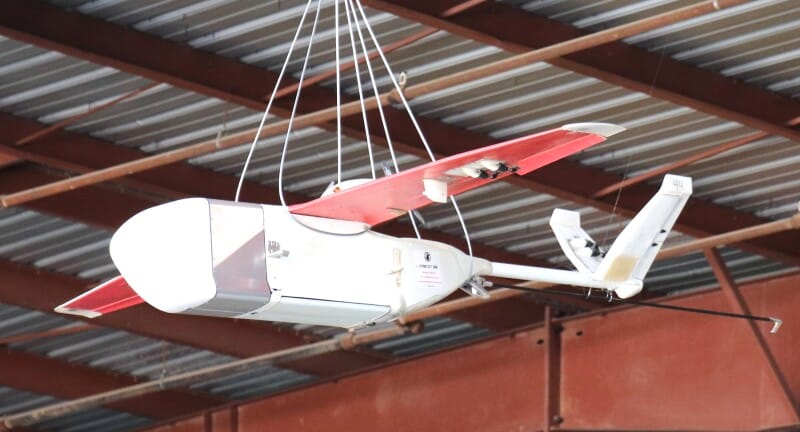
Delivery drones tell the same story. The market reached $1.47 billion in 2026 and is projected to hit $6.74 billion by 2031 — a 35.69% CAGR (Mordor Intelligence). Zipline has logged over 100 million autonomous miles with 1.4+ million deliveries using fixed-wing VTOL hybrids. Wing (Alphabet) perfected the transition. Meituan operates massive urban networks in Shenzhen and Shanghai. The regulatory bottleneck — BVLOS (Beyond Visual Line of Sight) flight approval — finally cracked open in 2026 as both the FAA and EU U-Space frameworks matured.
Search-and-rescue is perhaps the most compelling use case. The DeltaQuad Evo carries thermal cameras and flies for over four hours, covering search grids that would take a quad days to complete. The WingtraRAY surveys 1,300 acres per hour and sits on the FAA's "Blue UAS" list (cybersecurity-certified for sensitive operations) (Wingtra). When minutes matter, range and endurance aren't luxuries. They're lifesavers.
The Hybrid Paradox: Best of Both Worlds, Worst of Both Weights
Here's the uncomfortable truth: hybrid drones promise the best of quads and fixed-wings, but they also inherit the worst.
Mechanical complexity is the killer. You're carrying propulsion for two flight modes — vertical motors for VTOL, aerodynamic surfaces for cruise. More moving parts mean more failure points. The transition phase (hover ↔ cruise) is exponentially harder to control than either mode alone. Flight controllers have to manage thrust imbalances, airspeed changes, and aerodynamic instabilities simultaneously. ArduPilot's QuadPlane documentation is 50+ pages for a reason (ArduPilot).
Weight compounds the problem. A hybrid system is heavier than a pure quad or a pure fixed-wing designed for the same mission. You pay the penalty in both modes — extra mass during hover, extra drag during cruise.
Cost reflects the complexity. A hybrid VTOL drone costs roughly 3.5× more than an equivalent quadcopter (Acecore). For commercial operators, that's a justifiable premium if the mission demands long range and flexible landing. For hobbyists or budget-constrained applications, it's a non-starter.
Crash fragility is worse than either parent platform. Wings break easily. If you're doing aggressive FPV racing or operating in urban environments with tight spaces, those fragile wings are a liability.
So when do you choose hybrid over pure quad or pure fixed-wing?
| Scenario | Best Choice | Why |
|---|---|---|
| Survey <200 hectares | Quadcopter | Cheap, precise, simple |
| Survey >200 hectares | VTOL hybrid | 14× coverage, no runway |
| Delivery <5 km | Quadcopter | Short range, precise landing |
| Delivery 5-50 km | VTOL hybrid | Range + landing flexibility |
| Delivery >50 km | Fixed-wing | Pure efficiency at distance |
| FPV racing | Quad or Wing | Depends on class rules |
| Tactical short-range | FPV quad + wings | $500, fast, retrofit |
| Tactical long-range | Fixed-wing FPV | Speed, range, survivability |
| Search & rescue | VTOL hybrid | Large area, land anywhere |
Ukraine's lesson is clear: pragmatism beats perfectionism. A $500 quad with 3D-printed wings that reaches 25 km is tactically more valuable than a $50,000 bespoke system that takes months to produce. Good enough, fast enough, cheap enough.
Convergence is Coming
The boundaries between drone categories are dissolving. Five technological drivers are accelerating the shift:
1. Battery technology: Higher energy density extends flight times across all platforms, but wings still multiply the gains.
2. Fiber-optic FPV: Russia produced over 50,000 fiber-optic drones per month in late 2025, achieving 50-65 km range with complete immunity to RF jamming (Ukraine's Arms Monitor). The only countermeasure is kinetic — shoot it down.
3. AI and autonomy: Ukraine tested swarms of 8-25 drones operating cooperatively. Autonomous navigation reduces pilot workload and enables missions beyond line-of-sight without constant manual control.
4. 3D printing democratization: Custom airframes, wing profiles, and hybrid frames are now accessible to hobbyists and military units alike. Design, print, fly — iteration cycles collapsed from months to days.
5. BVLOS regulation maturity: 2026 is the turning point. The FAA's Remote ID implementation and the EU's U-Space framework finally enable commercial-scale operations beyond visual range. Wings are no longer a hobbyist curiosity — they're a regulatory-compliant enterprise tool.
The drone of 2027 won't be a "quadcopter" or a "fixed-wing." It'll be a platform that switches fluidly between modes, like a hummingbird that hovers when it needs precision and glides when it needs efficiency.
The Question Isn't If
The physics are undeniable. Wings reduce energy consumption by 64% in cruise. They quadruple range without touching the battery. They enable applications — long-distance delivery, large-area mapping, extended search-and-rescue — that pure quads can't touch.
The implementations vary. Ukraine retrofits consumer quads. FPV racers build custom spec-class wings. Enterprise operators buy turnkey VTOL platforms from DeltaQuad and Wingtra. But the principle is universal: lift is cheaper when the air does the work.
The question isn't if your next drone has wings. It's which implementation you choose — and whether you're ready to accept the trade-offs. Complexity for capability. Fragility for efficiency. Cost for range.
But if you need to fly farther, stay aloft longer, or cover more ground per charge, there's only one answer. Add wings.
Sources
Military & Tactical Applications
- United24 Media — Ukraine's New Winged FPV Drones
- Militarnyi — Fixed-Wing FPV Drones on the Frontline
- Gwara Media — Ukraine Equips FPV Drones with Wings
- Ukraine's Arms Monitor — Drone Warfare Key Trends
- EuroMaidan Press — Russia's Ring-Wing FPV
Aerodynamics & Technical Research
- Nature — Transition Flight Aerodynamics of Quad-Tiltrotor UAV
- ResearchGate — Aerodynamics and Hover Control for X-wing VTOL MAV
- ArduPilot — QuadPlane Building Guide
Hobbyist & FPV Racing
- TBRC Wings — Product Line
- FPVWRA — Rules and Regulations
- Oscar Liang — Budget 7-inch FPV Build
- ArduPilot — MiniTalon Build
- The Drone Girl — FAA Drone Safety Day 2026
Commercial & Enterprise
- UAV Coach — VTOL Drones Guide 2026
- Propeller Aero — Fixed-Wing vs Quadcopter for Surveying
- DeltaQuad — Evo Platform
- Wingtra — VTOL Drone
- Mordor Intelligence — Delivery Drones Market
- DroneDJ — Elroy Air Cargo Drone
- Market.us — Hybrid VTOL Drone Market
Trade-Offs & Comparative Analysis
- Acecore Technologies — Hybrid Drones Advantages and Disadvantages
- MAVDrones — Fixed-Wing Hybrid VTOL Advantages
- GeoNadir — Fixed-Wing vs Multirotor 2026
- DJI Enterprise — Fixed-Wing vs Multirotor Surveying