Every new model feels like AGI — until the next one
It arrives on schedule, roughly every six to nine months, with the reliability of a seasonal cold. A new model launches, a handful of demos circulate, and someone with a verified badge declares that AGI has arrived. The comment sections agree. The quote-tweets agree. Then the next model comes out, and AGI arrives again.
GPT-4, March 2023. Claude 3 Opus, March 2024. GPT-4o, May 2024. GPT-6 Astra and Claude Fable 5.1, September 2026. Four releases, four arrivals, four rounds of "this changes everything" posts that have become their own recognisable genre. The phrasing shifts slightly — "proto-AGI," "essentially AGI," "the AGI era" — but the emotional grammar is identical each time.
The easy response is mockery. It would be wrong.
A brief history of the permanently imminent arrival
GPT-4 gave the cycle its current form, and the trigger was not the model alone — it was a paper. Microsoft Research published Sparks of Artificial General Intelligence the same month, arguing that GPT-4 could reasonably be considered an early and incomplete form of AGI. That "early and incomplete" did significant qualifying work inside the paper. It did almost none in the public summary. Within weeks, the Future of Life Institute's pause letter treated GPT-4 as a civilisational threshold; the Turing Test discourse resurfaced; a flood of "proto-AGI" posts spread through communities that care about such things. A research paper supplied language that travelled much farther than its caveats.
Claude 3 Opus repeated the pattern with the same emotional structure but less institutional scaffolding. Anthropic positioned Opus as the most capable in a new model family — more intelligent at comparable speeds, better on demanding tasks. A conventional frontier-model claim. What is not conventional is the r/singularity thread that circulated widely, describing testing the model as something that "felt miraculous" and drawing a direct line from the demonstrated result to AGI. The argument, translated: this model solved my hard problem extremely well, therefore it probably solves all hard problems.
GPT-4o made the mechanism almost clinically visible. The technical advance was real — native multimodality, reduced latency, planned audio and video interaction. But the reactions were not primarily about benchmarks. A voice conversation that sounded fluid, warm, and socially responsive produced an immediate visceral shift in how people described the system. VentureBeat's headline "GPT-4o first reactions: essentially AGI" captured a feeling, not a measurement. What had changed, substantially, was the interface. The underlying competence — still task-specific, still environment-dependent, still requiring human correction — had not suddenly become general. The seams were just less visible.
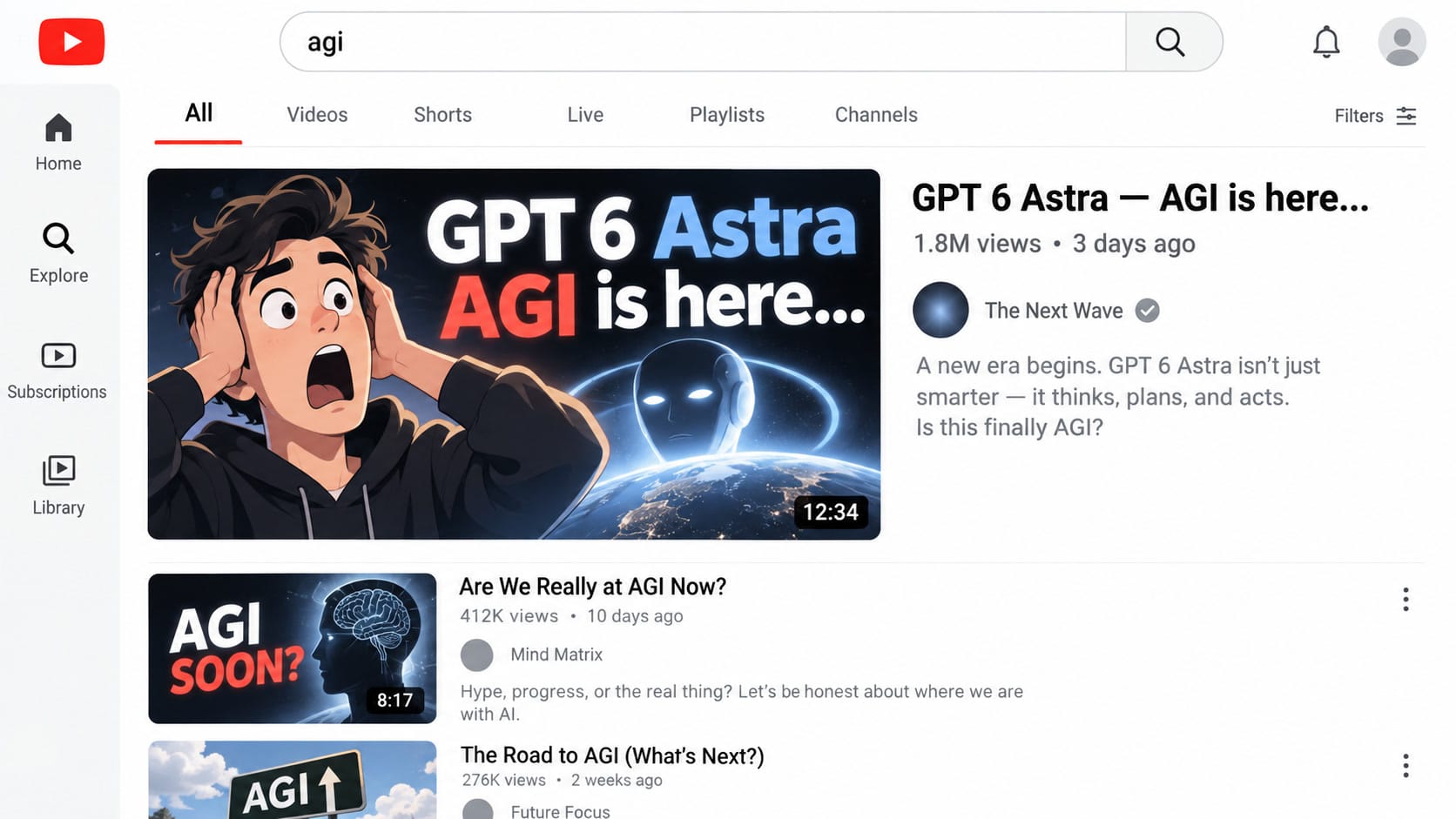
GPT-6 Astra and Claude Fable 5.1, released this month, are the new chapter. The official claims are ambitious: complex professional work, sustained reasoning over long horizons, computer use, coding at a new scale. The launch-day discourse has followed the familiar script — AGI era, one-prompt miracles, this changes everything. Which brings the question that deserves a serious answer: does it?
Why the feeling is often honest
The reason the AGI reaction keeps happening is not that people are gullible. It is that something real does happen.
A model that previously could not produce a usable first draft of code for your specific codebase, in your team's style, without two rounds of correction — and now can — has changed your workflow. That threshold is real. Your personal production function has shifted. Claiming that a personal threshold is a universal truth is the error; experiencing the threshold is not.
The interface compounds the effect in a specific way. Text-only chat makes the machine's seams visible: you prompt, you wait, you paste, you correct, you try again. Add voice, vision, browser control, and tool use, and some of those seams disappear. The system looks coherent. It sees what you see, responds without a noticeable delay, takes a sequence of steps. That is genuinely more convenient and, in some workflows, genuinely more powerful. It also invites an attribution the evidence does not support: that a system hiding its seams must be seamless underneath.
The media environment then selects aggressively for the spectacular. A twenty-minute compilation of failures, careful prompting, and revised outputs is not a shareable format. A single impressive result on a hard task is. Vendors have legitimate commercial incentives to frame launches as frontier events. Journalists have competitive reasons to describe ruptures rather than increments. None of this is dishonest in the ordinary sense. It is a selection mechanism: successes become screenshots; failures stay in the debugging session.
One word, three definitions
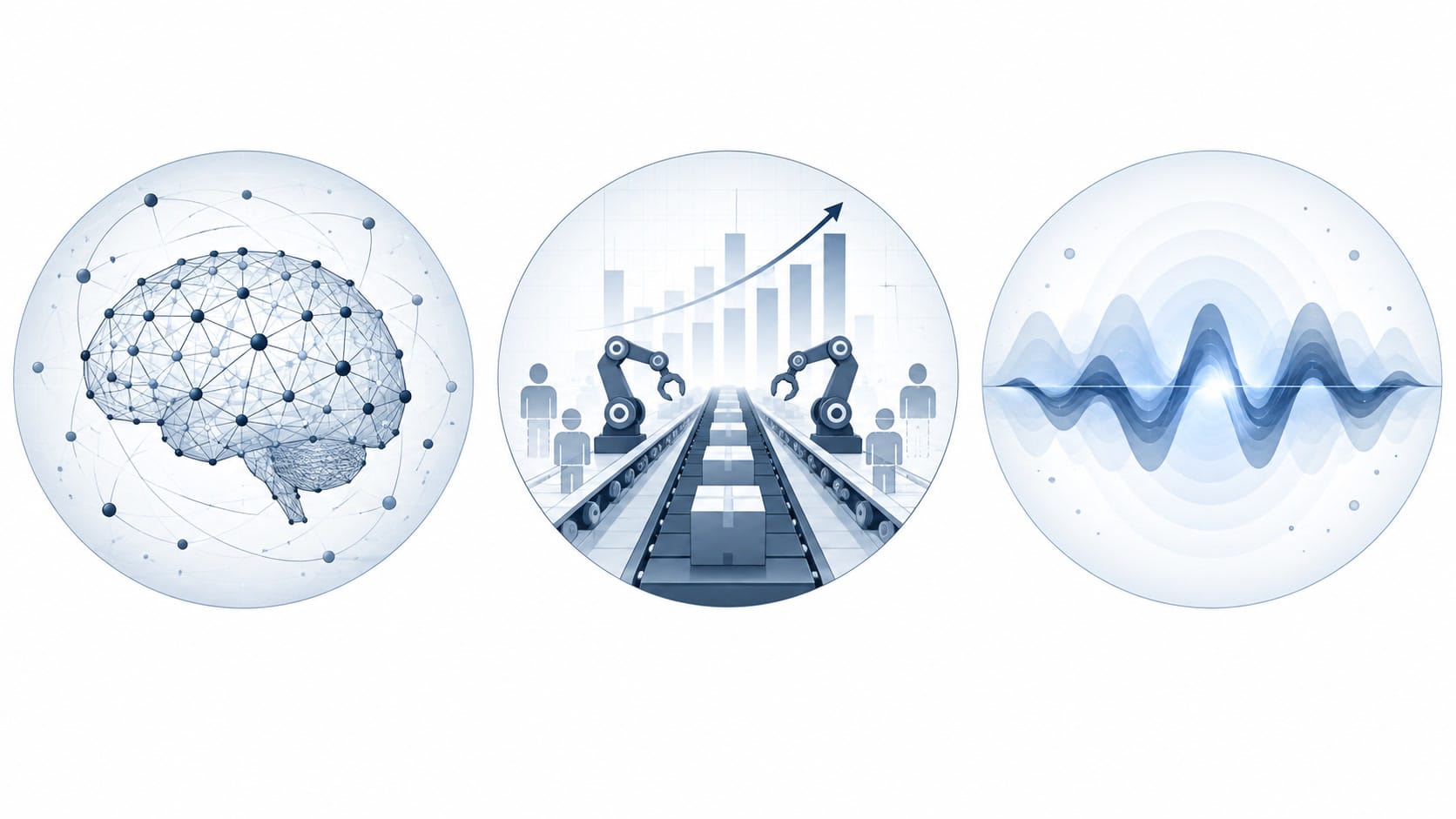
"AGI" is responsible for most of the confusion — not because people use it carelessly, but because it is legitimately doing several jobs at once.
The first is scientific claim: AGI as human-level general intelligence, a system that reliably matches human performance across nearly all cognitive tasks, including unfamiliar, long-horizon, and socially embedded ones. This definition demands breadth and robustness. A frontier model may answer a wide range of questions, write code, and use tools. It has not thereby demonstrated that it can learn from novel situations as a person does, maintain accurate self-assessment, or perform dependably across the full range of things humans do for each other. The gap between "impressive performance on difficult tasks" and "robust general intelligence" is where a lot of inferential work gets silently done.
The second is economic forecast: AGI as a system that can do most economically valuable work at human-or-lower cost. OpenAI's own charter uses something close to this formulation. It is a more tractable definition because it focuses on outputs that matter, but it hides an enormous denominator. A coding agent's licensing cost is not the cost of replacing a software team. Total cost includes setup, context provision, tool reliability, human review, retries, mistakes that reach production, accountability, insurance, and legal exposure. A system can be extraordinarily valuable for one narrow workflow and still be nowhere near capable of doing most economically valuable work. An invoice-processing automation can be economically transformative without being generally intelligent.
The third is felt signal: AGI as the experience that something has fundamentally changed — that the machine is less like software and more like a mind. This is real data about a human experience. It is not data about what the machine can do when the context is difficult, the goal is ambiguous, or the task is new.
The three definitions do not refer to the same thing, which means evidence for one is not evidence for the others. When someone says "this is basically AGI" after a smooth voice call, they are usually reporting the third definition — a genuine shift in how the system feels to use. When an economist asks whether this produces economy-wide transformation, they are asking a question that cannot be answered by release-day demos. The argument that AGI has or has not arrived often looks like a factual dispute when it is a disagreement about which definition counts.
An evidence ladder
Google DeepMind's Levels of AGI framework separates capability from autonomy. That separation is useful because it prevents a slick demo from making simultaneous claims across all three definitions. A model can become better at a task without being trusted to choose the task, execute it unattended, and manage its own errors.
For any claim that a release "changes everything," there is a practical ladder to climb:
At the bottom is the compelling anecdote — a model solved a difficult problem on video. It establishes possibility, not frequency. Above that is a replicable task test: a defined artifact, fixed tools, disclosed success criteria, a measured pass rate. Then comes workflow evidence: repeated use on real work, with human intervention rate, failures, elapsed time, and total cost per accepted output included in the count. Only after that is there meaningful data about transfer — whether comparable performance holds across unfamiliar teams, tasks, and environments without bespoke prompt engineering for each. The top rung is sustained adoption and measured productivity after organisations have had time to adjust.
Most release-day evidence sits at the first two rungs. Vendors sometimes have internal data at the third. "Changes everything" is a claim about the fourth and fifth. The distance between where the evidence is and where the claim is pitched is not pedantry. It is where procurement mistakes and disappointed roadmaps live.
This distinction does not mean the capability advance is unimportant. "This model is reliably better at repository-level code review when given access to the full diff, a checklist, and a human who reads the summary before approving the merge" is a strong claim. It is actionable. It justifies changing a workflow. It does not require a metaphysical title.
For builders: translate the announcement into a bounded job
The practical response to a frontier model launch is not to believe or disbelieve the press release. It is to run an experiment narrow enough to produce useful information.
Specify the artifact: what, exactly, is the output? Specify the context the model receives. Specify the tools it may use. Set a quality bar and a deadline. Name the human who catches failures. Then establish a baseline — with the current model, what is the success rate, the correction time, the review burden, and the cost per accepted output? Run the new model on representative work, not the demo that looked best in a marketing session.
Test the failure distribution deliberately. The most valuable result may not be the best case — it is the boundary. "Excellent at drafting the implementation plan, poor at touching production configuration" is useful engineering knowledge — the kind that The last line of code shows becomes essential once agents enter software development workflows. That boundary tells you what role to give the model and where the human needs to stay.
Treat model upgrades as experiments with rollback. A new model can be markedly better at one workflow and worse at tone, tool-calling reliability, or consistency elsewhere. And keep capability separate from authority: a model that writes excellent first drafts may deserve a larger drafting role. It does not thereby earn the right to deploy, purchase, or send without review.
The useful unit of belief
Every new model that delivers a genuine capability advance does not need to be the end of history to deserve a careful trial. The adult response to frontier-model progress is neither "nothing changed" nor "everything changed."
AGI has arrived four times in three years, depending on who is counting and which definition they hold. Each arrival coincided with real capability advances. Each arrival was followed by another arrival that was, somehow, even more arrival-esque. The pattern will continue.
The better question to bring to the next launch — and to this one — is not whether AGI has arrived. It is: which task is newly feasible, under what conditions, at what cost, and with what human fallback?
That question has a specific answer. The AGI question, at least four more times, will have the same answer as before.
Sources
Model launches and primary sources
- GPT-6 Astra launch — OpenAI (2026) — Official launch announcement for GPT-6 Astra
- Claude Fable 5.1 / Mythos 5.1 launch — Anthropic (2026) — Official launch announcement for Claude Fable 5.1
- Hello GPT-4o — OpenAI (2024) — Official launch announcement for GPT-4o
- Claude 3 family launch — Anthropic (2024) — Official launch announcement for Claude 3 Opus
Research and frameworks
- Sparks of Artificial General Intelligence — Microsoft Research (2023) — The paper that supplied much of GPT-4's AGI framing
- Levels of AGI for Operationalizing Progress on the Path to AGI — Google DeepMind (2023) — Framework separating capability from autonomy
- Pause Giant AI Experiments: An Open Letter — Future of Life Institute (2023) — Letter that treated GPT-4 as a civilisational threshold
- OpenAI Charter — Contains OpenAI's own definition of AGI as economically valuable work
- The transformative potential of artificial intelligence — Gruetzemacher & Whittlestone (2022) — Academic analysis of transformative AI definitions
- Transformative AGI by 2043 is <1% likely — Tom Davidson (2023) — Quantitative estimate on AGI timelines
Media and community reaction
- GPT-4o first reactions: essentially AGI — VentureBeat (2024) — Headline capturing the felt-signal definition in action
- AGI definitions and disagreement — Associated Press (2024) — Mainstream coverage of the definitional dispute
- GPT-4 "proto-AGI" reaction — r/singularity (2023) — Community thread illustrating the inferential leap
- Claude 3 Opus "felt miraculous" reaction — r/singularity (2024) — Community thread illustrating the personal-threshold-to-AGI inference