
Civilization's First Obsession Was Beer, Not the Wheel
If you ask what launched civilization, the standard answers arrive in a neat procession: the wheel, writing, irrigation, the city wall. Beer rarely makes the list. That looks less like an oversight than a failure of imagination.
The oldest strong evidence for brewing predates agriculture — the earliest traces of grain domestication, around 10,000 BC — by roughly 3,000 years. In Raqefet Cave near Haifa, archaeologists found traces of grain processing and fermentation in stone mortars at a Natufian burial site dated to around 13,000 BC. The residue suggested more than crushed grain. Researchers found starch granules, phytoliths, and signs that the mash had been heated to around 60 to 70 degrees Celsius, the range that converts starch into fermentable sugar. That is not what accidental rot looks like. It looks like people learning, by repetition, how to coax grain into something new.
That date matters because domesticated cereal agriculture came later. Much later. Which forces an awkward question into the open: if people were brewing before they were farming, what exactly was farming for?
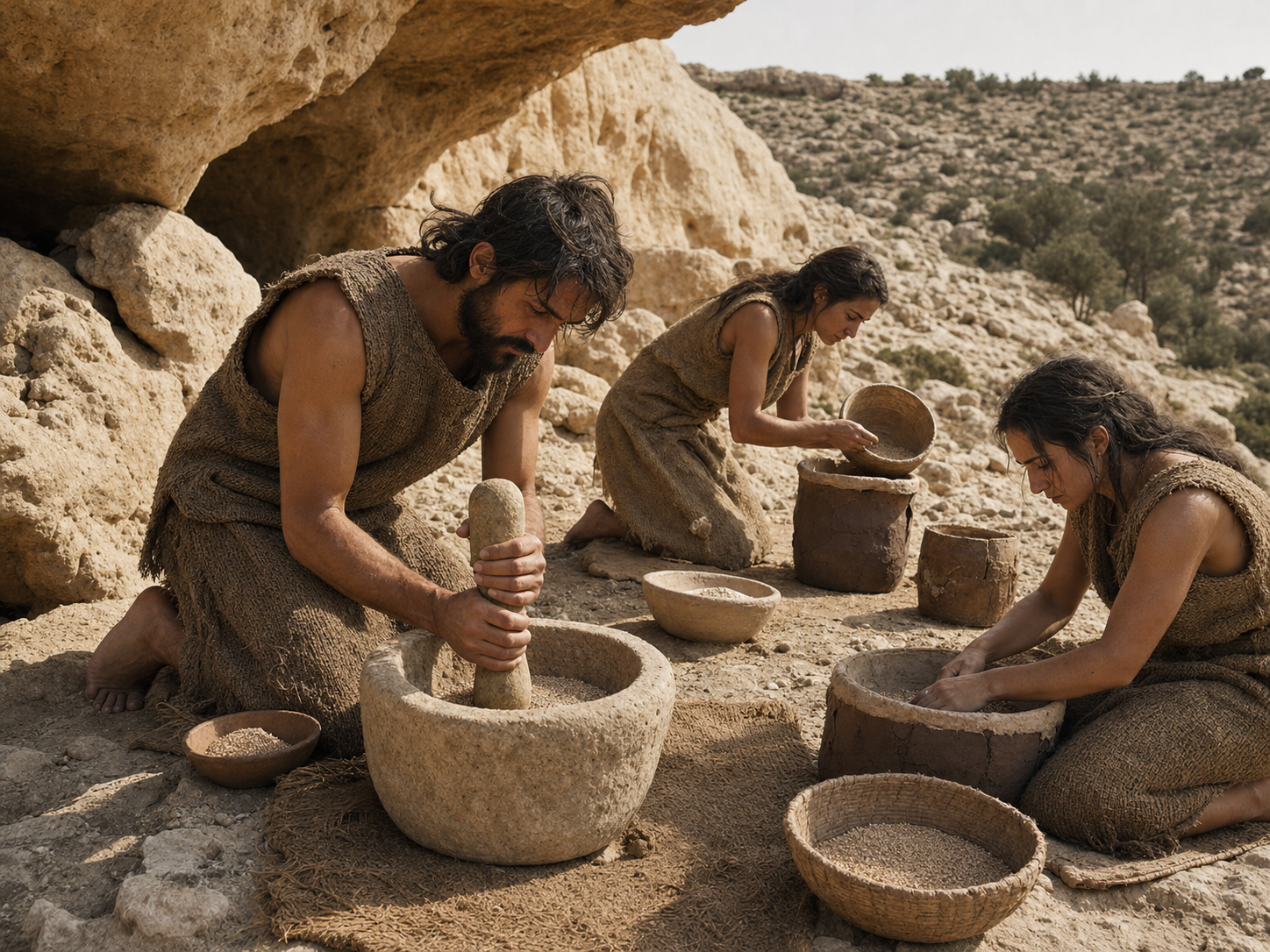
Solomon Katz and Mary Voigt asked that question in 1986 and offered a deliberately disruptive answer: perhaps grain cultivation was driven not only by bread, but by beer. The "beer before bread" idea remains a hypothesis, not a verdict. Still, it survives because it explains more than it first appears to. Fermentation changes grain in ways that matter to real human lives. It can improve nutrient availability, add B vitamins, produce lysine through yeast activity, and turn a dry staple into something caloric, storable, shareable, and mildly intoxicating. Bread feeds. Beer feeds, binds, and persuades people to come back tomorrow.
That last part matters. Civilization is not built by invention alone. It is built by repetition. A technique survives when it solves several problems at once, and beer did exactly that.
Early beer was not a crisp pint with a foamy head. It was thick, cloudy, lightly alcoholic, and often closer to liquid grain porridge than to what now fills a glass at the pub. In some places it was probably sweet, fruity, and sour at once, built from grain but often enriched with ingredients such as dates or honey that would have made it taste less alien to ancient drinkers than it does to us. That matters because the modern idea that beer must first be endured before it is enjoyed is mostly an anachronism imported from bitter modern styles. Some cultures drank it through long straws, not as a ritual flourish, but as a practical way to filter out suspended grain and yeast solids. Yet primitive does not mean pointless. Brewing made water safer not because alcohol alone sterilized it, which is an overstatement, but because the brewing process combined heating, fermentation, acidity, and later preservation methods into something less risky than untreated water in dense settlements. Beer was also nutrition in liquid form: calories, carbohydrates, vitamins, yeast, and in some societies a major part of daily labor rations.

It also carried something harder to quantify and easier to underestimate: social force. Robin Dunbar's work on bonding has argued that alcohol engages some of the same endorphin systems involved in laughter, singing, and communal ritual. A 2025 study in Humanities and Social Sciences Communications found a positive relationship between alcohol use and greater political complexity in early societies. Correlation is not destiny, but the pattern fits what archaeology and history have long implied. Beer was not just consumed by groups. It helped make groups feel like groups.
This helps explain why beer appears so early in ritual settings. At Raqefet Cave, the brewing evidence was tied to a burial context. Beer was present not at the margins of life, but at the scene of death and ceremony. Later cultures made the connection explicit. In ancient Egypt, beer appeared in religious festivals and funerary practice. In Sumer, brewing belonged under the protection of Ninkasi, the goddess of beer. The famous Hymn to Ninkasi is often described as the world's oldest beer recipe, though that claim needs restraint. It is better understood as possibly the oldest brewing instruction: a text that clearly describes brewing activity, even if scholars disagree on exactly how literal or practical it was.
By the third millennium BC, beer had already moved from ritual substance to organized system. The clearest symbol of that shift is Abydos in Egypt, where archaeologists identified what is currently the oldest known industrial brewery. Dating to around 3000 BC, the site contained eight large production units with a combined output estimated at roughly 22,000 liters per batch. That is not household brewing. That is logistics.
Beer entered administration just as quickly. Cuneiform tablets from Mesopotamia record beer as wages and rations. In Egypt, archaeologists have found bakeries and breweries operating side by side near major labor sites. The popular claim that the builders of the pyramids drank four or five liters a day is shakier than it is often presented, but the broader point is secure: beer belonged to the labor economy. It was fuel, compensation, hydration, and routine all at once. Once a society is paying workers in beer, beer is no longer a curiosity. It is infrastructure.
That scale did not erase beer's domestic roots. For most of brewing history, women were central to the craft. From ancient Mesopotamia through much of medieval Europe, women were the primary brewers, tavern keepers, and small-scale beer sellers. In England they were known as brewsters. In Sumer, women could own taverns. Brewing belonged to the household economy long before it belonged to industrial capital.
The later masculinization of brewing was not a natural technological upgrade. It was a legal and economic takeover. As brewing became more commercial, more regulated, and more profitable, women were edged out by guild systems, municipal rules, and shifting property arrangements. The familiar image of the witch may even preserve a distorted memory of the female brewer: the tall hat for visibility in markets, the broom as a sign, the cat to protect grain from rats. That should not be flattened into a single-cause explanation for witch hunts, but the overlap is revealing. A visual language associated with working women could be turned, under pressure, into a language of suspicion.
If the social history of beer is about ownership, the technological history is about control. For most of brewing's existence, people were managing processes they did not really understand. They could malt grain, heat mash, skim foam, reuse yeast from a previous batch, and judge a brew by smell, taste, and memory. But they did not know why one batch worked and another soured.
The long breakthrough came in stages. Hops gradually displaced gruit, the herbal mixtures once used to flavor and preserve beer, because hops were better at stability, bitterness, and bacterial suppression. The Bavarian purity law of 1516, later known as the Reinheitsgebot, tried to standardize what belonged in beer, though it famously omitted yeast because brewers still did not grasp its role. In the nineteenth century, Louis Pasteur recast fermentation as a biological process rather than a chemical accident. Then came one of the most consequential acts of scientific generosity in food history: Emil Christian Hansen at Carlsberg isolated the first pure yeast culture used in commercial brewing in 1883 and chose not to patent it. Modern brewing became more consistent not because brewers suddenly became artists, but because they finally gained reliable control over invisible life.

That may be the deepest continuity in the entire story. Brewing began as an encounter with forces no one could see: starch becoming sugar, wild yeast taking hold, time doing its quiet work. Over millennia, beer became a way of taming those invisible forces and putting them to use. First in mortars at a burial cave. Then in temple economies, wage systems, taverns, monasteries, guild halls, laboratories, and factories.
So was civilization's first great project beer? Put that too bluntly and it sounds like a gimmick. Put it more carefully and it becomes hard to dismiss. Before people could explain fermentation, they were already organizing around it. They were returning to it, improving it, scaling it, ritualizing it, and eventually building institutions around it. The wheel helped people move. Beer may have helped give them a reason to gather, stay, and build.
That is the more interesting claim anyway. Not that civilization was drunk into existence, but that one of its earliest durable achievements was learning how to make cooperation taste good.
Sources
Origins and Archaeological Evidence
- Li Liu et al. — Raqefet Cave brewing evidence (ScienceDaily, 2018) — Primary evidence for fermentation predating agriculture by roughly 3,000 years
- Solomon H. Katz and Mary M. Voigt — "Bread and Beer" (Expedition, 1986) — Original formulation of the beer-before-bread hypothesis
- Princeton University / Deborah Vischak — Abydos brewery discovery (2021) — World's oldest known industrial brewery, dating to circa 3000 BC
Social Bonding and Political Complexity
- Robin Dunbar, University of Oxford — Alcohol and social bonding (2017) — Endorphin-based mechanism linking alcohol consumption to group cohesion
- Humanities and Social Sciences Communications (2025) — Alcohol use and political complexity — Statistical relationship between early alcohol use and societal organization
Administrative Records
- Cuneiform Digital Library Journal (2012) — Mesopotamian brewing and ration records — Cuneiform evidence for beer as wages and administered commodity
Technological Mastery
- Carlsberg Group — Emil Christian Hansen and the pure yeast culture (1883) — The isolation of the first commercial pure yeast strain and Hansen's decision not to patent it