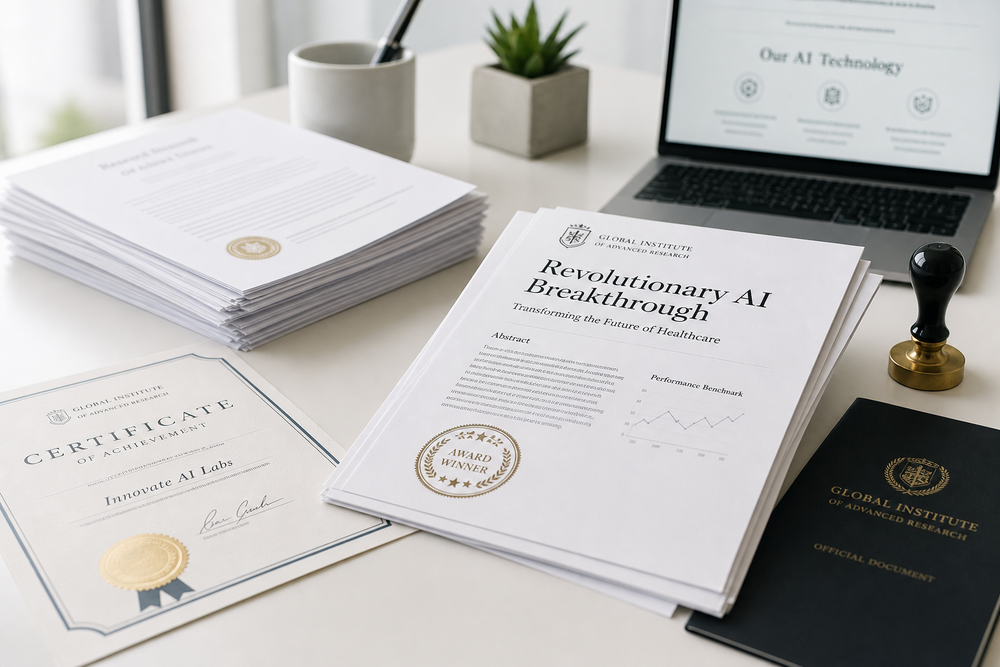
When AI Marketing Cosplays as Science
The modern snake-oil salesman rarely arrives in a wagon. He arrives with a theory page, a digital object identifier (DOI), and a vocabulary that sounds expensive.
You do not need to understand every layer of an AI system to notice when a company is selling science-shaped confidence rather than publicly testable results.
That is worth saying plainly because the public conversation about AI fraud, hype, and overclaiming often gets stuck in the wrong place. It assumes the hard part is the technology. Sometimes it is. But often the easier question comes first: does this claim behave like science, or does it mainly dress like science?
Real technical breakthroughs usually become narrower as they become more serious. The promise gets more precise. The task boundary gets clearer. The testing conditions get stricter. The caveats multiply. That is what honest engineering looks like under scrutiny.
Pseudoscientific AI marketing tends to move the other way. The language gets bigger. The theory gets grander. The institutional packaging gets heavier. The independent verification gets thinner. What you are left with is an asymmetry: maximum rhetorical ambition, minimum external control.
That asymmetry is the real tell.
The white-lab-coat trick, updated for AI
Old-fashioned pseudoscience used props. Lab coats. Charts. Brass instruments. The point was not to prove the claim. The point was to borrow the visual authority of proof.
The twenty-first century version is tidier. A vendor now has other props available:
- a named law or proprietary theory - a dense cloud of interdisciplinary jargon - a journal-looking publication with a DOI - an institute, board, or college in the background - status markers that sound like accreditation even when they are not
None of these things is damning on its own. A real paper can have a DOI. A legitimate system can rely on unusual theory. A small publication is not automatically nonsense. The problem appears when all of these cues point upward while the underlying evidence stays stubbornly hard to inspect.
Then the form of science starts doing work the substance has not yet earned.

Five signals that deserve a second look
You do not need to become a full-time skeptic to read AI claims more intelligently. A short checklist is enough.
1. The theory is bigger than the test
One warning sign is the grand private framework: a named law, principle, or cross-disciplinary theory that appears to explain a remarkable amount. Again, that is not automatically unserious. Science has always needed theory.
But theory earns its keep by cashing out into a narrow, falsifiable statement. What exactly does the system do better? On which task? Compared with what baseline? Under what failure criterion?
If you finish reading the pitch and still cannot reduce the claim to one concrete sentence that someone else could test, the theory may be functioning less as explanation than as prestige architecture.
2. The jargon multiplies faster than the evidence
Biophysics. Cybernetics. Information physics. Entropy. Negentropy. Systems theory. Viability. Complexity. Emergence.
Every one of those words has a legitimate home somewhere. The problem starts when they arrive in a pile that never resolves into a public measurement claim. The effect is familiar: the reader is meant to feel that something profound must be happening because the language comes from many serious places at once.
That is not proof. It is often just atmospheric pressure.
3. The claim is enormous, but the public testing is tiny
The bigger the promise, the less polite you should feel about asking for independent evidence.
If a vendor claims not merely that its system helps with a task, but that it uniquely evaluates other AI systems, avoids structural failure modes, or operates from a deeper law of functionality, then the evidence burden goes up sharply. That does not require public source code. It does require something more substantial than prose, internal reference loops, or broad assurances.
Exceptional claims do not become credible because they sound confident. They become credible because outside parties can check them.
4. Scientific form is standing in for scientific validation
A DOI is not peer review. A journal layout is not rigorous criticism. An issue number is not independent replication.
This should not be a controversial sentence, yet it often needs repeating because fringe or weakly validated claims routinely borrow the visual grammar of scholarship. Volume numbers, editorial language, citations, and institutional branding all help create the sensation that the hard epistemic work has already been done.
Sometimes it has. Sometimes it has not. The point is that form alone cannot answer the question.
5. Registration, recognition, and accreditation start melting into each other
This is one of the oldest tricks in institutional marketing: place several different status markers close together until the reader remembers only the aura.
A legal registration is not a quality judgment. A listing in a provider register is not an endorsement. A niche professional affiliation is not the same as broad academic recognition. But in marketing copy, these categories often drift toward each other until they produce a fog of implied legitimacy.
When that happens, read the nouns carefully. The difference between “exists,” “is listed,” and “is independently validated” is doing more work than the prose wants to admit.
Why Cassandra makes a useful case study
This matters in the abstract, but it becomes easier to see in public examples. Cassandra is useful not because it is the only case of ambitious AI marketing, and not because one product can summarize a whole industry, but because it puts several of these signals in one place.
Publicly, Cassandra is presented through Sustenance4all as a system for evaluating man-made systems through a framework that draws on biophysics, cybernetics, and information physics. The site says the system uses VanCampen's Law to analyze entropy and negentropy and describes it as “uniquely equipped” to evaluate outputs from other AI systems for feasibility constraints and malfunctions.
That is not a modest use-case claim. It is a claim about superior judgment. More specifically, it is a meta-claim: this system can assess other systems through a proprietary theoretical lens that supposedly reveals what others miss.
At that point, the natural journalistic question is not “Do I personally like the tone?” It is: what public evidence matches a claim of that scale?
The publicly visible support looks thin relative to the ambition. What is easy to find is the marketing layer, the theory layer, and the publication layer. What is not easy to find is a strong independent evaluation layer: reproducible tests, external benchmarking, or a clear public protocol showing why this system should be trusted to escape the ordinary failure modes of AI assessment.
That does not prove the system fails. It proves the burden of proof has not been met in public.
The closed circle problem
VanCampen's Law is part of why this case is so instructive. The theory is named after its author. The author is publicly tied to the surrounding organization. The theory is used to support the product's positioning. The product, in turn, points back toward the theory.
That arrangement does not automatically invalidate the idea. Many ideas begin in a small circle. But it does create a closed legitimacy loop, and closed loops are precisely where outside verification matters most.
If an exceptional framework mostly circulates inside its own ecosystem, then the reader should become more interested in adoption, criticism, replication, and adversarial testing beyond that ecosystem. Without those, the theory may still be sincere, but sincerity is not the same thing as scientific standing.

Prestige without enough proof
The publication context matters for the same reason.
VanCampen's Law appears in IPI Letters, complete with the formal signals many readers associate with academic seriousness: a title page, issue structure, DOI conventions, and institutional styling. That appearance is real. It exists. The question is what it proves.
The answer, based on the broader context of the publication environment, is: not nearly enough on its own.
The wider mix of material associated with the same environment includes topics that should make any cautious reader slow down before treating the venue itself as a strong proxy for validation. That does not mean every piece in that orbit is false. It means the venue's formal appearance cannot carry the full evidentiary weight of an unusual AI claim.
This distinction matters because a lot of weak technical marketing survives on a simple substitution:
scientific appearance in place of scientific resistance.
The real test of a serious claim is not whether it can be published somewhere that looks official enough. It is whether the claim can survive contact with independent parties who have no stake in preserving the aura around it.
The status-slide problem
The Warnborough layer of this story is useful for a different reason. It shows how institutional language can accumulate authority by blurring categories the reader may not think to separate. It belongs here because the product claim is not standing on its own; it is surrounded by status language that can lend borrowed credibility to the wider package.
On its own materials, Warnborough College says it is accredited by government-recognized bodies and then lists organizations including the UK Register of Learning Providers. But the UKRLP's own FAQ is explicit about what the register does and does not mean. It is not an endorsement or accreditation, and it is not meant to be used for assurance purposes. Registration mainly confirms that a learning provider exists as a legal entity.
That difference is not a technicality. It is the whole point.
Once a register that disclaims quality assurance appears inside a cluster of status language about recognition and accreditation, the reader is invited to carry more confidence away from the sentence than the underlying institution actually grants.
Companies House adds another useful note of realism. A company listing can tell you that an organization exists, what type of entity it is, and under which classification it operates. It does not certify educational quality or public scientific credibility. It is a legal and administrative fact, not a scholarly verdict.
That is why these status signals belong in a reader's checklist. They often do not lie outright. They simply sit close enough to stronger words that the marketing implication outruns the plain meaning.
What to do instead of being impressed
The practical lesson is refreshingly simple.
When you meet an AI breakthrough claim that arrives wrapped in theory, publication form, and institutional texture, ask five questions:
1. What is the narrowest testable version of this claim? 2. Who verified it besides the people selling it? 3. Which status markers are actually quality judgments, and which are just registration or affiliation facts? 4. Does the theory clarify the measurement, or only decorate it? 5. If the claim were false, where would that become publicly visible?
Those questions do not require cynicism. They require ordinary evidential discipline.
The previous Schrijfhuis article on so-called “hallucination-free AI” argued that reliability language often outruns technical reality. This case sits one layer higher. It is less about model architecture than about credibility theater: how science can be imitated rhetorically and institutionally long before it is matched methodologically.
That is why pseudoscientific AI marketing is not just a technical nuisance. It is a literacy problem. The target is not only the investor or the engineer. It is the ordinary reader who has been trained to equate a scientific tone with scientific accountability. That is a cousin of the pattern described in The Invisible AI: authority rises when a system recedes behind a calm, professional surface.
Real breakthroughs ask to be checked. They may be bold, but they become more legible under scrutiny.
Pseudo-breakthroughs often ask for something else. They ask whether the theory sounds advanced, whether the institution sounds respectable, whether the publication looks formal, whether the vocabulary feels bigger than your hesitation.
In that sense, the oldest warning still applies.
Real breakthroughs ask for independent scrutiny. Pseudoscientific breakthroughs mostly ask whether you are impressed.
Sources
Case study materials
- Sustenance4all Cassandra page — Public-facing product page describing Cassandra and its claims.
- VanCampen's Law landing page — Landing page for the theory cited around Cassandra.
- VanCampen's Law PDF — Full text of the paper associated with the product's theoretical framing.
- IPI Letters, Vol. 2 Issue 3 — Publication context referenced in the article.
Institutional status references
- Warnborough About Us — Marketing language around accreditation and recognition.
- UKRLP FAQ — Clarifies that UKRLP is not accreditation or assurance.
- Companies House: Warnborough College Limited — Corporate registration record.
- University Observer, 23 September 2008 — Historical reporting cited as context, not as a standalone verdict.