The Shroud of Turin: an archive of hands
A new genomics study of the Shroud of Turin generated headlines about ancient India. The paper says something more precise, and more interesting.
On 9 July 2026, Gianni Barcaccia and nineteen co-authors formally published a peer-reviewed study of DNA extracted from the official 1978 sample collection of the Shroud of Turin in Scientific Reports. An earlier version had circulated as a preprint and attracted media coverage months before — which is where the confusion begins. The paper is real. It uses a rigorous modern protocol, and its raw data are publicly available for independent re-examination. By the standards of ancient DNA research, it is careful work.
The headlines it generated were not careful. "DNA links Shroud to India," ran the shorthand. The actual finding points somewhere else entirely: the dominant human DNA profile in the samples matches the man who collected them in 1978.
That correction is not a reason to dismiss the study. It is, in fact, what makes the study worth reading.
PCR-free, and why that matters
The Shroud of Turin has been analysed before, with and without permission, by varying methods, with results that have fed argument for decades. What distinguishes the 2026 paper is not its subject but its technique. Where earlier Shroud DNA work relied on PCR — polymerase chain reaction (PCR), which selects and amplifies specific target sequences — Barcaccia's team used PCR-free shotgun sequencing on twelve aliquots from the 1978 official collection: linen filaments, vacuum-extracted dust, and one microscopic biological fragment.
The distinction matters because PCR amplifies differentially. Sequences that happen to be better preserved, or that match a primer by chance, get louder; everything else stays quiet. Shotgun sequencing reads, in principle, whatever is present in the library. It allows researchers to examine fragment lengths, damage patterns, and a much wider contamination landscape. The raw reads are deposited at the European Nucleotide Archive under project PRJEB88938 — an unusual step for Shroud research, and a significant one, because external analysts can now check the bioinformatics and the taxonomic assignments independently.
The dominant signal
The most telling result sits in the human mitochondrial data. The dominant profile — haplogroup K1a1b1a — corresponds to the mitogenome of Pierluigi Baima Bollone, the collector of the 1978 official samples. Relatedness analyses show three Shroud samples matching him or a first-degree relative. More than 98.3 per cent of reads carry low post-mortem-damage scores. The authors identify clear patterns of modern contamination throughout.
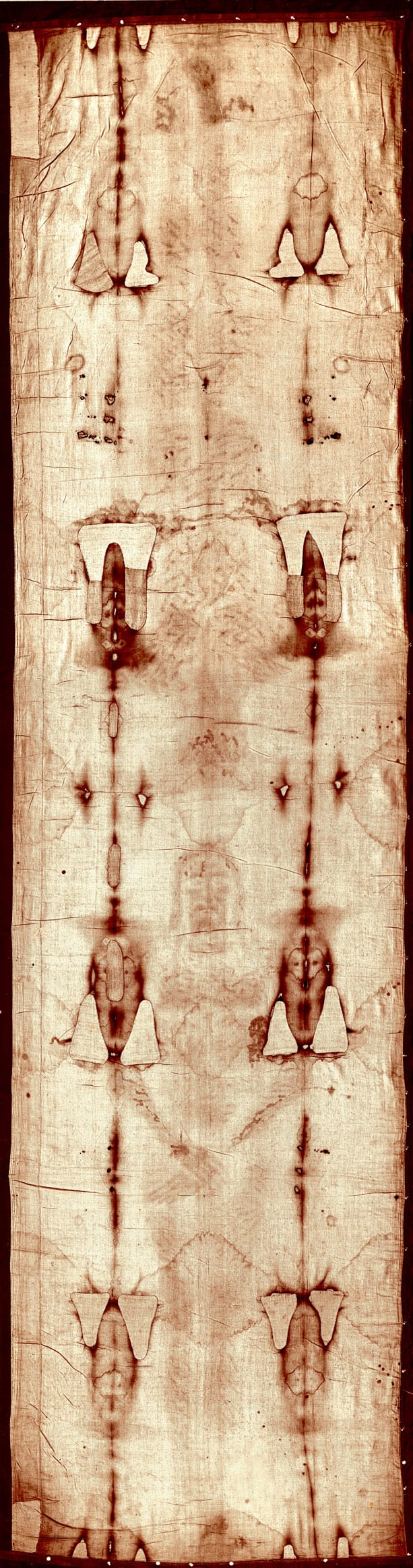
Their conclusion is unambiguous: the diversity of variants, the high degree of heteroplasmy, and the absence of ancient damage signatures make it impossible to isolate the Shroud's original human DNA.
This is not, the authors are careful to note, a failure of the method. It is the historical answer. The method looked at what was there and reported accurately: an object that has been revered, displayed, transported, repaired, stored, and repeatedly sampled over centuries has absorbed the molecular traces of everyone who touched it. The sequencer found the archive of hands.
Where the percentages actually come from
A separate question is why so many accounts attached specific numbers to the 2026 paper — 55.6 per cent Near Eastern, 38.7 per cent from the Indian subcontinent — that do not appear in it.
Those figures come from an earlier study: Barcaccia et al., 2015, also in Scientific Reports, same first author, very different method. That paper analysed a partly different set of particulates using PCR-amplified mitochondrial markers. It reported a distribution in which the majority of human amplicon data was linked to Near Eastern lineages, with the Indian subcontinent figures that have since circulated widely.
The 2015 authors were themselves careful about what their data could support. They flagged that recent contamination was highly probable, while also raising the possibility that certain haplogroups might reflect Indian-made yarn or linen. The caveat did not survive the summary cycle. By 2026, those numbers had quietly detached from their methodological context and were being cited as established fact.
The historical background behind the Indian hypothesis is not absurd on its face. Textile trade between South Asia, the Red Sea, Egypt, and the Mediterranean was extensive and durable. The Metropolitan Museum documents Indian cotton textiles from Gujarat recovered in thirteenth- and fourteenth-century Egypt: cloth did travel distances that modern national borders make seem improbable. A medieval linen with South Asian genetic traces is not geographically impossible.
But historical plausibility and forensic identification are not the same thing. A mitochondrial haplogroup found in heavily mixed dust from a much-touched object cannot establish where flax was grown, where thread was spun, or where a weave was completed. It establishes that someone with a particular matrilineal genetic ancestry contributed to that molecular mixture — at some point, in some capacity, in a chain that includes veneration, trade, storage, repair, and scientific sampling. "The Indian subcontinent" is also not a precise genetic category: it covers a vast range of populations with overlapping and divergent lineages, none of which map cleanly onto ancient textile routes.
The 2026 study's contribution, against this backdrop, is to shrink rather than validate that interpretive leap. It uses different official samples, locates the primary human signal in a known modern individual, and states explicitly that original DNA cannot be isolated. It does not support the 2015 percentages as a route map. It supersedes them — not because the 2015 authors were dishonest, but because better tools produce more accurate results, which sometimes means less certainty, not more.
A material biography
The metagenome is richer than the human fraction, and more instructive. Skin-associated bacteria, fungi, and halophilic archaea are present — the last of these reflecting storage conditions rather than geography. There is DNA from domestic animals, livestock, and cultivated plants. Several crop signals are worth pausing on: maize, potato, peanut, pepper, and banana are all Columbian Exchange species. Their presence is consistent with post-1492 contact, not with any ancient provenance story. An object frozen in the ancient world would not contain them. An object that has been handled, displayed, and stored in European settings across many centuries would.
Mediterranean red coral (Corallium rubrum) stands out among the animal contigs. The species is endemic to the Mediterranean basin and has been commercially and symbolically important for millennia — worked into jewellery, amulets, devotional objects, and medicinal preparations. A contact connection with Mediterranean material culture is plausible. But the coral signal carries no detectable ancient damage, and the routes by which it could have arrived are numerous: a rosary, a reliquary fitting, a conservator's tool, a visitor's ornament. The study's own authors place much of the biological diversity in recent-century contamination.
Two radiocarbon dates from threads in the reliquary are perhaps the most concrete data points for the Shroud's material history. They bracket 1451–1622 and 1642–1800. These ranges align with documented repair phases: after the Chambéry fire of 1532, repair work was conducted in 1534, and further conservation followed in 1694. The radiocarbon figures do not date the entire cloth; they date specific threads. But they do something useful: they connect molecular evidence to a known, documented material biography. The sequencer, at those coordinates, is reading a repair job that historical records also describe.
What a genuine genomic archive would require
Forensic genomics can read historical objects productively — but not as a magic origin scanner. A defensible origin claim requires a chain of custody per sample location, extraction and field blanks, ancient damage patterns confirming pre-modern deposition, reference profiles for every known handler and conservator, comparison with storage and restoration materials from the same periods, and independent replication by at least one other ancient DNA laboratory.
These requirements mirror the audit trail demanded by other forensic disciplines applied to historical objects. The attribution of works by Rembrandt has taken centuries of multi-method verification — dendrochronology, X-ray, infrared reflectography, pigment analysis — and still yields contested cases. Genomics applied to textiles faces a structurally similar challenge: accumulation of evidence across methods, not resolution by a single technique.
None of this is a criticism specific to the 2026 study. The authors identify these requirements themselves and note that their material — an object of very low biomass that has been touched by an enormous number of people across many centuries — presents forensic genomics with one of its hardest cases. The dataset is a beginning, not a verdict. The open deposit at the European Nucleotide Archive (ENA) is an invitation to continue, not a closing argument.
The practical implication for future work is straightforward, if laborious: systematic sampling across defined zones of the cloth and reliquary; swabs from storage textiles and restoration materials; provenance dossiers for every intervention; independent laboratory replication of core results. Only then can signals like red coral, halophilic archaea, or specific plant taxa be tentatively linked to particular phases of the object's life rather than to its full, undifferentiated history.
The question that gets more interesting
The headline version of this study — DNA proves ancient Indian origin — asks a question genomics cannot answer with this material. The study itself asks a better one: what can the molecular record of a much-touched object tell us about the history of its touching?
That reframing is not a consolation prize. It is a genuine expansion of what the discipline can contribute to the history of objects. A cloth that has been venerated, paraded, survived a fire, been repaired by nuns, displayed under controlled conditions, and sampled repeatedly by scientists carries a social history in its fibres. That history is not a clean origin story, but it is a real one — legible, partially, to instruments that previous generations of scholars did not have.
Forensic genomics is at an early stage of learning what historical objects are actually asking of it. The Shroud is an unusually clear case study because its documented life is so well attested: the fire is in the records, the repairs are in the records, the 1978 sampling protocol produced an official collection with named participants. When the sequencer's dominant human signal turns out to be the collector himself, that is not an embarrassment. It is the method working as it should — locating the most recent and abundant source of contamination in an object where contamination is centuries deep.
The lesson for how genomic findings migrate into public discourse is less comfortable. The percentages from 2015 found their way into 2026 coverage because they were striking, because they had a good story shape, and because the methodological gap between a PCR amplicon distribution and a linen origin claim is not visible at headline speed. That gap is precisely what the 2026 study makes legible, for anyone who reads past the abstract.
More resolution does not always produce more certainty. Sometimes it produces a more accurate picture of what cannot be known — and a clearer understanding of what the object has been, since the moment it first left the hands of whoever made it.
Sources
Primary study
- DNA signatures preserved in the official 1978 sample collection of the Shroud of Turin — Barcaccia et al., Scientific Reports 16, 21206 (2026) — The peer-reviewed 2026 study using PCR-free shotgun sequencing; includes raw data at the ENA
- European Nucleotide Archive, project PRJEB88938 — Raw sequencing data deposited for independent replication and reanalysis
Comparative study
- Uncovering the sources of DNA found on the Turin Shroud — Barcaccia et al., Scientific Reports 5, 14484 (2015) — PCR-based predecessor study whose haplogroup percentages entered wide public circulation
Historical and archaeological context
- Made in India, Found in Egypt: Red Sea Textile Trade in the Thirteenth and Fourteenth Centuries — Metropolitan Museum of Art — Documentation of pre-modern South Asian textile routes to the Mediterranean basin
Methodology
- Touching the (almost) untouchable — Hauenstein et al., International Biodeterioration & Biodegradation (2023) — Contamination analysis of relics and historical objects via metagenomic sequencing
- Re-inventing ancient human DNA — Llamas et al. (2017) — Methodological standards for ancient DNA research, including authentication criteria
Media coverage
- Shroud of Turin contaminated with carrot and red coral DNA — Live Science (5 April 2026) — Reporting on an earlier preprint version, ahead of formal journal publication on 9 July 2026; includes independent commentary by Andrea Nicolotti