The Return of Handwriting
Why writing by hand matters more when machines can write too
For years, the story seemed settled. Screens would absorb the work of writing. Keyboards would outcompete pens. Paper would remain only where bureaucracy or sentimentality had not yet caught up with reality. If handwriting survived at all, it would survive as a quaint residue.
That is not what happened.
Handwriting did not beat digital writing on speed, convenience, searchability, or scale. It lost on all of those fronts. Yet in 2026 it is hard to argue that writing by hand has simply faded into irrelevance. Premium notebooks remain culturally visible. Journaling systems continue to spread. Writing instruments still support large global businesses. Researchers continue to find that writing by hand changes how people process information. And in the age of generative AI, handwriting has picked up an additional charge: it can serve as evidence of human presence.
That is the stronger way to understand its return. Handwriting is not coming back as a more efficient production tool. It is becoming more valuable as a counter-form inside a culture saturated with digital text and AI-generated prose. The less friction there is in producing words, the more meaning that friction itself can carry.
The market never behaved like a dying medium
The first thing to avoid is overstatement. This is not a story about everyone suddenly buying fountain pens again. But it is also not a story of straightforward decline.
Commercial market reports, which should always be handled carefully, still point in the same direction: writing instruments remain a large and growing category. Grand View Research estimates the global writing instruments market at $19.2 billion in 2025 and $20.0 billion in 2026, with further growth projected through 2033. The Business Research Company places the luxury writing instruments and stationery market at $4.33 billion in 2025 and $4.53 billion in 2026. Those are secondary commercial estimates, not final authorities, but they are useful for one corrective point: the old digital script, in which handwriting-related products were supposed to sink into economic irrelevance, does not fit the market picture especially well.
The language of manufacturers tells a similar story. Pilot, one of the largest names in the category, reported FY2025 consolidated net sales of 126,391 million yen and continues to describe writing instruments as a core global business. That does not prove a romantic mass return to analog writing. It does show that a major company does not treat the field as a historical leftover.
The premium notebook and planner world is harder to quantify exactly because some of its most visible brands are private. Leuchtturm1917 does not publish the kind of public revenue detail that would make for neat headlines, and Rhodia sits inside broader corporate structures. Still, what is publicly visible is hard to miss: line extensions, special editions, Bullet Journal collaborations, planner formats, personalization, a persistent emphasis on paper quality and writing experience. These are not the moves of a culture preparing for disappearance.
The deeper point is that pens and notebooks no longer live or die by office efficiency alone. If the only question were whether paper beats software at productivity, the argument would already be over. Their contemporary value comes from different functions: concentration, ritual, pleasure of use, gift value, aesthetic value, and the experience of thinking through a material object rather than through a pre-built interface.
Slowness can be productive
That shift is one reason the cognitive science around handwriting continues to matter. The famous 2014 study by Pam Mueller and Daniel Oppenheimer became memorable because it offered a satisfying reversal: students taking notes on laptops could record more, but often performed worse on conceptual questions than students writing by hand. The proposed explanation was not mystical. Typing made verbatim capture easier. Handwriting made compression and reformulation harder to avoid.
Popular retellings turned that into a slogan, and slogans tend to flatten the evidence. Not every later study finds the same effect in the same way. Context matters: the class format, the subject, what students do with their notes later, the role of distraction, and the simple fact that different learners work differently.
Still, the broader picture has held up better than the skeptics sometimes imply. A 2024 meta-analysis in Educational Psychology Review, covering 24 studies, concluded that handwritten notes were associated on average with higher learning outcomes among college students, even though typed notes produced more volume. That is a useful distinction. Typing wins on speed. Handwriting may win, on average, on the kind of processing that turns information into something closer to understanding.
Neuroscience adds another layer, though it too needs restraint. A 2024 study by Ruud van der Weel and Audrey van der Meer reported more widespread brain connectivity during handwriting than during typing in their experimental setup. The plausible interpretation is not that keyboards damage thought. It is that handwriting recruits a different package of attention, motor control, visual recognition, and sequential coordination. Writing by hand asks the body to participate more explicitly in the making of text.
That matters because slowness is not always waste. In some contexts, slowness is the mechanism. A keyboard allows near real-time transcription. A pen makes that harder. It forces choosing, trimming, reformulating. In a culture that tends to reward maximal output, that kind of drag can become cognitively useful.
The notebook as anti-app
The cultural story looks similar. People are not choosing handwriting in 2026 because they have failed to discover better software. They are choosing it because software comes with assumptions built in.
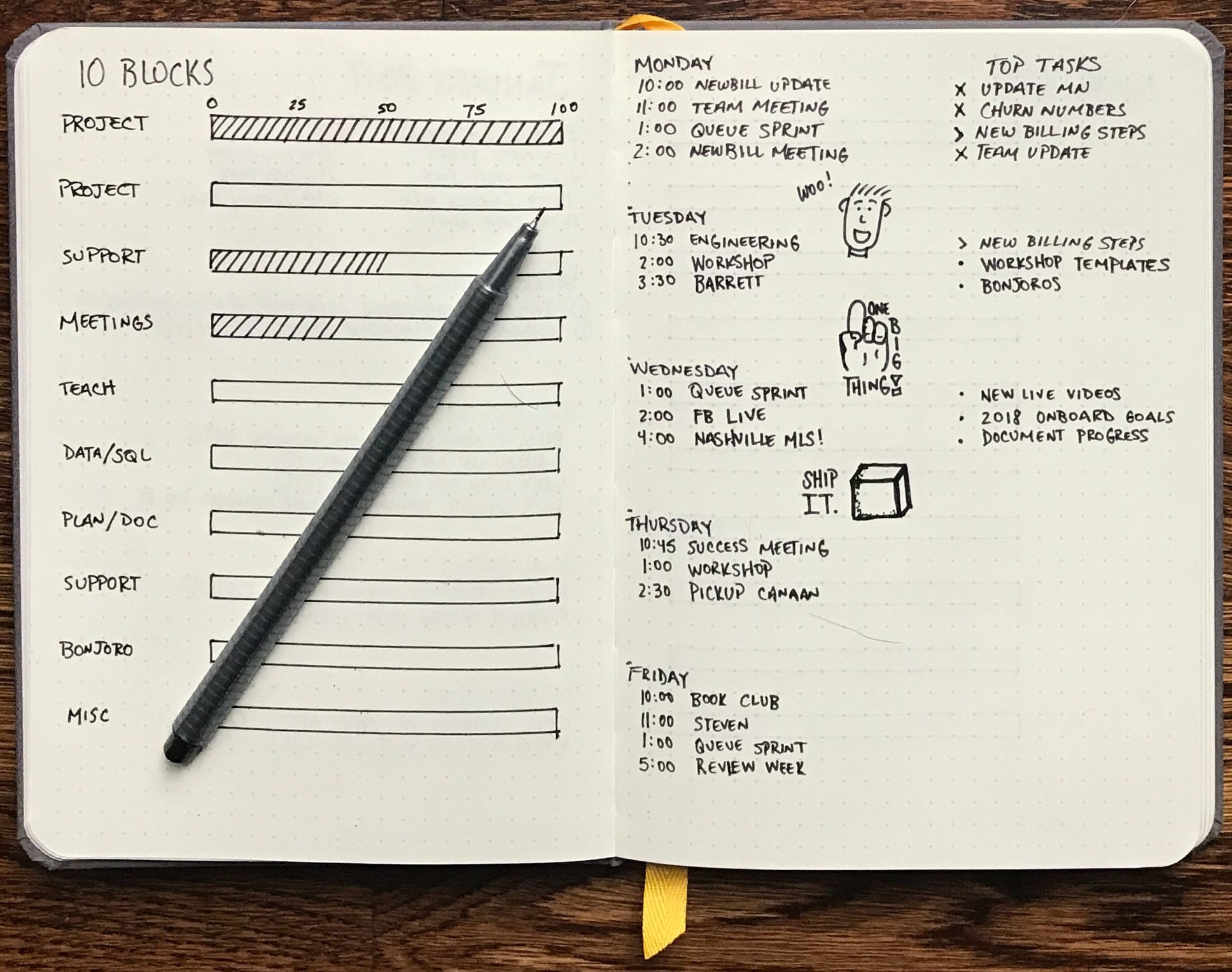
Bullet journaling makes this unusually clear. Its own creators call it an analog method for the digital age. The phrase risks sounding like marketing until you notice what it gets right. A notebook does not just store information. It lets a person build a personal system without accepting the logic of someone else's app. Layout, sequence, emphasis, mess, revision, dead ends, symbols, fragments: all of it remains negotiable.
That freedom matters in a culture of optimization. Screens are excellent at standardizing behavior. They sort, remind, sync, autocomplete, search, and smooth away irregularity. Those are often real advantages. They also make it harder to feel the shape of your own attention. A notebook is less powerful in the computational sense and more permissive in the human one. It does less for you. That is exactly why some people want it.
The same is true of the visible effort embedded in handwriting. A handwritten note, letter, card, margin annotation, or journal page carries not only a message but also a trace of labor. It shows hesitation, pressure, correction, pacing. In an era of copy-paste and prompt-generated polish, that trace acquires cultural weight. The point is not that handwriting is pure while digital writing is fake. The point is that handwriting leaves evidence of time spent and attention paid.
This helps explain why premium stationery culture is not merely decorative. The appeal of a Leuchtturm notebook, a Rhodia pad, or a carefully chosen pen is not reducible to luxury fetishism. These objects sit at the intersection of use and self-formation. They do practical work, but they also help stage a relation to thought: slower, more intentional, less pre-programmed, more visibly owned.
New media rarely kill old writing practices outright
History offers a useful corrective to the usual extinction narrative. Handwriting has already lived through several revolutions that were supposed to make it obsolete.
The printing press did not eliminate it. As the historian Ann Blair has shown, early modern Europe was in many ways a great age of note-taking. Print expanded the supply of text, but that only increased the need for excerpting, annotating, copying, sorting, and building personal knowledge systems on paper. Mechanical reproduction took over large-scale duplication. Handwriting remained the place where readers selected and processed what mattered.
The typewriter did something similar. It captured domains where uniformity, speed, and legibility mattered most: office work, formal documents, professional correspondence. But even there it did not abolish handwriting so much as narrow its role. Notes, drafts, signatures, private correspondence, annotations, and the visible mark of personal presence stayed behind.
The computer accelerated the shift by making text production even easier and more fluid. But that, too, changed handwriting's function more than it erased it. Each new writing technology tends to absorb the tasks where scale and standardization matter. What remains for handwriting are the domains where thinking-in-motion, intimacy, improvisation, and bodily trace still count.
That is why the contemporary revival should not be described as a miraculous comeback from the dead. Handwriting never disappeared. What changed is the meaning of using it on purpose.
AI sharpened the question of presence
Generative AI did not create this shift. Premium notebooks, journaling systems, and analog planning cultures were already well established before ChatGPT. But AI has intensified the symbolic force of handwriting in a striking way.
One concrete sign comes from education. In June 2025, Inside Higher Ed published a detailed account of professors returning to handwritten assignments and in-class writing as one response to AI-assisted cheating. What matters there is not nostalgia. It is verification. Who actually wrote this? Where is the thinking visible? What makes a piece of writing harder to outsource?
That institutional change points to a broader cultural one. When smooth, plausible prose can be produced instantly by a machine, text itself becomes less reliable as evidence of effort. The bottleneck shifts. The question is no longer only whether the sentence exists, but what kind of trace the making of that sentence leaves behind.
Handwriting answers that question differently from typing. It does not just deliver words. It records pace, interruption, correction, and pressure. It is not impossible to imitate or fake, of course. But it is more resistant to frictionless automation, and that alone changes its symbolic role. In an AI-saturated environment, the value of handwriting lies partly in its inefficiency. It is harder to outsource, harder to mass-produce, and harder to confuse with an effortless surface.
That may be the central paradox of the whole story. AI makes text cheaper. Handwriting makes authorship more tangible. The old prestige of writing came partly from the difficulty of producing clean, coherent text at all. As machines absorb more of that difficulty, the difficulty that remains becomes newly visible elsewhere: in selection, patience, presence, and the willingness to move thought through the body rather than around it.

What returns is not the old order
So no, handwriting is not marching back in as the default technology of everyday composition. It will not defeat the keyboard, let alone replace digital systems. That is the wrong frame.
What is returning is handwriting as a chosen practice. A notebook instead of an app. A page of notes instead of a transcript. A hand-written assignment instead of a seamlessly generated submission. A visible trace instead of a frictionless output.
The interesting thing about this return is that it is not anti-modern. It belongs to modernity's next phase. The rise of AI did not make handwriting relevant by accident. It made visible what handwriting had been conserving all along: slowness, selectivity, materiality, and the stubborn fact that some forms of meaning still depend on how a text came into being.
When words become cheap, the human trace inside them becomes expensive again.
Sources
- Grand View Research, "Writing Instruments Market Size & Trends" - Market size estimates for the global writing instruments sector.
- The Business Research Company, "Luxury Writing Instruments and Stationery Global Market Report" - Commercial market estimates for premium writing instruments and stationery.
- Pilot Corporation, FY2025 sales overview - Public sales reporting from a major writing instruments manufacturer.
- Pilot Integrated Report 2025 - Strategic positioning of writing instruments within Pilot's business.
- Pam A. Mueller and Daniel M. Oppenheimer, "The Pen Is Mightier Than the Keyboard" - Foundational study on handwritten versus laptop note-taking.
- K. E. Flanigan et al., 2024 meta-analysis in Educational Psychology Review - Meta-analysis on handwritten and typed note-taking outcomes.
- Ruud van der Weel and Audrey L. H. van der Meer, 2024, Frontiers in Psychology - Study on brain connectivity during handwriting and typing.
- Bullet Journal - Official framing of bullet journaling as an analog method for the digital age.
- Ann Blair, "The Rise of Note-Taking in Early Modern Europe" - Historical account of note-taking in the age of print.
- Public Books, "Is Handwriting History?" - Cultural-historical interpretation of handwriting's changing meaning.
- Inside Higher Ed, "The Handwriting Revolution" - Reporting on handwritten assignments as a response to AI-assisted cheating.