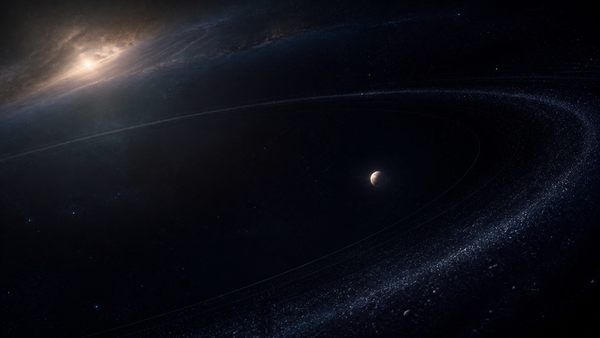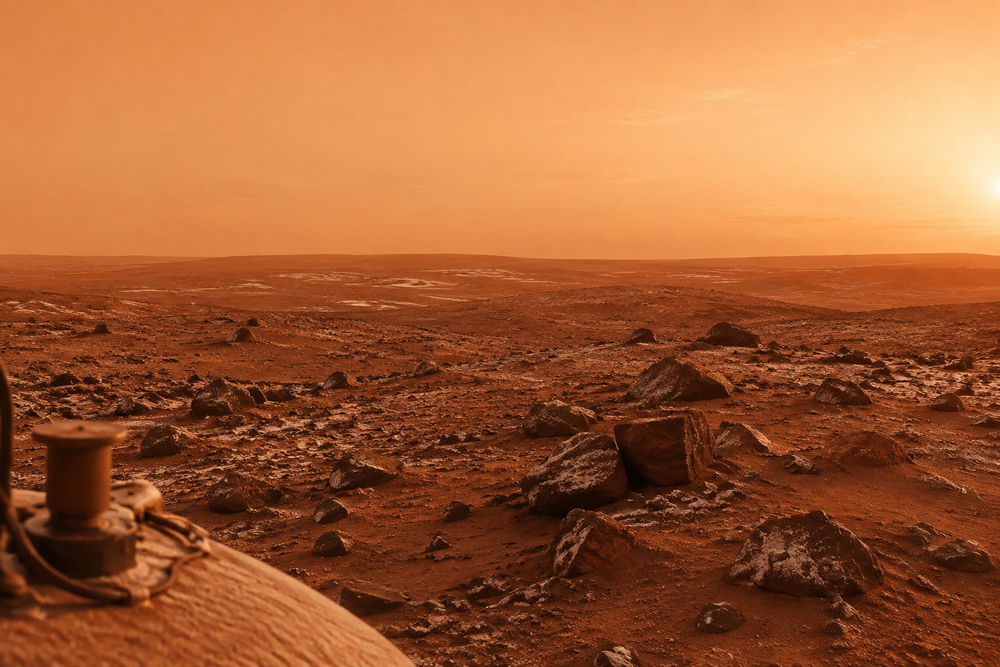
The experiment that left Mars unfinished
Viking 2 turns fifty. What it found — and didn't find — still shapes every mission looking for life.
On 3 September 1976, a machine touched down on Utopia Planitia. There was no audience. The closest human observer was nineteen minutes away at the speed of light, which meant that by the time mission controllers in Pasadena learned the lander had survived entry, the craft had already been sitting quietly on its tripod legs for the length of a short film. No one could have intervened at any point in the descent.
Viking 2 was the second act of an already remarkable mission. Its twin had landed six weeks earlier at Chryse Planitia, roughly 4,000 miles to the southwest. Scientists wanted two sites, partly for redundancy, mostly because one reading of a complex result is not a result — it is a reading. If both landers found the same thing, that carried weight. If they disagreed, both answers were data.
They did not disagree. That, in retrospect, is part of why a question posed in 1976 is still being asked in 2026.

What the biology lab was designed to ask
Viking's designers understood that they could not put a microscope on Mars and hope to see a microbe stroll past the lens. Life, if present, would be sparse, possibly unlike anything a camera would recognise, and definitively invisible at the scale of available imaging. What the landers could do was something cleverer and more indirect: ask whether the soil behaved like living soil.
Each lander carried three biology experiments and a separate Gas Chromatograph-Mass Spectrometer (GCMS) to hunt for organic molecules. The experiments did not look for organisms. They looked for the consequences of metabolism.
The Labeled Release (LR) experiment, designed by Gilbert Levin and Patricia Straat, worked like this: moisten Martian soil with a liquid nutrient solution laced with carbon-14-tagged organic molecules. If anything in the soil was eating — or doing anything resembling eating — it would release carbon dioxide or other gases carrying that radioactive label. The detector would see the signal. As a control, a second portion of the same soil was heated enough to kill any microorganism, and then tested. If the heated sample showed markedly less activity, the difference would point to something biological.
Both landers produced a rapid, reproducible signal. The heated controls showed far less response. Levin and Straat's 1976 paper in Science noted the available facts and carefully stopped short of declaring life detected. Their 1977 paper went further, stating that on Earth, an equivalent result would be interpreted as microbial activity.
The problem with the soil
The GCMS told a different story.
It analysed Martian surface soil and found no organic molecules. No amino acids, no simple carbon compounds, nothing. On Earth, even in the most hostile deserts, soil holds traces of organic chemistry — the detritus of life, or at least of organic chemistry brought in by meteorites. On Mars in 1976: nothing detectable.
This created a genuinely difficult interpretive problem. The LR signal could mean metabolism. Or it could mean reactive chemistry — an oxidising compound in the soil that, when wetted with nutrients, released gas without any organism involved. Mars's exposed surface is bombarded by ultraviolet radiation, cold, dry and chemically aggressive. It was plausible that something in the soil was reacting energetically with the nutrient solution without being alive.
The Gas Exchange experiment and the Pyrolytic Release experiment added further ambiguity: both produced intriguing initial activity, but the Pyrolytic Release signal compatible with photosynthesis could not be repeated. Without organic molecules detected by the GCMS, the Viking team and most of the scientific community concluded that a reactive, oxidising soil chemistry was more plausible than a Martian ecosystem. NASA's retrospective framing remains the same today: the evidence showed a conflict between instruments, not a clear biological signature.
This was not a cover-up, and it was not a settled question brushed under the carpet. It was a genuine scientific verdict based on the available evidence — held in the knowledge that the evidence was incomplete.
Levin's case: a minority view that earned its standing
Gilbert Levin did not accept the consensus. He maintained the biological interpretation for the remaining decades of his career, until his death in 2021. His argument was limited in scope but not without substance: the LR gave a repeated signal at two geographically separated sites; the heat controls behaved as they would if biology were present; no abiotic reaction has ever fully reproduced all observed LR flight data in a controlled setting.
His 2016 reassessment in Astrobiology pressed the same points. Levin was not a crank. He was a scientist defending an interpretation the field had not accepted, on the grounds that the counterargument had never been completely demonstrated either.
The story became more complicated in 2008, when NASA's Phoenix lander discovered perchlorate salts in Martian soil. Perchlorate is a highly oxidising compound that, when heated in the presence of organics, can destroy those organics and mimic certain chemical reactions. Critics of the original Viking GCMS conclusion — Levin among them — pointed out that if Martian soil contains perchlorate, the GCMS might have burned up organics that were actually there rather than detecting them.
This is a real complication, and it has to be stated precisely: perchlorate gives a credible reason why the GCMS might have missed organics that were present. It does not prove that organics were present. And it does not prove that the LR signal was biological. The disciplined conclusion, fifty years on, is that the Viking result remains genuinely disputed, and no later mission has rerun an equivalent metabolic test on undisturbed Martian material.
What Levin's persistence actually achieved was to keep a legitimate scientific question from calcifying into a closed case. The LR result is not explained; it is set aside by the weight of other evidence. Those are different things.
Fifty years changed the question
The missions that followed Viking progressively moved the search further back in time.
Mars Pathfinder, Spirit and Opportunity established that ancient Mars was geologically active and had been exposed to liquid water. Opportunity's years on the Meridiani plains found chemical signatures of standing water that had evaporated, leaving layered sedimentary rock behind. A Mars with liquid water in its past was a Mars that might once have been habitable. Might. That word acquired specific scientific meaning as the missions accumulated.
Curiosity made the distinction explicit. At Gale Crater, drilling into the Sheepbed mudstone, it found what geologists had been looking for: evidence that ancient Mars had liquid water that persisted long enough to deposit fine sediment, chemical energy sources available to microorganisms, essential elements, and organic compounds. Curiosity's team announced that ancient Gale Crater was habitable — meaning it had the conditions under which microbial life as we understand it could have existed.
Habitable does not mean inhabited. This is the rung that matters. Habitability is evidence of possibility; it says nothing about occupancy. The finding was genuinely significant. Mars had not always been the frozen, irradiated wasteland Viking observed. It had a window — perhaps a long one — when the chemistry was permissive.
Perseverance is exploring the next rung. At Jezero Crater, a dry lake bed with an ancient river delta, the rover has been drilling and sealing rock samples into titanium tubes. Its scientific purpose is not to announce a discovery on Mars but to collect the most carefully chosen, most carefully preserved samples for analysis on Earth, where laboratory instruments vastly exceed anything that can be carried to Mars and landed on a budget.
In 2025, a peer-reviewed study published in Nature supported NASA's description of the "Sapphire Canyon" sample from the Cheyava Falls rock as containing potential biosignatures. The organic compounds and structural patterns found were described as consistent with biological processes. They were also described as not yet distinguishable from non-biological chemistry by the instruments available.
Potential biosignature is the third rung, below life. It means the chemistry is suggestive enough to warrant serious investigation. It does not mean life has been detected. Any article that reports Perseverance found evidence of life has mistranslated the science.
What Viking's autonomy actually was
Because Mars was roughly nineteen minutes of radio travel from Earth during the Viking missions, there was no possibility of real-time guidance. When Viking 2 entered the Martian atmosphere, the controllers who had spent years designing its trajectory were receiving data from a point eighteen minutes in the past. By the time a signal arrived saying something had gone wrong, the lander had already handled it, or hadn't.
Viking's guidance, control and sequencing computers flew entry, parachute deployment, radar-guided terminal descent and landing from sensor input and preloaded programs. A 1977 NASA navigation paper describes this as autonomous onboard navigation. The stored sequences could manage the first 22 Martian days without requiring uplinked commands.
This was a genuine technological achievement and it should not be understated. But it should not be overstated either. Viking executed bounded, pre-validated logic — sequences designed, tested and transmitted by ground teams who had anticipated the conditions as closely as they could. The computer had an 18,000-word memory per channel. It was not forming hypotheses about its environment. It was not reasoning. It was following extraordinarily carefully designed instructions with enough local decision-making to handle a range of anticipated contingencies.
The comparison with modern Mars autonomy — Perseverance's on-board terrain navigation, Ingenuity's autonomous flight planning — is instructive precisely when the difference is kept clear. The constraint is the same: communication delay forces local action. The scope of what that local action can encompass has expanded by orders of magnitude. Viking's achievement was to prove the constraint was navigable. Fifty years of engineering has expanded what navigation means.
What remains open
Mars Sample Return is the proposed next step, and it is worth being honest about its status. Perseverance's sealed tubes exist; the retrieval-and-return architecture does not. NASA has been reassessing its plans under significant cost and schedule pressure, and the timeline is under revision. The samples are ready. The mission to retrieve them is not. Describing Mars Sample Return as a late-2020s certainty would misrepresent where things stand.
The James Webb Space Telescope contributes to the broader science of habitability — comparative planetology, atmospheric chemistry at other worlds — but it is not a sequel to Viking. It cannot look at Jezero Crater. It will not confirm or deny Martian microbes.
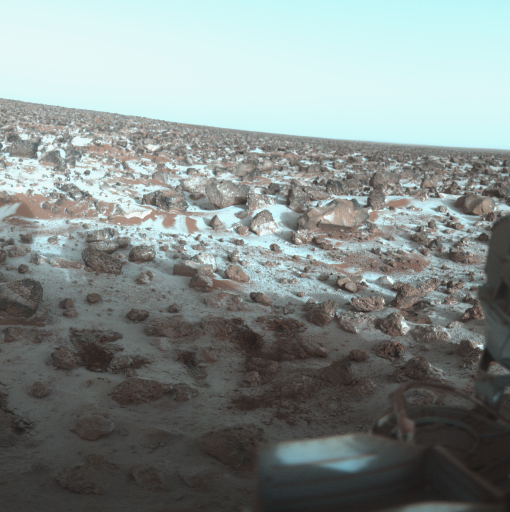
What Viking set in motion was a particular kind of patience. The mission asked whether current Martian surface soil would metabolise a meal. The answer was ambiguous enough to be discomfiting, and honest enough to be useful. Over fifty years, better instruments and bolder mission designs have narrowed the question from "is there anything alive on Mars today" to something more precise and in some ways more interesting: which ancient environments were hospitable, which rocks preserve the chemical record of those environments, and whether a chain of evidence — from geology to organics to isotope ratios to microscopic textures — can ultimately distinguish life from the chemistry that mimics it.
That is a harder question than Viking asked. It is also a more answerable one.
Utopia Planitia is still there. Viking 2 is still there too, silent since 1980, in terrain that has been photographed from orbit but never visited. The soil beneath it has never been retested with modern instruments. Somewhere in the tubes Perseverance has been sealing, there may be an answer to a version of Levin's question that is precise enough to resolve it.
The experiment is not finished. It changed premises.
Sources
Primary sources & mission documentation
- NASA, Viking Project and Astrobiology — overview of the mission and its biological experiments.
- NASA, Viking: 50 Years on Mars — retrospective and contemporary framing.
- NASA, Viking Encounter Press Kit (1976) — original mission documentation.
- Euler, E.A., Navigating the Viking landers, NASA NTRS (1977) — autonomous onboard navigation and sequencing.
Scientific literature
- Levin & Straat, Viking labeled release biology experiment: interim results, Science (1976) — original LR results from both landers.
- Levin & Straat, Life on Mars? The Viking labeled release experiment, Biosystems (1977) — extended interpretation of LR data.
- Levin et al., The Case for Extant Life on Mars, Astrobiology (2016) — Levin's 2016 reassessment defending the biological interpretation.
- NASA, Curiosity detects largest organic molecules found on Mars — Curiosity findings at Gale Crater.
Current missions & sample return
- NASA, The Mars Report: September 2025 — Perseverance sample results including Cheyava Falls biosignature findings.
- NASA, Perseverance and Mars Sample Return — current status of sample collection and retrieval architecture.