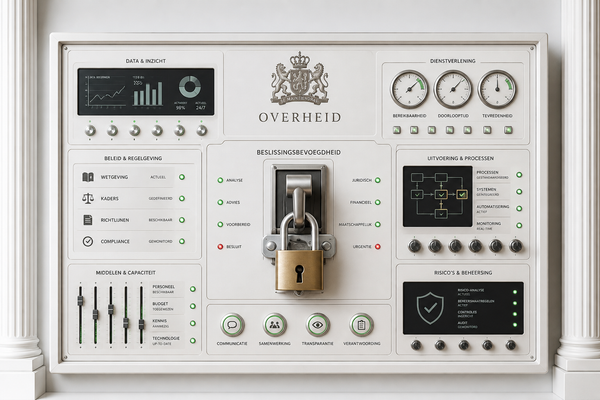
When AI Colleagues Need Managers Too
Multi-agent AI looks, at first glance, like a cheap way to add more intelligence to the room. The economics say otherwise.
Spawn four extra agents and the office metaphor starts to feel literal. There is a planner, a few specialists, a handoff, a trace, an approval gate, a final sign-off. On a product demo, this can look like a small miracle: one AI digs up sources, another summarizes, a third checks policy, a fourth drafts the answer. The manager model ties it all together and delivers something that feels broader and more competent than a single chat window.
But the magic trick has a price tag. Not just in tokens, though those matter. In supervision. In observability. In retries. In deciding which agent should own which part of the work, and in making sure someone, human or machine, is still accountable when the answer goes wrong.
That is the most useful way to understand multi-agent AI in July 2026. It is not free extra intelligence. It is a management structure. It becomes economically sensible only when the value of parallel work exceeds the cost of coordinating it. And that same logic tells us something larger about work itself: AI is not simply erasing jobs. In many places, it is pushing them upward, toward orchestration, verification, judgment, and responsibility.

The infrastructure finally caught up to the metaphor
One reason this argument lands more cleanly now than it did a year ago is that the infrastructure has matured. OpenAI's current Agents SDK no longer treats orchestration as a clever pattern developers improvise from scratch. It explicitly positions the SDK for workflows with repeated tool loops, branching specialists, sessions, tracing, guardrails, and resumable approval flows. The SDK now exposes orchestration primitives that make approval-gated, traceable workflows much easier to build than they were a year ago.
That matters because it shifts the conversation. The interesting question is no longer whether teams can build agent workflows at all. They can. The sharper question is what kind of managerial overhead the platform now expects to be normal. In higher-risk settings, that overhead increasingly includes the kind of approval gates agents cannot route around rather than soft prompt-level warnings.
Anthropic's production writeup on its own research system points in the same direction, but from the operator's side rather than the platform's. The architecture is straightforward: a lead agent coordinates subagents that search in parallel, each with its own local context, and then compresses the results back into a final synthesis. What makes the writeup useful is not that it celebrates multi-agent in the abstract. It does something rarer: it says where the pattern is worth it, and where it is not.
Anthropic says the gains are strongest on breadth-heavy research tasks that branch into multiple independent directions. It also says plainly that some shared-context or dependency-heavy domains are poor fits, and that many coding tasks do not parallelize as cleanly as people like to imagine. That is a much better starting point than the old industry habit of treating "more agents" as synonymous with "more capability."
An AI team is a cost structure
The cleanest sentence in this entire debate is also the least glamorous: an AI team is a cost structure.
That cost lives in layers.
First comes the orchestrator: the stronger model that decides what needs doing, delegates work, merges results, and produces the answer that the user sees.
Then come the workers: cheaper models, ideally, handling bounded subtasks.
After that come the hidden lines on the bill that product demos tend to skip past. Tool calls. Failed branches. Retries. Trace collection. Evaluation runs. Human review. The time it takes to inspect why one subagent found the wrong thing while another answered the wrong question correctly.
The reason this matters is that falling model prices do not make those layers disappear. They only change which layer is easiest to ignore.
Official pricing now makes the planner-worker split much more plausible than it was in early 2025. Anthropic introduced Claude Sonnet 5 on June 30, 2026 with introductory pricing of $2 per million input tokens and $10 per million output tokens through August 31, 2026, moving after that to $3 and $15. Claude Haiku 4.5 is priced at $1 per million input tokens and $5 per million output tokens, and Anthropic explicitly frames it as suitable for sub-agent orchestration under a stronger planner.
That is real progress. It means the cheap-worker story is no longer just a hand-wavy architectural instinct. There is now an official price spread that supports it.
Still, "more plausible" is not the same as "cheap."
Take a transparent, modest scenario. Suppose one strong Sonnet 5 run uses 300,000 input tokens and 40,000 output tokens. At standard pricing after August 31, 2026, that comes to about $1.50 in model cost. Now keep a Sonnet orchestrator, but add four Haiku 4.5 workers, each using 150,000 input tokens and 20,000 output tokens. The workers together add about $1.00, bringing the visible model bill to $2.50.
That $1.00 is not automatically overhead. If the workers replace execution that Sonnet would otherwise have done itself, the right comparison is not $1.50 versus $2.50. It is the cost of cheap workers plus the extra planning, summarizing, merging, retries, tool calls, tracing, approvals, and human review, compared with the cost of letting the stronger model do the execution directly. The breakeven question is simple to state and hard to measure: does the avoided expensive execution cost exceed the worker layer plus the new coordination cost?
That does not prove multi-agent is wasteful. It proves something more useful: the business case depends on what the extra structure really buys you. If the task is valuable, branchy, and expensive to miss, the extra structure may be trivial. If the workers replace little expensive work and mainly create planner labor, the same architecture is not buying intelligence. It is buying bureaucracy.

Where multi-agent earns its keep
There are now a few cases where the economics look defensible without rhetorical gymnastics.
The first is breadth-heavy parallel research. This is the clearest production-backed use case. When a problem branches into several independent lines of inquiry, separate workers can search in parallel and return compressed findings to an orchestrator. That can buy both speed and coverage.
The second is context-window pressure. Multi-agent systems are not only about dividing labor; they are also a way of dividing memory. Separate workers can carry local histories without forcing one model run to drag the whole investigation around as an ever-growing blob of context.
The third is policy separation. In regulated or high-risk workflows, it often matters that not every component gets the same tools, permissions, or decision rights. OpenAI's SDK makes this legible by exposing handoffs, guardrails, tracing, and resumable approval patterns as first-class workflow primitives. Once you are dealing with real consequences, that kind of structure stops looking like overhead and starts looking like governance.
The fourth is the planner-worker hierarchy itself. A stronger orchestrator delegating bounded subtasks to cheaper workers is a rational design when the boundaries are clear and the workers do not need to improvise outside their lane. That is the most credible version of the "AI team" story in 2026: not a synthetic staff meeting, but a layered cost architecture.
The fifth is human cognition. A multi-agent system can be easier for a person to reason about because the roles are explicit. Planning, research, editing, review, and publication can each have their own channel, memory, tools, and expectations. That separation is not just ergonomic. It can also keep context windows smaller: the research worker does not need to carry PDF production history, and the editor does not need every exploratory branch from the research phase. Some of the economic value comes from that containment.
Where it still turns into theater
The anti-hype case is also stronger now, precisely because the sources are better.
In Anthropic's own research workflow, ordinary agent runs used roughly four times the tokens of a normal chat interaction, while multi-agent runs used roughly fifteen times as many. Those numbers are editorial gold because they cut through vague language about "powerful workflows." Much of what looks like collective intelligence is, in practice, a willingness to spend more tokens across more branches.
That point gets sharper when paired with independent research. An April 2026 paper on multi-hop reasoning found that single-agent systems consistently matched or outperformed multi-agent systems when thinking-token budgets were held constant. The paper is not a universal verdict against agent teams, nor should it be treated as one. Its value lies elsewhere. It reminds us that some apparent multi-agent gains come from budget, not from social form. If you give one system more total thinking capacity, it should not be surprising when it sometimes looks smarter. The practical conclusion is close to one we argued earlier in an essay on why the winners keep multi-agent systems simple: branching is expensive, so it should be earned.
This is why multi-agent still looks like overkill in dependency-heavy work. If subtasks share one evolving context, if each branch depends on what the previous branch just discovered, or if no one can clearly name the owner of the final answer, the structure starts to multiply cost faster than it multiplies value. Coding often falls into that trap. Not always, and not categorically, but often enough that the caution matters.
The industry may keep talking about AI teams as if they were obviously the next default. The more sober reading is narrower: multi-agent pays when work genuinely branches. Otherwise it can become a very modern way to reintroduce middle management.
The labor market consequence is subtler than replacement
This is where the argument stops being just a developer debate.

BCG argued on April 3, 2026 that 50 percent to 55 percent of US jobs will be reshaped by AI over the next two to three years, while full substitution will be slower. On a longer horizon, BCG says 10 percent to 15 percent of jobs in the US could be eliminated. That framing matters because it resists the oldest bad habit in AI commentary: treating automation potential as if it were identical to immediate job disappearance.
PwC's 2026 Global AI Jobs Barometer adds the stronger social language. It describes a two-track labor market. About 22 percent of jobs are being professionalized, where AI strips out routine layers and leaves more expert, judgment-heavy work for people. About 52 percent are being democratized, where previously complex tasks become easier for non-experts to perform. PwC says professionalized jobs are growing twice as fast as democratized ones and have seen 42 percent higher wage growth since 2021.
These labor-market reports are not measuring multi-agent systems specifically. But they do describe the same directional shift: as more execution becomes automatable, the scarce human contribution moves toward supervision, exception handling, and accountability.
That alone would be enough to complicate the usual "AI destroys jobs" narrative. But the most revealing finding sits lower in the report: in highly AI-exposed US entry-level roles, traditionally senior capabilities now account for a much larger share of newly demanded skills than they do in the least exposed roles. The apprenticeship ladder does not disappear neatly. It gets warped. Some of the low-level tasks that once let people learn by doing are automated away, while expectations for judgment, leadership, and exception handling arrive earlier.
This is why the office metaphor matters. If companies can cheaply spawn more AI workers, the scarce human value shifts toward people who can define the task properly, inspect the result, decide what counts as good enough, and carry the consequences when it is not. In that sense, AI does not just automate execution. It can professionalize accountability.
That will not happen uniformly. Some specialist work will indeed be democratized and pulled closer to the center. Some forms of prestige may compress. Some junior roles may become easier to enter because tools lower the technical floor. But the broad direction is hard to miss. As AI systems take on more bounded execution, the remaining human work tends to become less about doing every step and more about owning the chain.
The future office may have more colleagues, not fewer
The most misleading picture of AI at work is the lonely one: a single system quietly replacing a single employee. The reality emerging in 2026 is stranger and more managerial. Organizations are not just buying one machine intelligence. They are increasingly assembling stacks of orchestrators, workers, traces, approvals, policies, and review loops. The office metaphor is becoming literal again, only this time many of the colleagues are instant to create and expensive to supervise.
That is why multi-agent AI is best understood as economics before ideology. It is useful when parallel work is valuable enough to justify the coordination cost. It is wasteful when the structure exists mainly to flatter the architecture. And it is socially important because every time a workflow turns into a small managed system, the value of human labor moves a little further away from raw execution and a little closer to judgment.
Cheap digital colleagues do not abolish management. They make it impossible to ignore.
Sources
Platforms and orchestration
- OpenAI API docs: Agents SDK - Official documentation on sessions, handoffs, tracing, guardrails, and resumable approvals.
- Anthropic Engineering: How we built our multi-agent research system - Production writeup on orchestrator-worker research workflows, fit, and token overhead.
- Anthropic: Introducing Claude Sonnet 5 - Official pricing and launch date for Sonnet 5.
- Anthropic: Introducing Claude Haiku 4.5 - Official pricing and positioning for Haiku 4.5 as a lower-cost worker model.
Labor market
- BCG: AI Will Reshape More Jobs Than It Replaces - April 3, 2026 analysis on reshaped versus eliminated jobs in the US.
- PwC: AI Jobs Barometer - Summary findings on the two-track labor market and accelerated skills change.
- PwC: 2026 Global AI Jobs Barometer (PDF) - Detailed report backing the professionalized and democratized split and entry-level skill shifts.
Research
- arXiv: Single-Agent LLMs Outperform Multi-Agent Systems on Multi-Hop Reasoning Under Equal Thinking Token Budgets - Research paper challenging the assumption that multi-agent architectures intrinsically outperform single-agent systems.