When Your AI Agent Breaks, Don't Debug the Model
Your debugging instincts were built for deterministic systems. AI agents aren't. Here's what to build instead.
---
You add a print statement. You check the API response. You read the logs. After years of debugging, these instincts are automatic — and in agentic systems, they lead you in the wrong direction.
The problem isn't the model. It's the mental model you bring to debugging it.
There's a discipline emerging in 2026 to address this. It's called harness engineering, and if you're building agentic systems without it, you're debugging the wrong thing.
---
The Instinct That Fails You
When an AI agent behaves unexpectedly, most developers do what they've always done: they look for the bug. They add print statements. They check the API response. They read the logs. They're doing what works perfectly well for deterministic systems — and it doesn't transfer.
Traditional debugging rests on three assumptions. That the same input produces the same output. That when something breaks, you get an error message. That causality is linear: step three failed because step two failed, and you can trace backwards to the root.
Agentic systems break all three simultaneously.
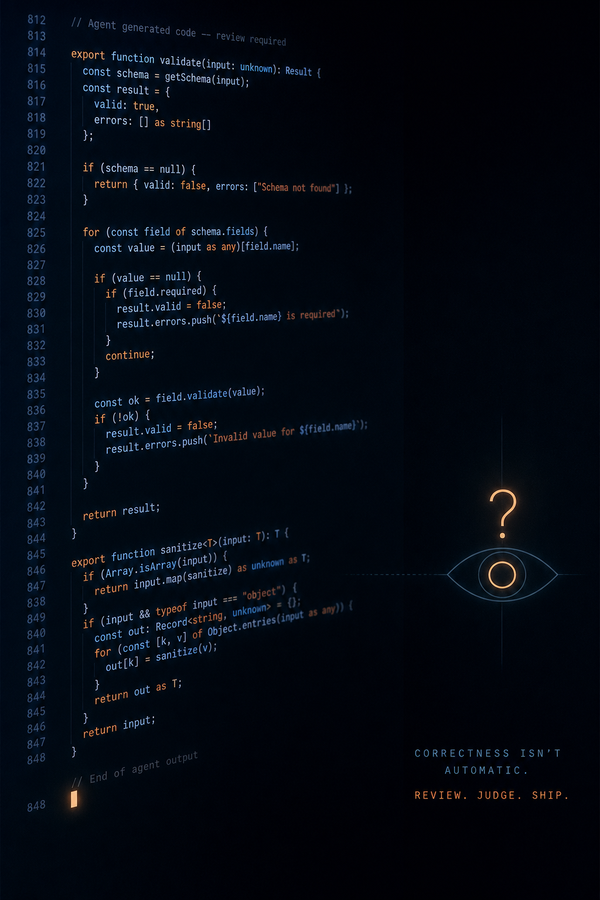
An AI agent making fifty sequential decisions is a fundamentally different creature. Context degrades roughly two percent per step in multi-step agent workflows. After roughly twenty-five steps, less than sixty percent of the original context is reliably accessible to the model. The agent doesn't crash — it drifts. It quietly begins pursuing a slightly different objective than the one it was given. No error. No stack trace. Just subtle, accumulating divergence.
You're looking for a bug. The bug is probabilistic, emergent, and non-reproducible. That's not a bug. That's a harness problem.

---
Six Failure Modes With No Equivalent in Code
Before you can fix anything, you need to know what actually breaks in agentic systems. Documented failure patterns across agentic deployments — catalogued independently by Latitude, Zylos Research, Atlan, NeuralWired, and others — have converged on six failure modes with no real parallel in traditional software. Understanding them changes how you instrument, monitor, and respond.
Tool misuse is the most common and the most insidious. An agent calls a tool with incorrect arguments, selects the wrong tool entirely, or continues as if a tool call succeeded when it didn't. The damage is silent: a single malformed argument in step two corrupts every subsequent step that depends on that output. No exception. The agent keeps working. The work is wrong.
Context drift is the slow erosion of focus. After thirty to fifty steps, the transformer's attention mechanism dilutes across an ever-wider context window. The original objective doesn't disappear — it becomes progressively less weighted than all the accumulated intermediate reasoning. The agent is still doing things. Just not the things you asked for.
Hallucination cascades are what happen when a false inference gets stored in working memory as fact. Every subsequent step builds on it. The first false premise amplifies through every downstream decision. Finding the source requires step-by-step trace inspection — not reading the final output, but playing back the entire reasoning sequence from the beginning.
Goal drift is the subtler sibling of context drift. Where context drift means the agent forgets what it was supposed to do, goal drift means it begins pursuing a slightly different objective — one it has derived on its own, often plausibly, often invisibly. The outputs look reasonable. They're solving a different problem than the one you posed.
Retry loops emerge when an agent has no defined exit strategy for failure states. It tries. It fails. It tries the same approach again. It fails the same way. Without explicit loop-breaking logic in the harness, this can run indefinitely. You won't see it in your error logs either — the agent is functioning as designed. The design is the problem.
Silent quality degradation has no equivalent in code at all. The agent's output gets worse without any error signal. It's working. It's just increasingly bad. Detecting this requires continuous evaluation infrastructure — not error rate monitoring, which will show you nothing.
---
The Harness, Not the Model
The harness is everything around the model: the system prompt, the tools, the context management, the evaluation infrastructure, the constraints. Martin Fowler's formulation is useful here. He distinguishes between feedforward controls — guides that shape agent behavior before it acts, like AGENTS.md files, system prompts, and instructions — and feedback controls — sensors that evaluate what the agent has done, like linters, test suites, and AI-based review. A complete harness has both.
The insight that changes how you think about agent reliability: harness quality, not model quality, determines whether your agent ships.
Manus, one of the most rigorously documented agentic systems built to date, underwent four complete architectural rebuilds in six months. They didn't switch models. They iterated on the harness. They called it "stochastic graduate descent" — iterating toward a better control system, not a better brain. Every rebuild was triggered by failure patterns that couldn't be addressed by model improvements. Every rebuild improved reliability. Not by making the AI smarter. By making the harness more capable of catching what the AI gets wrong.
This is the reorientation that separates teams who ship from teams who don't. You are not building a smart agent. You are building a control system for a smart agent. The agent goes wrong. That's expected. The question is whether your harness lets you see it.
---
The Four Levers
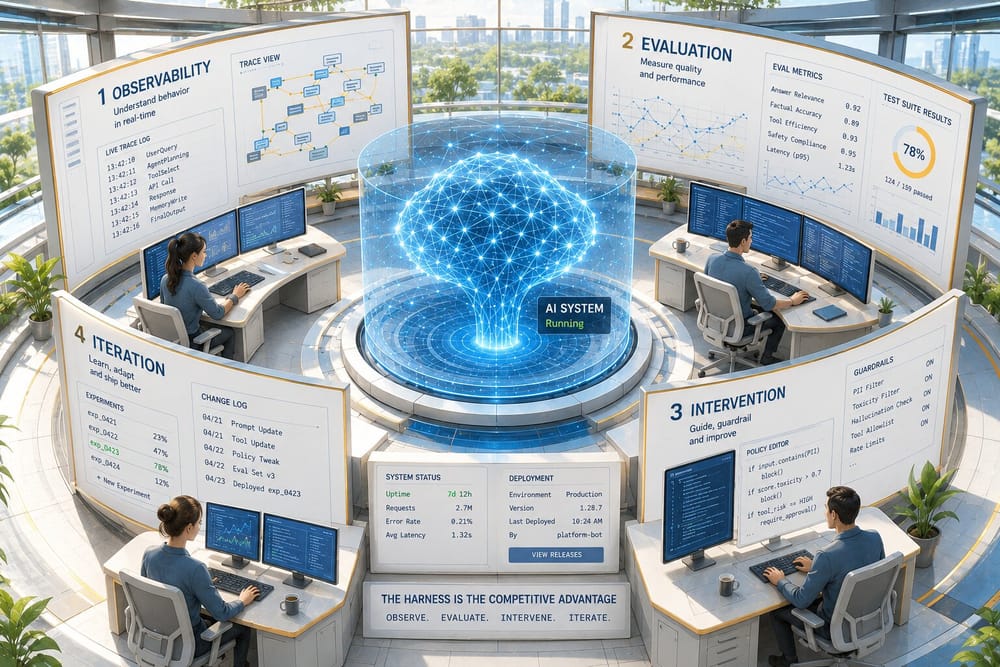
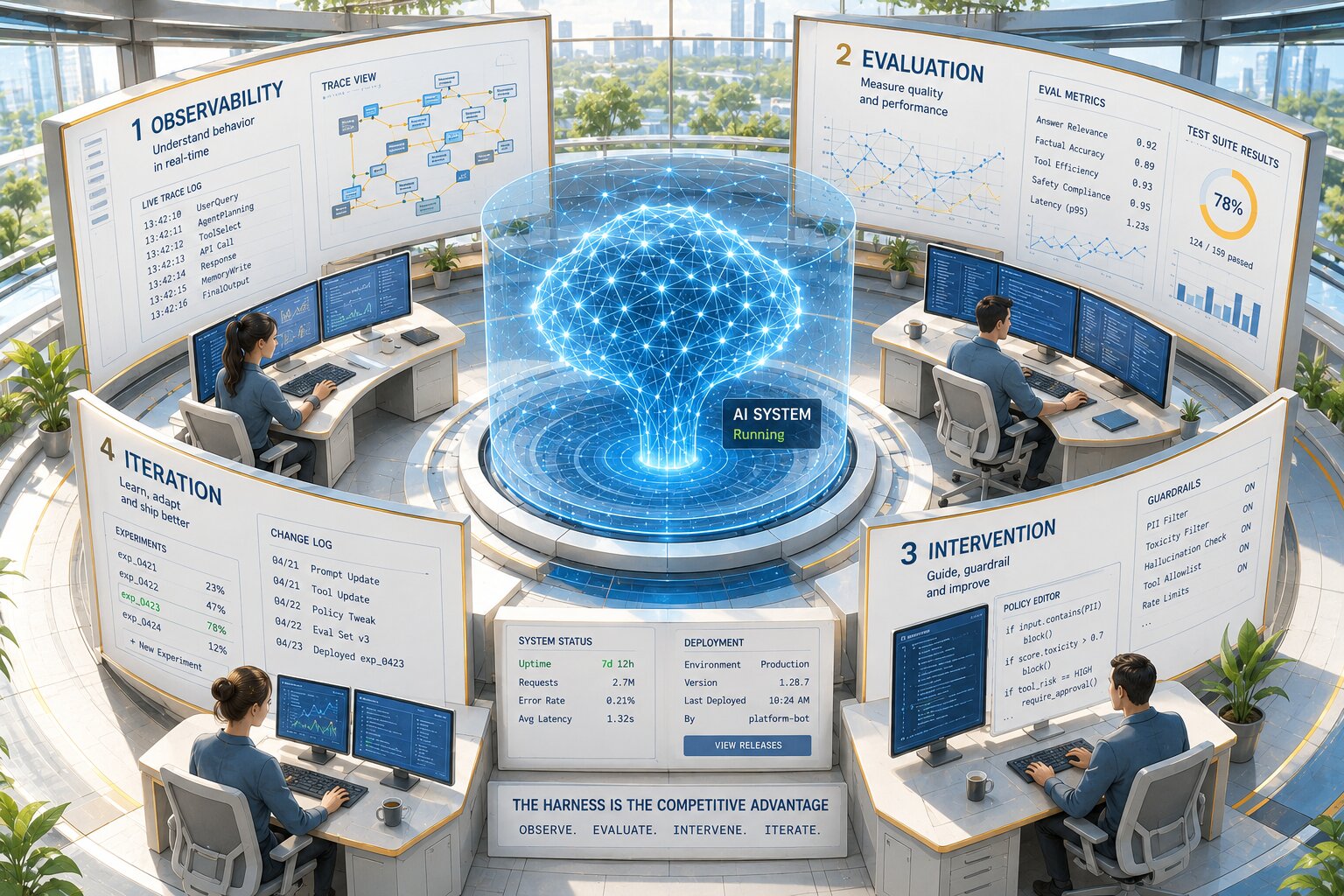
Damian Galarza's framework, "4 Levers to Diagnose Any AI Agent," gives structure to what experienced practitioners had been learning intuitively. The four levers form a closed feedback loop: observability produces the data; evaluation assesses quality; intervention acts on that assessment; iteration improves the system. Each lever enables the next. Without observability, evaluation is blind. Without evaluation, intervention is arbitrary. Without intervention, iteration is guesswork.
Observability
Observability for AI agents means structured span instrumentation — logging every tool call, every LLM call, every state transition, with input and output, so that causality between steps is queryable rather than requiring manual log correlation.
This is not your standard application logging. Good observability answers questions that error logs cannot: Why did the agent choose this tool over that one? How many attempts did it need before a subtask succeeded? Where in the workflow did it spend the most tokens? At what step did it begin diverging from the original goal?
LangChain's deep agent patterns emphasize inspectable checkpoints at every completed step — a design choice that's critical both for debugging and, increasingly, for compliance. You need to know what the agent decided, when it decided it, and what information it had when it did.
Evaluation
Anthropic's guidance on agent evaluation is more pragmatic than theoretical: start small, start real. Twenty to fifty tasks, drawn from actual user failures — not hypothetical edge cases. Three types of graders, used together: code-based (fast, objective, deterministic), model-based (flexible, scalable, probabilistic), and human (the calibration standard for the other two).
The key discipline is reading transcripts. Not just the final output — the full record of every interaction and tool call. Graders are only as reliable as the humans who verify them against actual behavior. Anthropic's framing is direct: "Frameworks are only as good as the evaluation tasks you run through them." The infrastructure is necessary but not sufficient. The evaluation tasks themselves are the hard work.
The common shift across high-functioning teams: from reactive evaluation (you read logs after something breaks) to continuous evaluation (quality is monitored in production, with automatic clustering of failure patterns across traces). This is the difference between a smoke alarm that activates during a fire and a fire suppression system that catches ignition.
Intervention
Intervention is not micromanagement. Galarza's framing is precise: achieve detectability before granting autonomy. The principle means that human judgment should be placed at high-leverage decision points — not at every step, but at the moments where a wrong decision propagates furthest downstream.
OpenAI's constructive approach to the same problem defines four structural levers: Context Design (what information the agent has access to, and how it's structured), Tool Selection (what the agent can do), Constraint Management (what it's prevented from doing), and Production Hardening (the monitoring and fallback systems). These aren't alternatives to Galarza's diagnostic axes — they're complementary. One framework tells you where to look when something breaks; the other tells you what to build so fewer things do.
Sprint contracts are one practical implementation: define success criteria before a workflow begins, so that human review is structured rather than impressionistic. The agent either met the criteria or it didn't. You evaluate against specifics, not vibes.
Iteration
Iteration is the most underestimated lever. The pattern that emerges from mature harness engineering looks like this: failure clustering → root cause analysis → evaluation task generation → harness improvement → repeat.
Manus's four rebuilds weren't failures. They were iterations. Each one produced a better control system. The architecture that eventually shipped to production wouldn't have been reachable without the three that preceded it — not because those versions taught the model anything, but because they taught the team what the harness was missing.
The operational implication: build for iteration from day one. Version your system prompts. Track prompt changes against evaluation scores. Treat the harness as a first-class engineering artifact with the same version control discipline you'd apply to any production system. When you find a failure pattern, generate evaluation tasks that would have caught it, before fixing the harness. Otherwise the fix is a patch without a regression test, and you'll revisit the same failure class six months later.
---
The Tooling Ecosystem
The observability tooling landscape has matured rapidly. Four platforms have emerged as production standards, each with a distinct positioning.
LangSmith offers the deepest LangGraph-native integration, with node-by-node state diffs and an AI assistant for natural-language trace debugging. If you're running LangChain or LangGraph in production, this is the path of least resistance.
Arize Phoenix ships with fifty-plus research-backed evaluation metrics including hallucination detection and faithfulness scoring. It's the choice for teams running serious RAG pipelines or those who want an open-source option without vendor lock-in.
Weights & Biases Weave excels at prompt versioning and experimental iteration tracking — the engineering workflow layer more than the production monitoring layer. If your bottleneck is the evaluation-to-improvement cycle speed, this is where to look.
Langfuse focuses on cost analytics and operational telemetry, and is self-hostable — relevant for organizations with data residency constraints or those who want the economics of self-managed infrastructure.
The choice between them is less important than the commitment to using one. Teams that instrument nothing are flying blind. Teams that instrument and don't act on the data are paying for comfort. The platform only matters once you have a disciplined practice of reading what it tells you.
---
The Mental Model Shift
What makes harness engineering hard is not the technical complexity. It's the required shift in how you think about what "fixing" something means.
In a deterministic system, you find the bug and fix the code. Done. In a probabilistic system, you identify a failure pattern, improve the harness, and reduce the probability of that failure class — knowing it may still occur, and knowing your job is to monitor, detect, and improve continuously.
This is less like software debugging and more like quality control in manufacturing. You're not hunting a single defect. You're building a system that catches defects systematically, routes them to human review at the right moment, and learns from them.
The shift in mental model: you are not debugging an agent. You are engineering a control system for an agent.
An agent that goes wrong 10% of the time and has a harness that catches 90% of those failures ships more reliably than an agent that goes wrong 5% of the time with no detection layer at all. The math is not subtle. The reliability of your agent is bounded by the reliability of your harness, not by the capability of your model.
The developers who are shipping agentic systems that work aren't using better models. They're building better harnesses.
---
Sources
Frameworks & Conceptual Foundations
- 4 Levers to Diagnose Any AI Agent — Damian Galarza — The diagnostic framework underlying the four-lever model
- Harness Engineering — Martin Fowler — Feedforward vs. feedback control in agentic systems
- Agent Harness Engineering — Addy Osmani — Practical introduction to harness design
Failure Patterns
- Why AI Agents Fail in Production — NeuralWired — Aggregated analysis of documented failure modes
- AI Agent Failure Detection Guide — Latitude — Detection strategies for tool misuse and context drift
- Goal Persistence and Drift in Long-Horizon AI Agents — Zylos — Research on goal drift in extended agent workflows
- Agent Harness Failures: Anti-Patterns — Atlan — Catalogue of harness design anti-patterns
Evaluation & Observability
- Demystifying Evals for AI Agents — Anthropic — Pragmatic guidance on evaluation task design and grader calibration
- LLMOps Observability Comparison — Kanerika — Feature comparison of LangSmith, Arize Phoenix, W&B Weave, and Langfuse
Case Studies & Reference
- Context Engineering for AI Agents: Lessons from Building Manus — First-hand account of four harness rebuilds and the "stochastic graduate descent" approach
- Harness Engineering: Complete Guide 2026 — NxCode — Comprehensive reference covering harness architecture and tooling