The last line of code
A Dependabot security alert arrives. The developer assigns it to a coding agent. The agent reads the advisory, traces how the vulnerable package is used across the repository, opens a draft pull request, and runs the tests. The build passes. By the time the morning standup ends, the fix is waiting for review. Nobody typed it.
That scenario is not a prediction. It is a feature GitHub shipped in April 2026, available to teams using Copilot, Claude, or Codex. You can watch an ordinary workflow notification become an engineering conversation between a tool and a codebase. The human enters at the end, as reviewer.
What that means — for the craft, for the profession, for how you train the next generation — is still being worked out. Not always honestly.
Not autocomplete with a longer context window
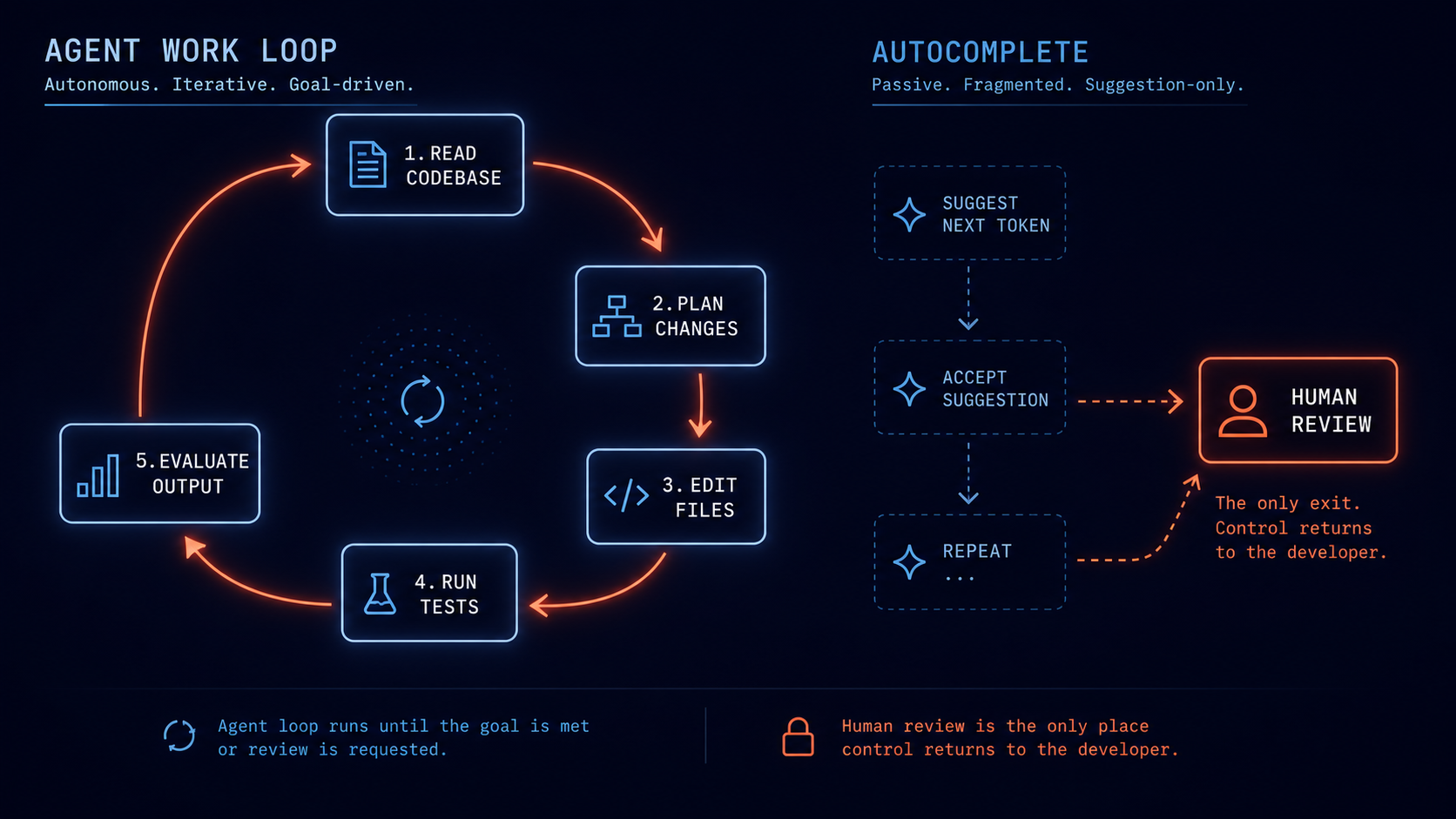
The completion tools of the early 2020s suggested the next expression and left everything else to the developer: what to inspect, what to run, what to commit, what to ship. They were fast, sometimes genuinely useful, and entirely passive about the outcome.
An agent has what a completion model lacks: a work loop. It navigates a codebase, chooses which files to change, edits them, runs tests, reads the output, decides what to do next. Claude Code describes this directly — reading the codebase, making cross-file changes, running tests, delivering committed work. OpenAI's Codex frames it similarly: sustained execution on complex tasks, refactors, migrations, debugging runs that take more than a single suggestion to resolve.
The Dependabot case is a useful signal precisely because it is not glamorous. This is not AI writing a new feature from a natural-language specification. It is an agent handling a bounded workflow that a developer would otherwise interrupt their morning to address: find the vulnerability, understand the blast radius, produce a fix, verify it holds.
Anthropic's analysis of roughly 400,000 Claude Code sessions in June 2026 described what appears to be a stable division: people tend to make the planning decisions about what should happen; the agent makes more execution decisions about how. That is an accurate empirical description. It is not proof that implementation knowledge has stopped mattering. In a real codebase, what looks like a pure execution detail — transaction boundaries, backward compatibility, a retry budget — frequently contains the product decision that the specification left unstated.
Five things that become scarce
When generating implementation gets cheap, the valuable work shifts. Five capabilities become harder to replace.
The first is problem framing. A request like "add team sharing" conceals a stack of choices: which roles exist, how invitations expire, who owns data when a user leaves, what the audit trail looks like, whether sharing across organisations is in scope. An agent can produce a plausible feature from an underspecified request. It cannot reliably discover which unstated policy the organisation actually intended. The developer who hands off an underspecified task and trusts the result owns what the agent assumed.
The second is architecture and constraints. Good agent prompts increasingly look like small technical contracts: preserve this API surface; do not alter the database schema; meet this latency budget; respect this authorisation boundary; add these observable behaviours. Architecture earns its keep by narrowing a large search space before code exists. That narrowing is not a bureaucratic step before the real work — it is increasingly the real work.
The third is delegation design. An agent given "modernise the app" has many ways to be locally reasonable and globally destructive. An agent given "replace this deprecated client in these three modules, preserve all public interfaces, add regression tests for X and Y" has a much better chance of producing reviewable work. The decomposition — clear owner, limited blast radius, testable completion condition — is not obvious. It requires understanding what the system does and which parts are fragile.
The fourth is verification. Tests are necessary but not a magic certificate. An agent can satisfy the tests it was shown while missing a production invariant that nobody wrote a test for. Reviewing an agent-generated diff means reading the diff, the data paths, the permission model, the dependencies, the operational effects, and the user-level acceptance criteria. The engineer becomes an author of evidence: a change should arrive with the test, the rationale, and the boundary that make it believable. That is a higher documentation standard than most codebases currently maintain.
The fifth is domain knowledge. Anthropic's session study found that greater domain expertise correlated with more success in agent-assisted work, and that domain experts could make more work possible per instruction. Understanding the outcome is a force multiplier — especially because someone must recognise a confident, technically tidy answer that violates the business reality it was built for.
What the demos do not show
The failures that reveal themselves immediately are the cheap ones. A malformed file, a build that will not compile, a test that errors on line one — these cost minutes to catch. The expensive failures are the ones that look finished: a plausible patch that omits a rare execution path, a dependency upgrade that weakens a security property the original developer understood but never documented, an interpretation of the requirement that is internally consistent but wrong about the world.
A 2025 preprint studying over 12,000 agent actions across 93 real-world software setup tasks found insecure actions in 21% of trajectories, across five different models. That number should not be treated as a universal rate — task design and permission scopes matter enormously. What it does is falsify the casual assumption that a model capable of completing most tasks safely can therefore be granted unrestricted access to a production environment.
The productivity data is similarly corrective. METR ran a randomised controlled study asking 16 experienced open-source developers to complete 246 tasks in large repositories they already knew well, using the frontier AI tools available in early 2025. Completion took 19% longer than without AI assistance, even though participants expected and reported feeling a speed-up. This is not a verdict on what 2026 tools can do — the models have changed, the sample was small, and familiar mature codebases offer less low-hanging fruit than greenfield work. It is excellent evidence against measuring agentic development by excitement, code volume, or a demo timer. Prompting, waiting, reviewing, and undoing are part of delivery time. They do not appear on the timer in the demo.
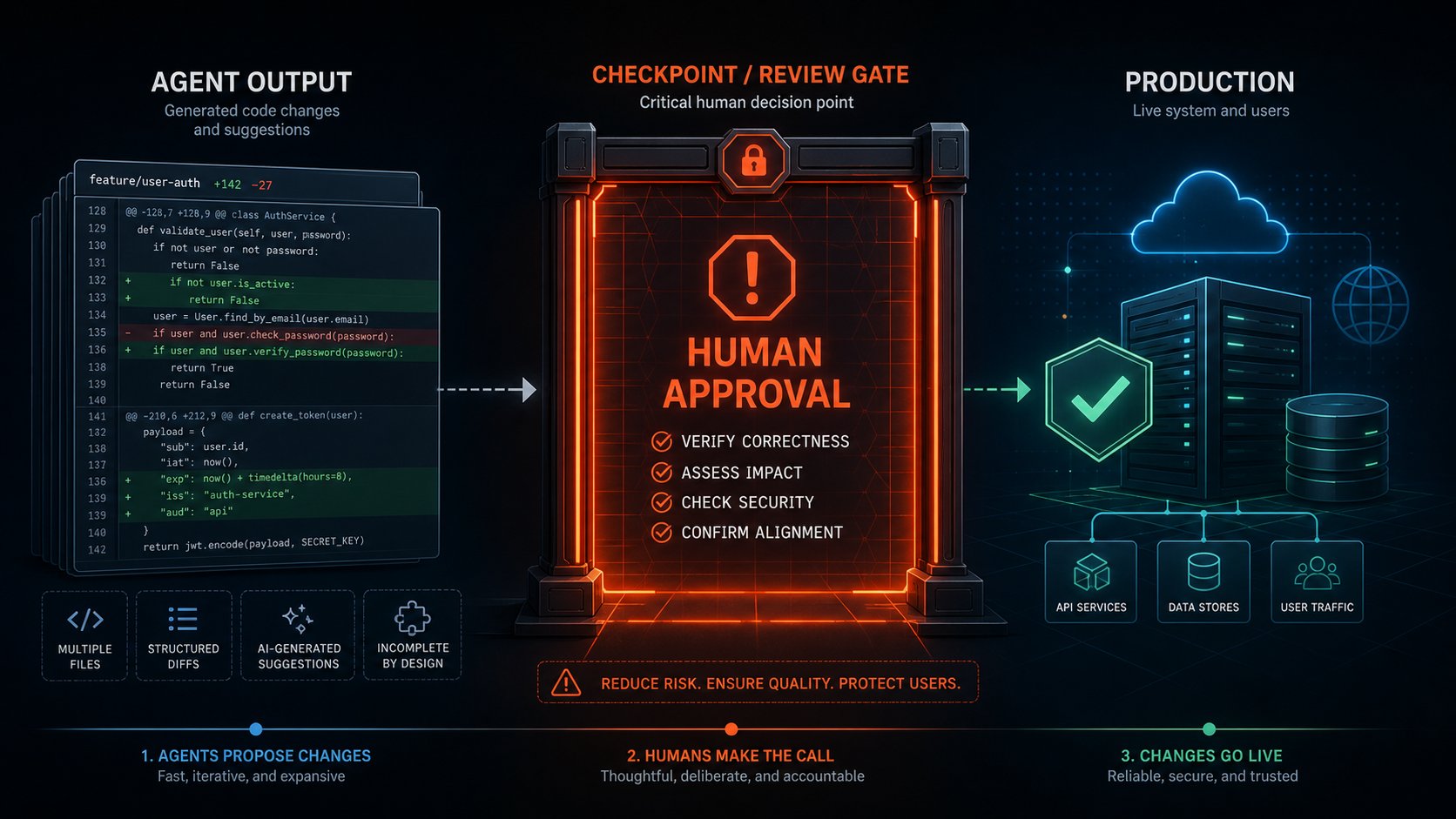
The response to both findings is engineering discipline, not a ban. Give the agent a branch and a sandbox; scope filesystem and network access narrowly; use least privilege; require behavioural tests; run CI and staging; keep a human approval gate for consequential changes. Anthropic reports that sandbox boundaries reduced internal permission prompts by 84%. GitHub now offers both local and cloud sandboxes that isolate an agent's tool execution from production systems. The lesson here is subtle and worth reading twice: fewer interruptions are safe only when permissions are bounded in advance. Reducing friction by expanding access is the opposite of the correct move.
Another abstraction, but not that kind
The historical comparison is real and worth making. Compilers moved programmers from machine instructions to languages that expressed problems at higher levels. IDEs automated navigation and refactoring. Version control made parallel work and rollback routine. CI/CD turned manual release ceremonies into executable pipelines. Each wave removed manual ceremony from the lower floors and raised the expected altitude of system design.
Agentic development continues that movement. It is also different from previous waves in a way that matters.
A compiler translates formally specified input according to defined semantics. Given the same source and configuration, it produces the same output. An agent interprets incomplete prose, invents intermediate steps, queries a codebase that changes between invocations, and calls external tools whose outputs affect subsequent decisions. It is not only an abstraction layer — it is a fallible collaborator operating under genuine ambiguity. That makes intent capture and result evaluation central to the work rather than incidental to it.
This is where the vibe-coding debate finds its correct frame. Vibe coding — specifying a system through feel and iteration rather than precision, accepting whatever the agent builds so long as it looks right — is a reasonable strategy for exploring a disposable prototype or automating a personal irritation. It becomes irresponsible when visual output substitutes for verification in a system with users, money, privacy, safety, or long-term maintenance obligations. The question is not whether every developer must read every generated line. It is whether someone, somewhere, has enough understanding and evidence to own the system's behaviour — and its failure modes.
The phrase "manager of agents" is tempting but misleading. It implies that technical accountability has thinned into coordination. A more accurate description is designer of a controlled engineering loop: someone who defines the intent, sets the constraints, and determines whether the result is actually correct. That is more demanding than it sounds when the agent is competent enough to produce confident wrong answers.
What a junior should learn
The obvious mistake is to train developers as human compilers — people who can memorise syntax and translate specifications into code that a tool can now retrieve. The less obvious mistake is to conclude that implementation knowledge no longer matters and that architecture alone is sufficient.
Architecture without a felt model of data flow, test failure, runtime behaviour, debugging, and cost is vocabulary without judgement. Knowing what a transaction boundary is does not tell you whether the one the agent chose is in the right place.
Anthropic's skill-formation experiment illustrates the risk. Participants learning a new Python library were given access to an AI assistant that could write correct code on request. Full delegation sometimes improved immediate productivity — the task got done faster. It also reduced understanding: the AI-assisted group scored 17% lower on a quiz about concepts they had just used. The study's sample and learning task are narrow enough that it cannot settle computer-science education. It does show why fluency in asking for code is not the same as competence in supervising it. A developer who never built the mental model cannot catch the confident answer that is wrong.
A durable curriculum has three strands. Build and debug small systems manually enough to develop causal intuition — the kind that tells you, before running anything, roughly what should happen and roughly what went wrong. Learn systems thinking: interfaces, state, security, testing, observability, and trade-offs at the design level. Then learn agent operation: write constraints, ask for explanations and alternatives, inspect diffs carefully, generate tests deliberately, and break the solution on purpose to understand its limits.
The goal is not to preserve typing as a rite of passage. It is to create people who can recognise when a smooth-looking agent result is wrong — and can direct it toward a better one.
The last line
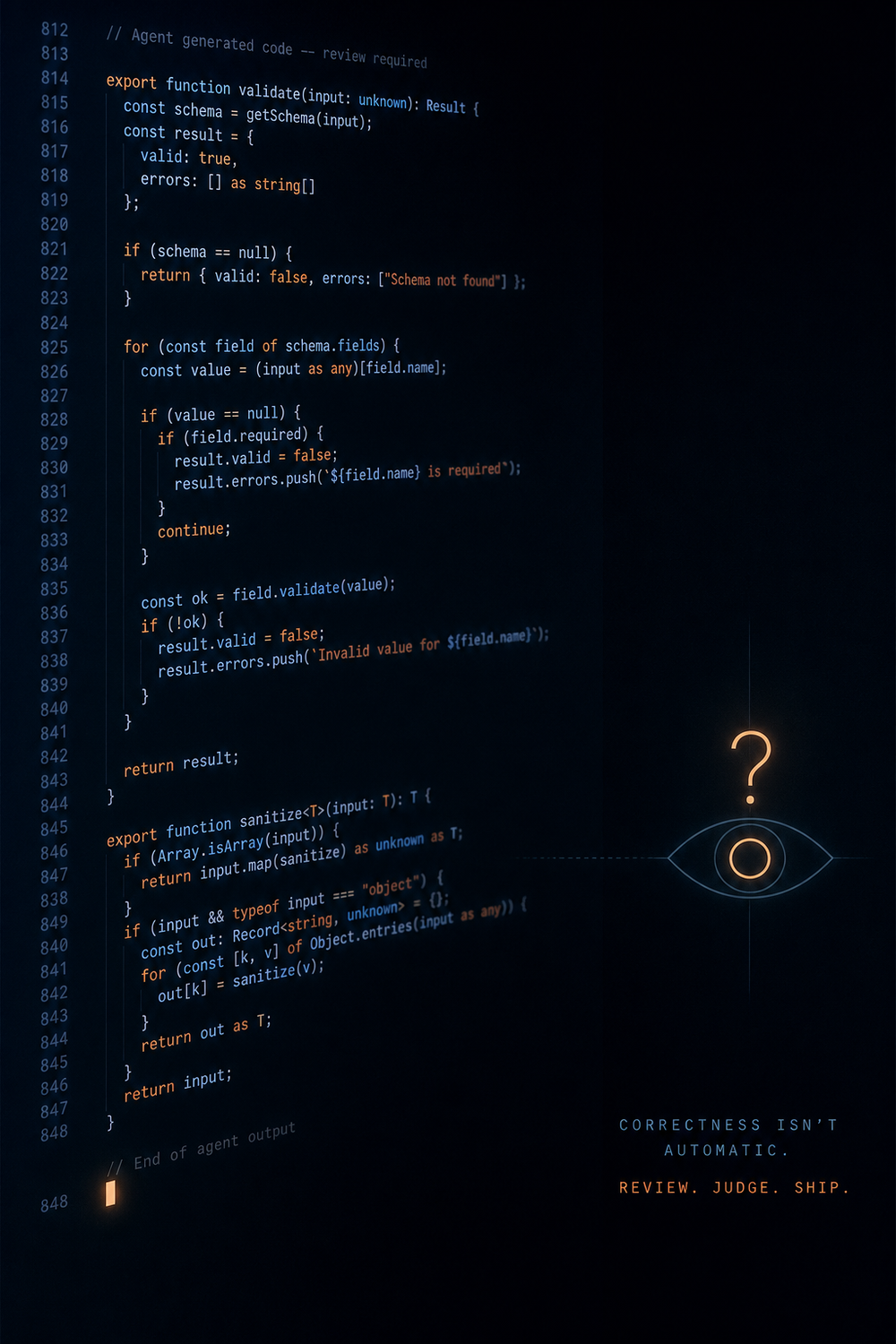
The Dependabot patch will be reviewed. Someone will read the diff, trace the change through the codebase, ask whether the test covers the actual vulnerability rather than a simplified version of it, check whether the upgraded dependency version is compatible with the rest of the build. The review might take three minutes. It might go back for revision.
The last line of code was not typed today. The judgement about whether it was correct still had to come from somewhere.
That judgement does not get cheaper as agents get better. It gets more consequential. The volume of apparently finished work that requires evaluation goes up. The cost of a wrong approval goes up with it. The developer who remains valuable in that environment is not the one who types faster than an agent, or the one who has delegated everything and calls it management. It is the one who can tell the difference between a result that looks right and one that is.
Sources
Agent platforms
- Dependabot alerts are now assignable to AI agents for remediation — GitHub (7 Apr 2026) — The specific GitHub feature that opens the article: Dependabot alerts routed directly to coding agents.
- Claude and Codex now available for Copilot Business/Pro+ users — GitHub (26 Feb 2026) — Context for which agent tools are now mainstream in developer workflows.
- Claude Code — Anthropic — Product overview describing the work loop: reading codebases, cross-file changes, running tests, delivering committed work.
- Introducing GPT-5.2-Codex — OpenAI (18 Dec 2025) — OpenAI's framing of sustained execution on complex tasks, refactors, and debugging runs.
Productivity research
- Measuring the Impact of Early-2025 AI on Experienced Open-Source Developer Productivity — METR — Randomised controlled study: 16 developers, 246 tasks, completion 19% slower with AI despite feeling faster.
- 2026 uplift study update — METR (24 Feb 2026) — Follow-up on METR's productivity research with more recent tool versions.
Safety and sandboxing
- When Developer Aid Becomes Security Debt — Deng et al. (preprint, 2025) — Study of 12,000+ agent actions across 93 real-world tasks: insecure actions in 21% of trajectories across five models.
- Claude Code sandboxing — Anthropic — Sandbox boundaries reduced internal permission prompts by 84%.
- Cloud and local sandboxes for GitHub Copilot now in public preview — GitHub (2 Jun 2026) — GitHub's approach to isolating agent tool execution from production systems.
Expertise and skill formation
- Agentic coding and persistent returns to expertise — Anthropic (16 Jun 2026) — Analysis of ~400,000 Claude Code sessions: domain expertise correlates with more agent-assisted success.
- How AI assistance impacts the formation of coding skills — Anthropic — Skill-formation experiment: AI-assisted group scored 17% lower on concept quiz despite faster task completion.
- How AI Impacts Skill Formation — Shen & Tamkin (preprint) — Underlying research on the relationship between AI delegation and learning outcomes.