The Pedal That Wasn't (But Was)
How Bohemian organ composers chose flexibility over virtuosity
Josef Ferdinand Norbert Seger (1716-1782) wrote organ works that ranked among the finest of his era. He composed fugues, preludes, toccatas — contrapuntal masterworks that contemporaries compared to Bach. But there's one problem: nobody knows for certain whether his music should be played with or without pedal. Not because his manuscripts were lost or damaged. Not because later copyists made errors. But because Seger deliberately left it open.
He wasn't alone. His teacher Bohuslav Matěj Černohorský did the same. So did Jan Zach, František Brixi, and virtually every composer of the so-called Prague School. They notated their organ works on two staves, like harpsichord music, and left it to the performer to decide whether the bass line should be played with the left hand or with the pedal. For modern organists wanting to perform their music, this is a puzzle. For Bohemian organists in the 18th century, it was normal.
The Hardware: South Germany in Prague
The Mundt organ in the Týn Church in Prague, built in 1673 by Johann Heinrich Mundt, is considered the prototype of the Bohemian Baroque organ. It's one of the best-preserved 17th-century instruments in Europe and shows exactly how Bohemian organ building worked: it's almost entirely South German.
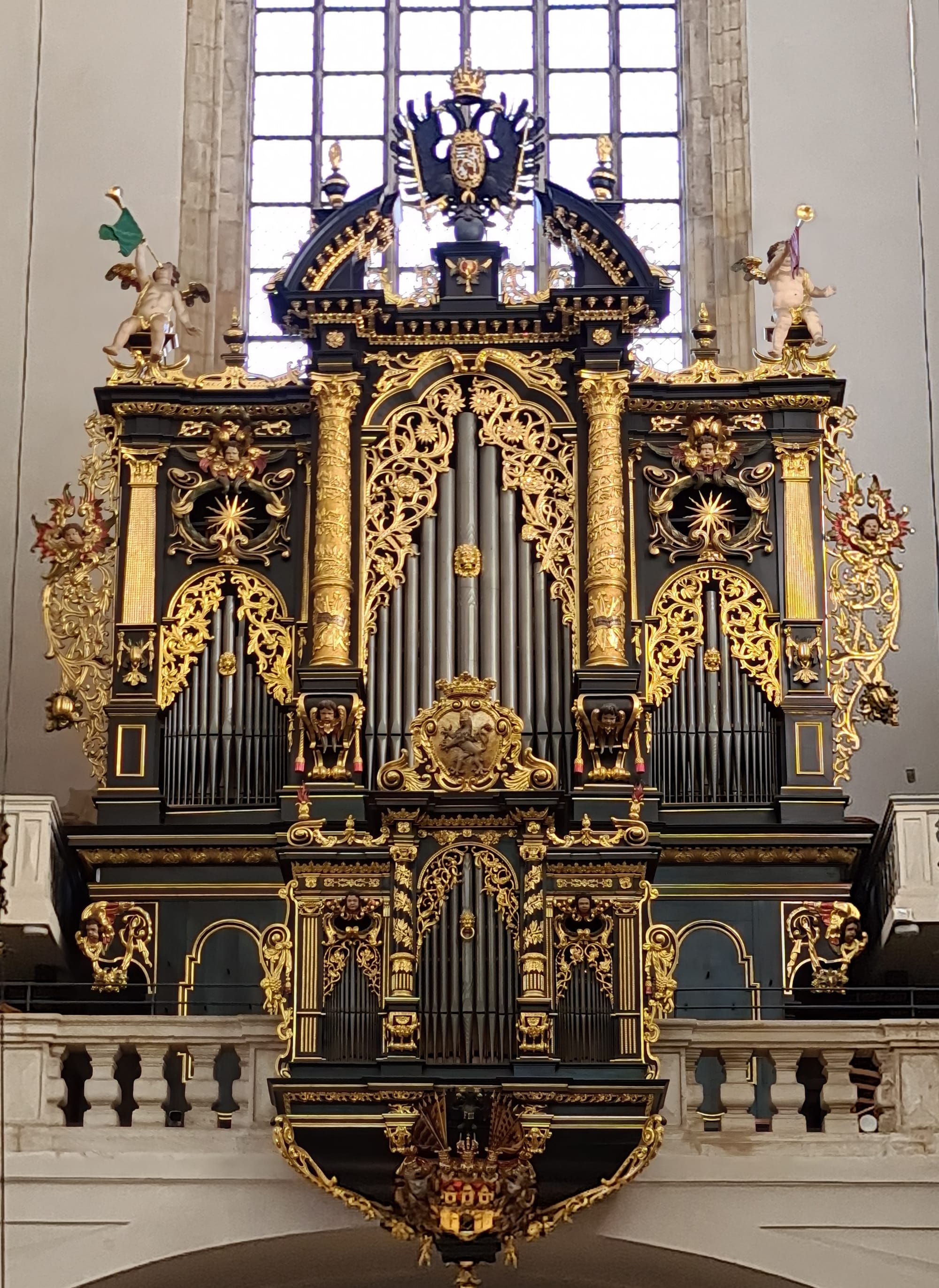
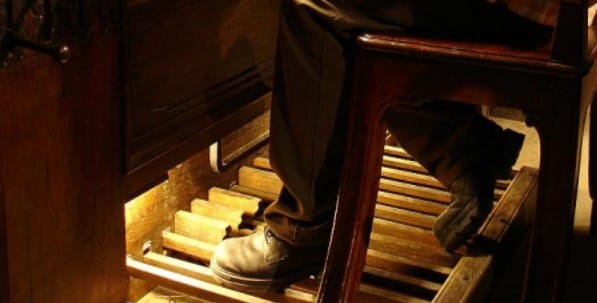
The pedal has 18 keys (C to a) with a short lower octave — a clever trick where f# and g# sound an octave lower to simulate a fuller bass range. Not full chromaticism, but enough for a solid foundation. The registration, however, is surprisingly rich:
- Subbass 16' (both stopped and open)
- Octavbass 8'
- Superoctavbass 4'
- Quintbass 2⅔'
- Posaunbass 8' (sounds like Fagot 16', typically South German)
- Mixture (2 to 4 ranks)
The organ has a predominantly labial character (sounds created by airflow across a lip, like flutes, not by vibrating reeds like trumpets) — reed stops are almost entirely absent. The principals are mild, the mixtures light and sparkling (often with tierce rank), and there are characteristic wooden Copulas. Dynamic contrast happens through manual divisions, not through the pedal. This isn't an instrument on which you play virtuoso pedal solos. It's an instrument where the pedal forms an optional foundation.
The Prague School: Teacher, Student, and the Power of Oral Transmission
Bohuslav Matěj Černohorský (1684-1742) studied and worked in Italy, returned to Prague, and established what would later be known as the Prague School. His organ works were described as "serious and well worked" — enough to impress J.S. Bach, according to contemporaries. He earned the nickname "the Bohemian Bach", though it's unclear whether Bach ever heard Bohemian music. It's a one-sided comparison: Bach was used as a benchmark, but Bohemia didn't influence Bach (as far as we know).
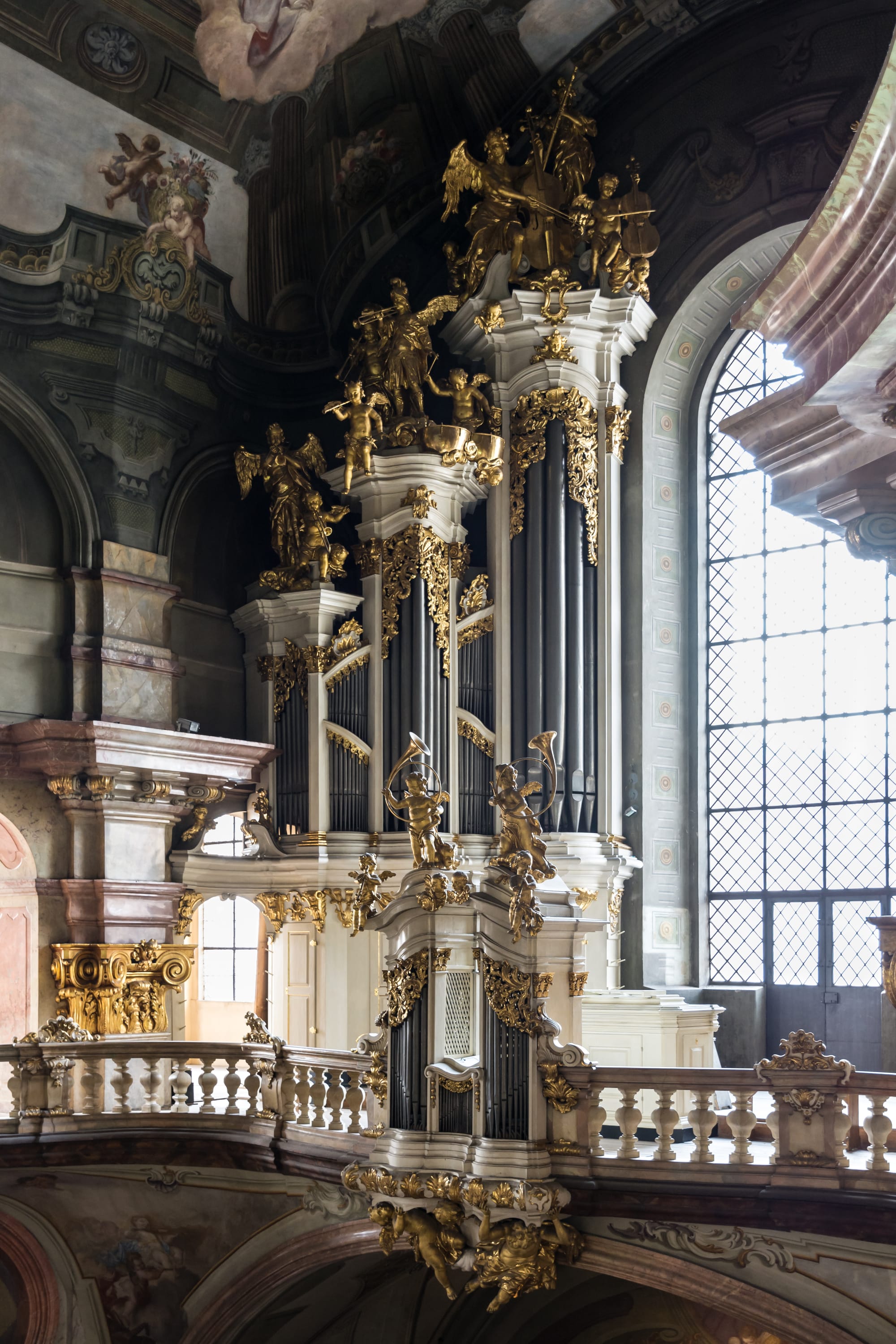
> "Bach was used as a benchmark, but Bohemia didn't influence Bach. It's a one-sided comparison."
Černohorský's most productive student was Josef Seger (1716-1782), who studied with him between 1723 and 1731. Seger became the most productive Czech organ composer of the 18th century. None of his works were published during his lifetime. His manuscripts survive, but with the notation problem we've already seen: in the vast majority of cases, it's not indicated whether the pedal should be used.
Other students of Černohorský included Christoph Willibald Gluck and František Tůma. Gluck became world-famous as an opera reformer, but his Bohemian musical education is rarely emphasized. The Prague School wasn't an institutional academy, but a teacher-student tradition. Knowledge was transmitted orally, not primarily through written notes. The score was a memory aid for someone who already knew how it should be played.
This explains why the notation was so ambiguous. If you learn a piece from your teacher, who plays it and explains it to you, you don't need to write in the notes "use the pedal here". You already know. The notation was intended for people already within the tradition, not as an instruction manual for outsiders.
The Contrast: Buxtehude's Virtuoso Pedal
Dietrich Buxtehude (1637-1707), working in Lübeck, was a phenomenon. He used the pedal as a full-fledged keyboard and wrote virtuoso passages for it that were among the most difficult of their time. He could do this because North German organs had 28 to 30 pedal keys with full chromaticism and because the pedals were technically optimized: longer, narrower, with fulcrum at the back for smoother leverage action. This made complex, fast pedal lines possible.
Buxtehude's 19 organ preludes "all make heavy use of pedal and are idiomatic to the organ". The North German school gave rise to "dramatic pedal solos" — the pedal as protagonist, not as foundation. J.S. Bach (1685-1750) traveled 400 kilometers on foot to hear Buxtehude. The influence is clearly audible in Bach's own organ works.
Bohemian composers had access to the same 18th-century organ culture. They knew the North German tradition (Černohorský's nickname "Bohemian Bach" implies comparisons were being made). But they consciously chose a different path.
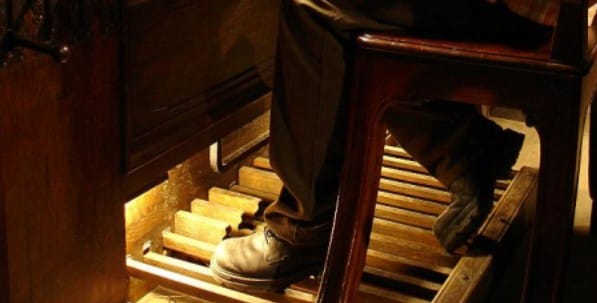
Pedal of the Mundt-organ (1673) in the Týn-church in Praguety">Why the Ambiguity?
Three reasons seem crucial:
1. Flexibility for Different Instruments
Not every organ had a full pedal board. Smaller village organs sometimes had no pedal at all, or only a very limited one. If you wrote a composition that could only be played with pedal, you excluded those instruments. If you wrote the bass line so it could also be played with the left hand, the same composition became usable on an 18-key city organ as well as a 12-key village organ.
This was pragmatism, not lack of ambition.
2. Interpretive Freedom as an Ideal
A Bohemian organist received not a dictate, but a framework. He decided himself:
- Whether the instrument had a pedal suitable for this passage
- Whether the bass line was technically feasible with the left hand
- What better suited the liturgical context
- What he personally found most beautiful
The composition wasn't a finished product, but a foundation upon which the performer built further. The performer completed the work during performance. This is a fundamentally different conception of what a composition is than what we're accustomed to today.
> "The composition wasn't a finished product, but a foundation upon which the performer built further. The notes were the starting point — what happened after that was the organist's doing."
3. The Pedagogical Tradition
If you're trained by a teacher who plays it for you and shows you how it should be done, you don't need detailed written instructions. The score was a memory aid, not an instruction manual. This works excellently within a closed teacher-student tradition, but it makes it difficult to reconstruct the music outside that tradition.
For modern organists who don't have access to Černohorský's lessons, the notation is frustratingly ambiguous. For Seger's contemporaries, it was perfectly clear.
The Modern Clash
Contemporary performance practice wants certainty. We want to know what the composer meant. We do historical research on instruments, sources, contexts. We search for the "authentic" version. And then we come to Bohemian organ works and hit a wall: there is no unambiguous version. The composer left it intentionally open.
This creates a paradox: authentic might mean making a choice, rather than seeking the "right" choice. The original organist also made a choice — each time anew, depending on the instrument, the liturgy, and his own preference. Perhaps the most authentic approach isn't to reproduce what Seger played (we don't know), but to do what Seger did: decide based on context and taste.
A Different Path
You might expect that Bohemia, geographically between North and South Germany, would be a middle way — a hybrid form of virtuoso pedal technique and South German austerity. But that's not the case. In organ construction, Bohemia was almost entirely South German: 18 keys, short lower octave, window layout, minimal reed stops. But in compositional practice, it developed its own path — even more flexible than South German, with a unique emphasis on oral transmission and interpretive freedom.
The pedal that wasn't there was there — but only if the organist chose it. This wasn't a lack of craftsmanship, but a fundamentally different conception of what a composition is: not a finished product, but a foundation for a conversation between composer and performer. The notes were the starting point. What happened after that — the organist made that himself.
Sources:
- Sonus Paradisi - Prague Baroque Organ — Technical specifications of the Mundt organ and Bohemian Baroque organ construction
- Pipe Organ Map - Mundt organ — The Týn Church organ from 1673
- Partitura Organum - Seger Præambulum — Analysis of Seger's work and the notation problem
- Organ Forum - Notation practices — Baroque notation conventions
- Wikipedia - Bohuslav Matěj Černohorský — Biography of "the Bohemian Bach"
- Wikipedia - Dieterich Buxtehude — North German pedal virtuosity
- Fiveable - Buxtehude and North German organ music — North German organ school
- Wikipedia - German organ schools — North versus South German organ schools
- Radio Prague - Baroque music — Overview of Bohemian Baroque music
- Baroque in Bohemia CD liner notes — Organ works by Černohorský, Seger, Zach, Brixi
- Chasing After Paradise - Slavic Baroque Composers — Slavic Baroque composers
- Britannica - Keyboard instrument history — European organ building to 1800
- Wikipedia - Pedal keyboard — History of pedal development
- The Diapason - New Aubertin organ — South German Baroque style
- IMSLP - Černohorský Organ Works) — Freely available scores