Music That Does Not Want to Be Explained, But Played
On the three-hundred-year quiet conversation between Paris and Prague
---
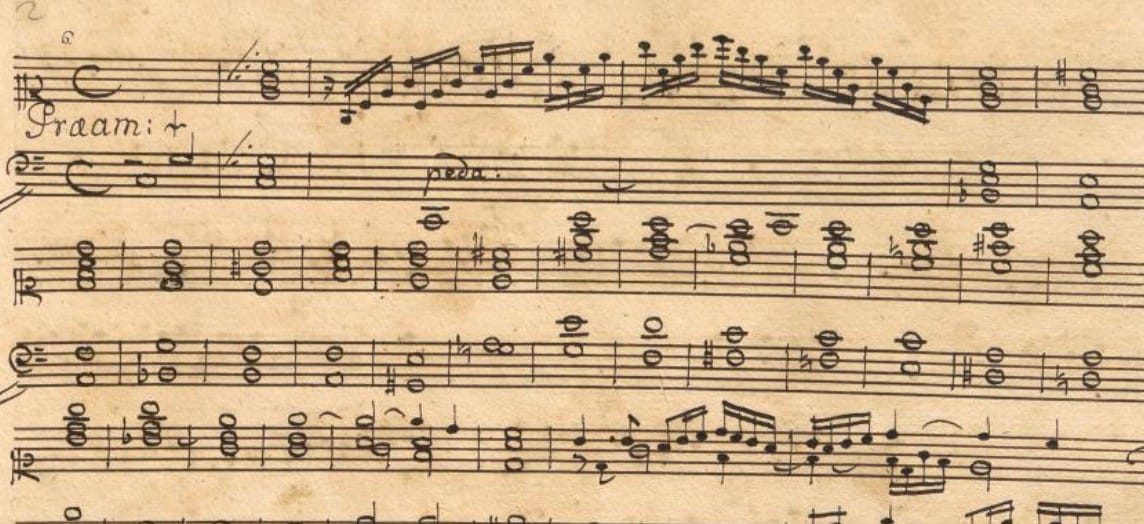
The score opens with a row of whole notes. A chord in C major, held for a full bar. Then another chord — the same notes, essentially, with a slight shift in the bass. Then another. The page is quiet, almost deliberately empty, and if you sit down at the organ and try to play it exactly as written, something goes wrong. Not technically. Emotionally. The music sounds like it is waiting for something.
That something is you.
---
The piece is the Praeambulum in C Dur (L 6) by Josef Ferdinand Norbert Seger (1716–1782), and I have spent a fair amount of time with it.
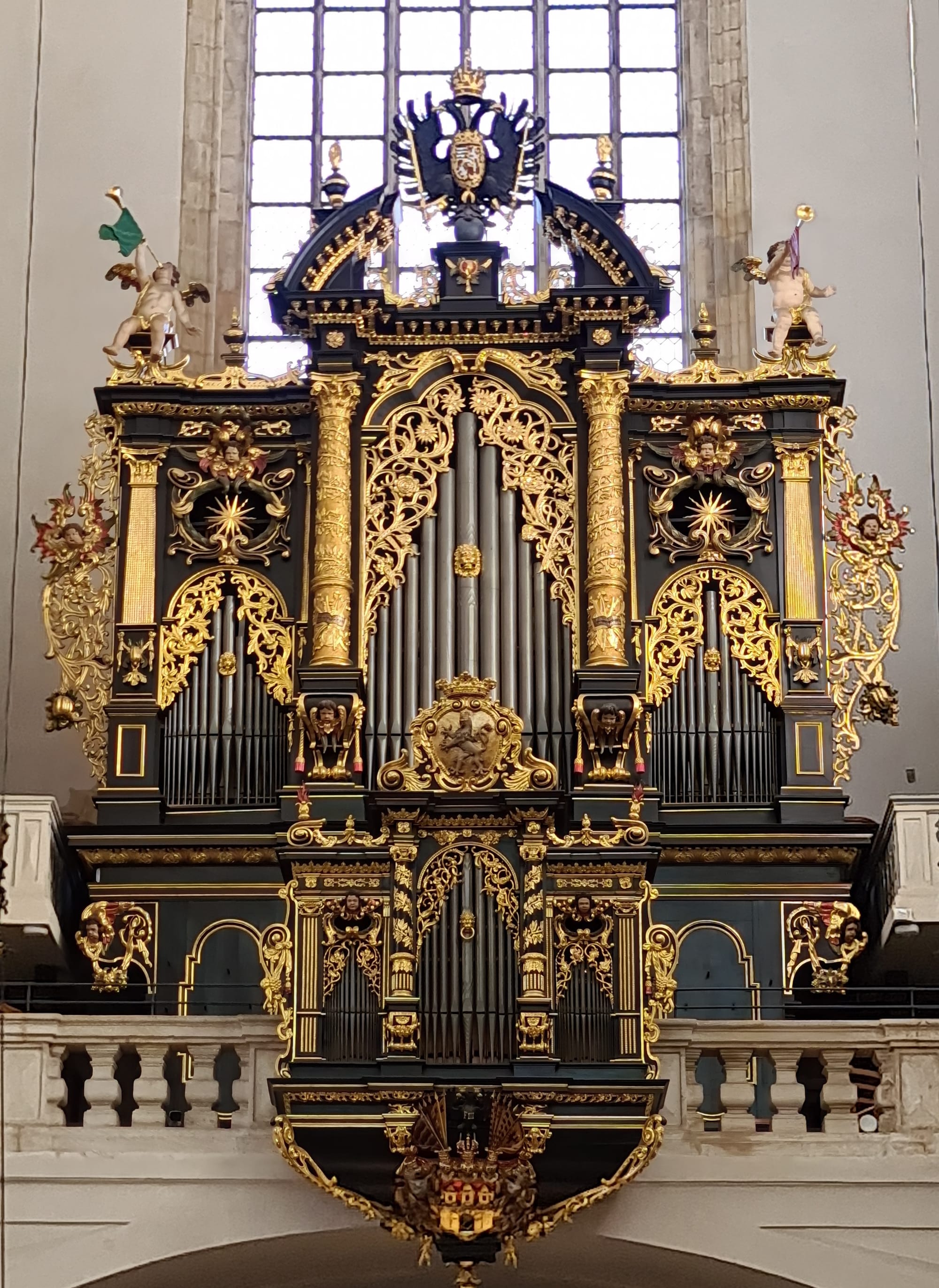
Seger was the most important organist in 18th-century Prague. For 41 years he held the position at the Týnský chrám — the Church of Our Lady Before Týn, with its great Mundt organ from 1673, the one that still stands today, its pipes looking out over the Old Town Square. His teacher was Bohuslav Matěj Černohorský, nicknamed "the Bohemian Bach," a man so devoted to improvisation that when fire destroyed the Minorite monastery in Prague in 1753, almost all of his manuscripts burned with it. What a legacy for a man who was apparently, in his prime, comparable to Bach himself: a mountain of musical thinking reduced to ash and rumour.
Seger inherited that tradition of immediacy, of music made in the moment. Charles Burney, the great English music historian who toured Europe in the 1770s, singled Seger out for extraordinary praise. One account captures it simply: Seger could improvise a fugue, without preparation, on any given theme. Not occasionally. On request. As a professional standard.
So when you open one of his preludes and find a row of silent whole notes looking back at you, the first response should not be to play them as written. The first response should be to wonder what they are for.
---
The score as skeleton, not script
When I edited these preludes for publication on [partitura.org](https://partitura.org/index.php/seger/), the question of those introductory chord passages became inescapable. Playing them literally, I noted at the time, "sounds boring." That is not a critical judgment of Seger — it is a diagnostic observation. A man who could extemporise a fugue on the spot did not write boring music. He wrote shorthand.
The chord sequences that open preludes like L 3 (D major), L 6 (C major), L 17 (E-flat major), L 20 (C major), and L 22 (D major) are not compositions in the modern sense. They are harmonic frames. The tonic chord, a movement through related harmonies, a turn toward the dominant — and then the "real" prelude begins, with its fugal subject or its flowing passagework. The whole-note chords are the map, not the territory.
Three kinds of evidence support this reading.
The first is internal. In the same manuscript — Becker III.8.63, now in the Sächsische Landesbibliothek in Dresden — other preludes contain elaborated figurations woven between the chord changes: broken chords, passing notes, short melodic figures that animate the harmony. The manuscript is, in these passages, showing you by example what you might do with the simpler chord sequences. The whole-note passages are the exercise; the elaborated versions are the worked answer.
The second is philological. The same preludes survive in multiple sources, and those sources do not agree on the introductions. Some copies have different chord sequences. Some have none at all. In the manuscript tradition of the 18th century, disagreement on this scale means the introductions were not "the work" in any fixed sense. They were starting points — interchangeable, omissible, replaceable. As I put it in my editorial notes: "there are several examples of the preludes from this manuscript that appear in other sources as well and have no introducing chords, or just another series of them."
The third is historical. Seger's musical world was saturated in figured bass. He wrote approximately 200 figured bass exercises — the Fundamenta pro organo — that Bohemian teachers used for decades after his death. Figured bass is, by definition, a notation of a skeleton: the bass line is written out, the harmony is indicated by numbers, and the player fills in the texture. Every realisation is different. Every performance is original. The whole-note chords of Seger's preludes are figured bass lifted out of the bass register and placed on the page as an open invitation: here are the harmonies; now make music.
In practice, the options are three. You can play the chords literally (historically unlikely, and it sounds exactly as empty as you would expect). You can omit the introduction and start with the actual prelude — defensible, since the sources demonstrate these passages were optional. Or you can elaborate: break the chords, alternate between hands, introduce movement, use the harmony as the frame for a brief improvised prelude-to-the-prelude. For L 6, I described what this looks like: "play the third chord as a broken chord, then perform remaining chords as alternating rapid chords between the left and the right hand." Suddenly there is rhythm, there is life — the harmony is the same, but the music has started.
That moment of decision — the moment when you choose to make the music rather than reproduce the notation — is the moment the score was waiting for.
---
A page from Paris, a century earlier
There is another score. Different city. Different century. Different instrument. Same problem, solved in a different way.
Louis Couperin (c. 1626–1661) was a French claveciniste who spent his brief life in Paris — he died at around thirty-five, having published nothing. His music survived in manuscript. The most important of these is the Bauyn collection, copied around 1658, which contains 122 keyboard pieces including a set of préludes non mesurés — unmeasured preludes.
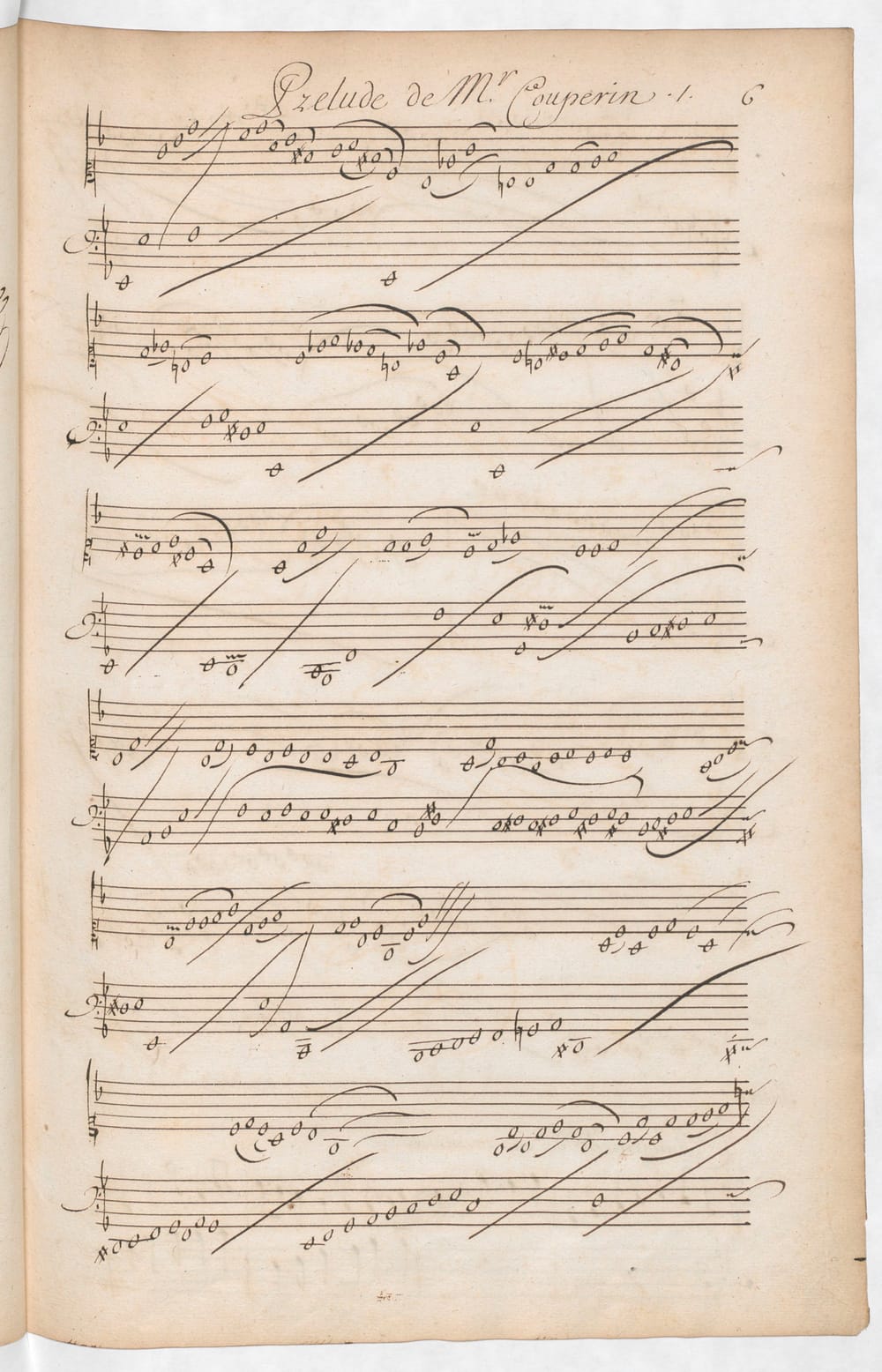
Open a Couperin unmeasured prelude and the first thing you notice is the absence of bar lines. Then the absence of time signatures. What you see is a field of oval noteheads — semibreves — connected by a system of curved and straight lines indicating harmonic groupings and cadential arrivals. There are no rests. There are no rhythmic values. The notation gives you the pitches and their harmonic relationships, and nothing else.
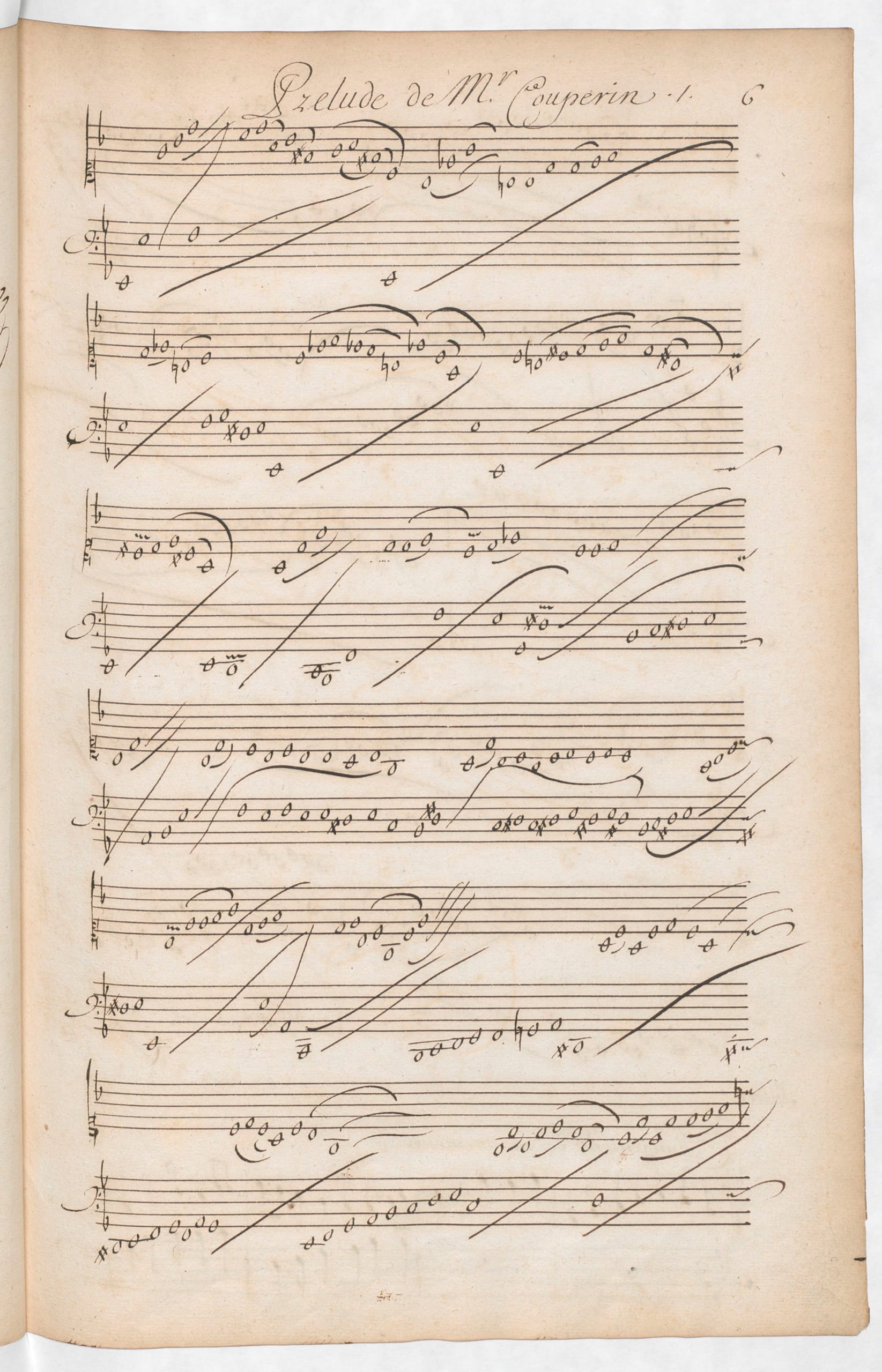
Couperin's understanding of what this was is explicit. François Couperin (the nephew, writing a generation later) preserved the family's position: "A Prelude is a free composition, in which the imagination gives rein to any fancy that may present itself." The notation captures the fancy's skeleton. The imagination provides everything else.
A later commentator, d'Anglebert, revised some of these unmeasured preludes into a "semi-measured" notation that used different note values — not to fix the duration, but to indicate harmonic hierarchy. Longer notes mark structurally important moments; shorter notes are connective tissue. This is, essentially, the same idea: the notation signals structure, the performer supplies time. As one scholar puts it, the score "documents compositional thinking rather than rigid instructions. Every performance requires an effort to transcribe the notation into sound."
---
Convergent invention
Here is what makes the parallel remarkable: Seger almost certainly never saw Couperin's preludes. The unmeasured prelude was a French phenomenon, brief and self-contained — the tradition was essentially extinct by around 1720, when Seger was four years old. It did not cross into the Bohemian organ school. Seger's training ran through Černohorský, whose contacts were Italian (Tartini was a fellow student of Černohorský's, in Assisi). The genealogy runs Prague–Rome–Naples, not Prague–Paris.
And yet — compare the two pages.
| Louis Couperin (c. 1626–1661) | Josef Seger (1716–1782) | |
|---|---|---|
| City | Paris | Prague |
| Instrument | Harpsichord | Organ |
| Genre | Prélude non mesuré | Praeambulum |
| Notation | Semibreves with connecting lines, no bar lines | Whole notes in chords, within bar lines |
| Rhythm | Entirely open | Formally present, functionally open |
| What the score gives | Pitches and harmonic shape | Harmonic skeleton |
| What the performer supplies | Everything else | Rhythm, texture, figuration |
Two composers. A century apart. Two countries, two instruments, two musical cultures. And the same fundamental decision: to notate the skeleton of music whose essence lies in what the player brings.
Biologists have a term for this: convergent evolution. Wings appeared independently in birds, bats, insects, and pterosaurs — not because any of them descended from each other, but because the physical constraints of flight limit how the problem can be solved. Given the same problem in different places, independent lines arrive at similar answers.
The musical problem here is equally fundamental: how do you notate music whose essence is the performer's contribution? If you write everything out, you destroy what made it worth playing. If you write nothing, the tradition cannot be transmitted. The solution — in Paris and in Prague, independently — is to write the structure and leave the execution open.
Couperin shouts the freedom. No bar lines, no time values: the page declares itself an invitation. Seger whispers it between the lines. His bar lines and whole notes look, to a modern eye trained on Urtext editions, like they demand literal execution. They don't. You need to know the conventions — of the Bohemian improvisatory tradition, of figured bass, of what a Praeambulum was actually for — to hear the invitation.
That difference in rhetoric is, in its way, as interesting as the shared principle. Couperin works in a culture where the unmeasured prelude is itself a genre: the notation is the statement of freedom. Seger works within regular mensural notation, and the invitation is embedded, invisible to the uninitiated. The modern organist with Urtext reflexes sees a row of whole notes and plays a row of whole notes. The 18th-century Bohemian organist who copied out this manuscript understood something the notation did not explicitly say.
---
> "Those introductions can be omitted, are interchangeable, and if you do play them, are best elaborated at least a bit." > — Editorial note, partitura.org, Praeambulum L 3
---
Why 2026 is the moment to ask this question
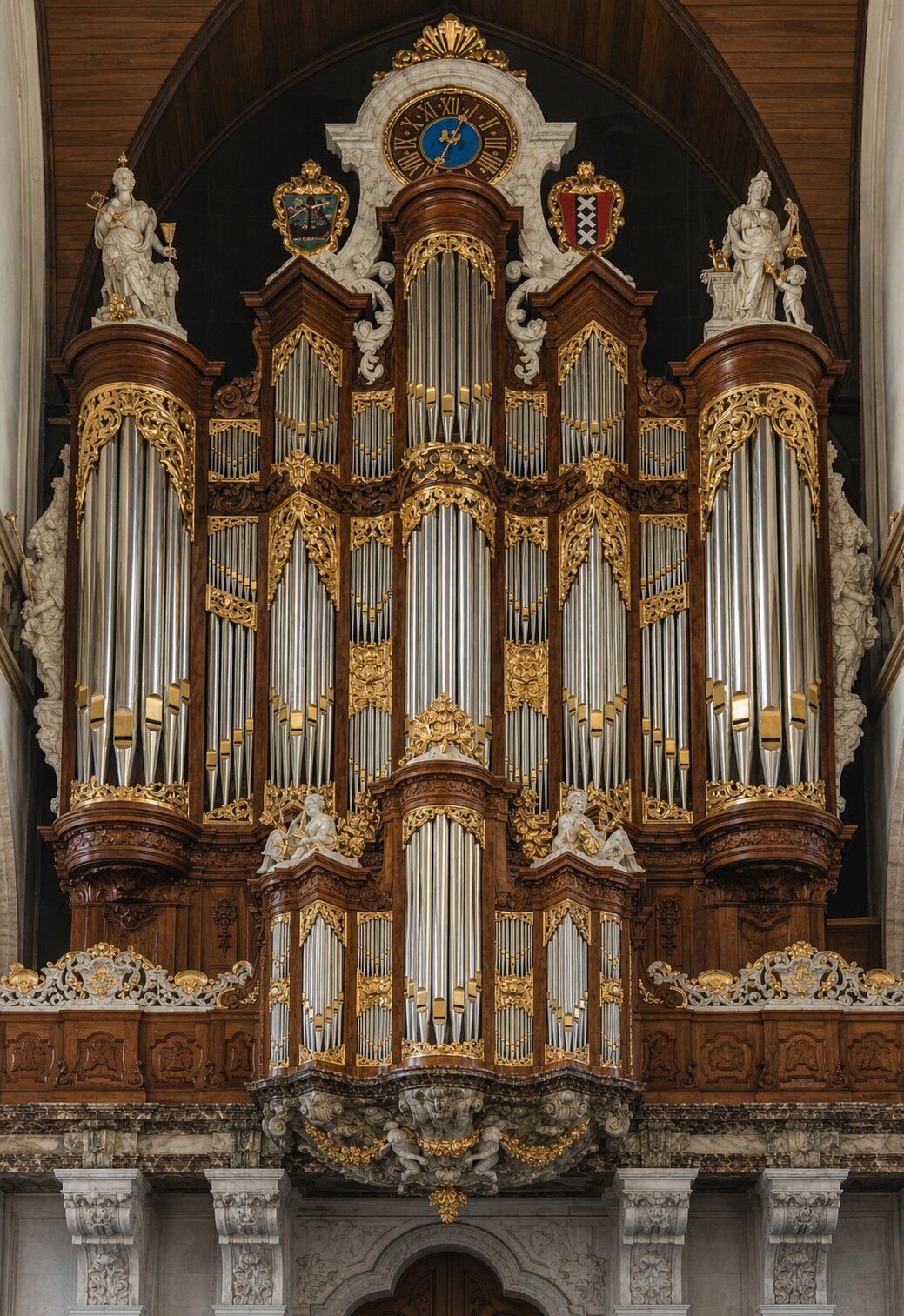
This year marks the 400th anniversary of Louis Couperin's birth (c. 1626) and the 300th anniversary of the completion of the Vater-Müller organ in Amsterdam's Oude Kerk (1726). Both jubilees invite reflection on the musical world of the 17th and early 18th centuries — its assumptions, its pleasures, and what we lost when it ended.
What ended, more than anything, was the performer's authorship over the music.
The 19th century gave us Werktreue — fidelity to the work — and the Urtext edition, and the idea that a musical composition is a fixed object whose correct form the performer's job is to discover and transmit. That idea was not always there. It was not there when Couperin left the rhythm unspecified. It was not there when Seger wrote a chord sequence intended to be elaborated differently every time it was played. For them, a score was a record of a musical possibility, not a prescription for a single correct event.
The historical performance practice movement of the last fifty years has slowly, imperfectly, restored some of what was lost. We have learned to add ornaments that Bach expected but did not write. We have learned to realise figured basses with something other than block chords. Some of us are learning, again, to improvise within the conventions of 17th- and 18th-century style — to fill in the blanks that were always there, and were always meant to be filled.
Seger's preludes sit at the intersection of all of this. They are practical music, written for the organ loft of a working church, probably taught to students whose names we no longer know. They were never intended to be museum objects. They were intended to be played — and "played" meant something richer than "executed accurately."
The 200 figured bass exercises Seger left behind trained exactly that capacity: reading a skeleton and knowing how to clothe it. The preludes with their whole-note introductions were, in this sense, the exam. The student who played them literally failed. The student who made music from them had understood.
---
The performer as co-author
In both the Paris and Prague cases, what the notation describes is not a composition in the modern sense but a collaboration. The composer provides the harmonic architecture. The performer provides everything that makes it music: duration, rhythm, texture, the shape of the phrase, the weight of the silence between chords.
This is a different musical ontology than the one most of us were trained in. We were trained to think of a score as the work, and a performance as an interpretation — a reading — of the work. But for Couperin and Seger, the score was not the work. The score was the possibility of a work. The work happened in performance — once, irreproducibly, in the moment when a player at a harpsichord in 17th-century Paris, or an organist at the Mundt organ in 18th-century Prague, decided what the music would be that day.
The fact that two musicians, in entirely separate traditions, arrived independently at this same solution tells us something that transcends any single anniversary. Notation has always been a negotiation. The question was never "how do you capture music on paper" but "how much of it do you need to capture, and how much can you trust the player to supply?" Couperin and Seger answered that question differently in their surfaces — different instruments, different centuries, different countries — and identically in their depths.
That convergence is not a historical curiosity. It is a reminder of what music is when it is working as it should: not an object to be preserved and transmitted unchanged, but an event that asks, each time, to be remade.
That is what the title means. Music that does not want to be explained, but played: this is not a romantic metaphor. It is a description of a specific notation practice — one that persisted, independently, in at least two places across at least a century, because it answered a real musical need. The question for us, in 2026, is not only how to celebrate these anniversaries. The question is whether we still know how to listen to the invitation.
Sources
Josef Seger
- Josef Seger — Wikipedia — Biographical overview and works list
- Josef Seger — Encyclopedia.com (Grove) — Scholarly article from Grove Music Online
- Praeambulum C Dur (L 6) — partitura.org — Edition with editorial notes on the chord introductions and elaboration options
- Praeambulum D Dur (L 3) — partitura.org — Edition with comparative source discussion and interchangeability of introductions
- Preludes and Fugues, manuscript Becker III.8.63 — IMSLP?ref=schrijfhuis.jongbloed.net) — Facsimile of the primary manuscript source (Sächsische Landesbibliothek, Dresden)
- Pavel Kohout — Seger Complete Organ Works Vol. 2 — Recording at the Mundt organ, Týnský chrám, Prague
Louis Couperin & the unmeasured prelude
- Unmeasured prelude — Wikipedia — Overview of the genre, notation conventions, and historical context
- Transcribing Couperin's Preludes à la D'Anglebert — Music and Practice (Chung) — Scholarly analysis of d'Anglebert's semi-measured revision and what it reveals about performance intent
- Louis Couperin — Pièces de clavecin du manuscrit Bauyn — IMSLP?ref=schrijfhuis.jongbloed.net) — Facsimile of the primary source for Couperin's keyboard works
Historical context
- Bohuslav Matěj Černohorský — Wikipedia — Seger's teacher and the Bohemian improvisation tradition he transmitted
- Partimento — Wikipedia — Background on the related pedagogy of skeleton-notation and its European spread
- Stylus fantasticus — Wikipedia — The broader improvisatory aesthetic context in 17th-century keyboard music