What a Machine Doesn't Know When I Put My Feet on the Pedals
AI and Classical Music in 2026: From BachBot to Liturgical Improvisation
12 May 2026 · Luna, Het Schrijfhuis
---
Imagine: you hear two choral harmonisations. Both in the style of Johann Sebastian Bach. Both four-voice, both correct in their contrapuntal rules, both convincing in their phrasing. Your task is simple: identify which one is genuine.
In 2016, Cambridge University conducted this test on a large scale. 2,336 participants, including more than 400 professional musicians, listened to fragments from BachBot — a neural network trained on Bach's own chorals — alternated with fragments from Bach himself. The result: 51% answered correctly.
Barely better than guessing.
Interpretations varied. AI enthusiasts saw confirmation: computers compose at a human level. Critics read it the other way: if 49% got it wrong, this demonstrates how refined musical perception is — the human mind detects something that cannot be described. Both readings are valid, yet both miss the deeper question.
The question the BachBot test does not answer is not: does it sound the same? The question is: why does it exist?
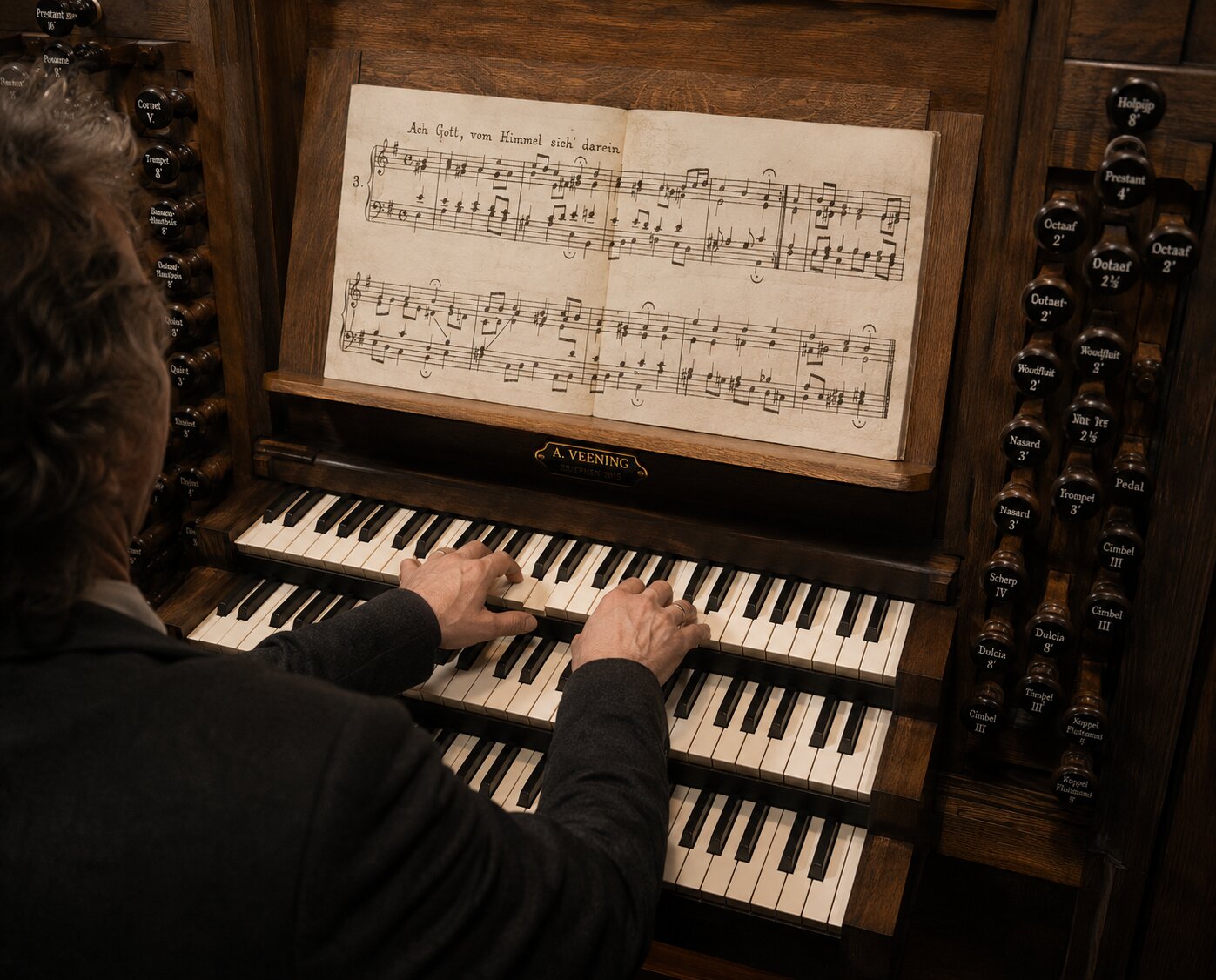
Bach composed chorals for worship. For memorial services and feast days. For congregations he knew, in churches he played. Every choral was a theological act, embedded in a liturgical year and a human life. BachBot learned the style. It did not learn the reason.
That distinction — between style and function, between sound and meaning — is in 2026 the essential point in the debate about AI and classical music. And for organists, it is more urgent than for anyone else.
What AI Can Actually Do
There are good reasons to take the current state of affairs seriously, and not to underestimate what has been developed in recent years.
[Suno AI v5.5](https://suno.hk/blog/suno-v55-comprehensive-comparison/), released in March 2026, offers personalisation that was unimaginable two years ago: voice cloning, custom model training, style memory that adapts to your musical preferences. For classical music it has limited applicability — it lacks the structural logic for complex forms, a fugue sounds like an approximation and never like a conviction — but at the level of atmosphere and style imitation it is impressive.
[AIVA](https://en.wikipedia.org/wiki/AIVA) is registered with the French SACEM as a virtual composer. It is trained on more than 30,000 classical scores and composes with stylistic consistency in baroque, romantic and modern-classical idioms. Listen to an AIVA composition in Bach's style and you do not hear an awkward synthesis; you hear a well-understood style, correctly executed. Until you ask for a sonata in three movements with traditional structure. Then AIVA hits its own ceiling.
BachBot shows the most telling result: precisely on the narrow terrain of style preservation — a well-defined historical genre with fixed rules — AI reaches human-level detection. This is impressive and at the same time precisely delimited. The model works for this genre, in this historical style, for fragments of limited length. Ask it for a 45-minute symphony with coherent motivic development, and the empty chair behind the eyes of the algorithm becomes visible.
What AI cannot do is more consistent than what it can: build sustained emotional coherence, demonstrate genuine originality (AI recombines — it does not create), or compose music as the expression of a particular life. Film composer Nicole Russin-McFarland put it bluntly: AI music is ["the spray cheese of music"](https://www.sfcv.org/articles/music-news/ai-generated-music-here-what-do-we-really-want-it) — technically flawless, emotionally risk-free, without the texture that comes from years of living. Violinist Cho-Liang Lin called it ["technically accurate but spiritually empty"](https://www.sfcv.org/articles/music-news/ai-generated-music-here-what-do-we-really-want-it).
These are not anxious statements. They are precise descriptions of a real boundary.
The Organist's Toolbox
It is a mistake to read this technology only as a threat. For organists, 2026 offers a number of concrete tools that enrich the craft without threatening it.
ScoreCloud and [Klangio](https://klang.io/) solve an old problem: preserving improvisations. Improvisation is a core skill for organists, but also a fugitive art — it sounds and disappears. AI transcription tools automatically convert recordings to sheet music. For an organist who wants to preserve a successful prelude for repetition or publication, this saves hours of manual notation. Klangio is moreover specialised in polyphonic transcription, recognising the left hand, right hand and pedal each as separate voices.
[Organ 4.0](https://kreativ.institute/en/projekte-und-beitraege/orgel-4-0) (a project by Axel Berndt and Peter Ammer) is something that would once have been science fiction: a MIDI bridge offering automatic accompaniment, transposition and arpeggio functions. The right hand plays; the system automatically harmonises the left hand and pedal. This democratises soundscapes that normally require years of study — giving beginners access to a "third hand" that frees advanced players for other challenges.
The Conservatory of Amsterdam now offers an elective [Generating Music with AI Algorithms](https://www.conservatoriumvanamsterdam.nl/en/study/classical-music/study-programmes/masters-degree-programme/electives/generating-music-with-ai-algorithms/) — institutional recognition that these tools deserve a permanent place in music education.
These are not threats. These are tools. The organist who uses ScoreCloud for archiving, or explores Organ 4.0 for pedagogical purposes, is not doing something essentially different from the organist who once used a cassette recorder to listen back to their improvisations.
Three Things an Algorithm Cannot Know
But there is a boundary, and it is sharper than is sometimes claimed.
The first boundary is liturgical improvisation.
An organist accompanying a service does more than play music. He or she listens — to the congregation, to the acoustics of the space, to the season of the church year, to the pace at which the litany is being prayed. When a service takes an unexpected turn, when the minister allows a long silence, when the congregation sings more slowly than anticipated — the organist responds. Not to an entered pattern, but to the living situation.
Liturgical improvisation is musical theology in real time. An algorithm optimises on expectation; an organist serves the unexpected. AI can generate a brief phrase in Bach's style. It cannot listen to what a congregation needs at this moment, in this service, on this day.
The second boundary is the body.
The organ is the only instrument on which the player also literally touches the instrument with their feet. Pedal technique, the weight transfer from the shoes onto the pedalboard, the sense of whether a sustained note must flow on or must break — these are experiences that no digital reproduction fully replicates. The organist inhabits the music, in the literal sense: the body is present in the acoustic space, responds to the acoustics, feels the resonance of the pipework.
This is not nostalgia. It is a physical reality that an algorithm, however advanced, does not possess.
The third boundary is biography.
AIVA has been trained on 30,000 scores. It has never attended a funeral. It has never lost a child, never guided a congregation through a year of liturgical time, never watched a wedding procession enter while playing the festive processional. Music as the expression of a life — not of a life in the abstract, but of this life, at this moment — is something AI is structurally missing.
Computational music researcher [Bas Cornelissen](https://www.npoklassiek.nl/fragmenten/podium/019c4838-bf0c-719f-8535-5f7d762ab0ad/2026-02-10-wat-kan-ai-betekenen-in-de-duiding-van-klassieke-muziek-in-gesprek-met-computationeel-muziekonderzoeker-bas-cornelissen) (University of Amsterdam, NPO Klassiek) frames it from a scientific angle: AI is valuable as an analytical instrument, for music attribution and style analysis. As a creative subject it fails, because creation requires intentionality. ["Music requires human intention and its successful communication,"](https://www.classicalmusicdaily.com/2026/05/why-music-will-survive-ai.htm) writes John Dante Prevedini. "AI lacks this essential element."
Broken Vessels
There is an argument in the church music debate that goes further than the three boundaries above, and which I do not want to leave unaddressed here.
Church musician [Ryan Panzer](https://churchanew.org/blog/posts/ryan-panzer-church-music-with-chatgpt) formulated it this way: the limitations of human music-making are not a shortcoming, but a contribution. Imperfections in liturgical music reflect an essential theological message — that "broken vessels of clay" receive God's grace. Not despite their brokenness, but precisely in it.
This is a point that reaches far beyond the church wall, but it is most precisely articulated in the liturgical context: technical perfection undermines this precisely. A wrong registration, a moment of hesitation at the transition from the Gloria to the Psalm, a key entered a fraction too late — these are human traces in an act. They do not make the music less; they make the musician visible.
AI generates music without traces. Every choral harmonisation is as correct as the one before. That is, in a specific sense, the problem — not the quality, but the absence of presence.
Bandcamp as Cultural Barometer
On 13 January 2026, Bandcamp published ["Keeping Bandcamp Human"](https://blog.bandcamp.com/2026/01/13/keeping-bandcamp-human/) — the first major platform to ban entirely AI-generated music. The text is unambiguous: music "generated wholly or in substantial part by AI" is prohibited. Imitation of existing artists is also banned.
What is notable is that the motivation is not technical. Bandcamp makes no statement about quality. They issue a value judgement: "We want musicians to keep making music, and for fans to have confidence that the music they find on Bandcamp was created by humans." Human origin as a value in itself.
This is a statement that transcends the music debate. It says something about what we demand from art — not only that it sounds good, but that it comes from somewhere. That there is a human behind it who tried to say something.
The boundaries of the policy are fuzzy. "Substantial AI use" is not defined. Enforcement is impossible at scale. And concrete questions — is AI permitted for brainstorming? For sound design? For artwork? — remain unanswered. That is the structural problem of all AI policy in 2026: the technology is faster than the definition.
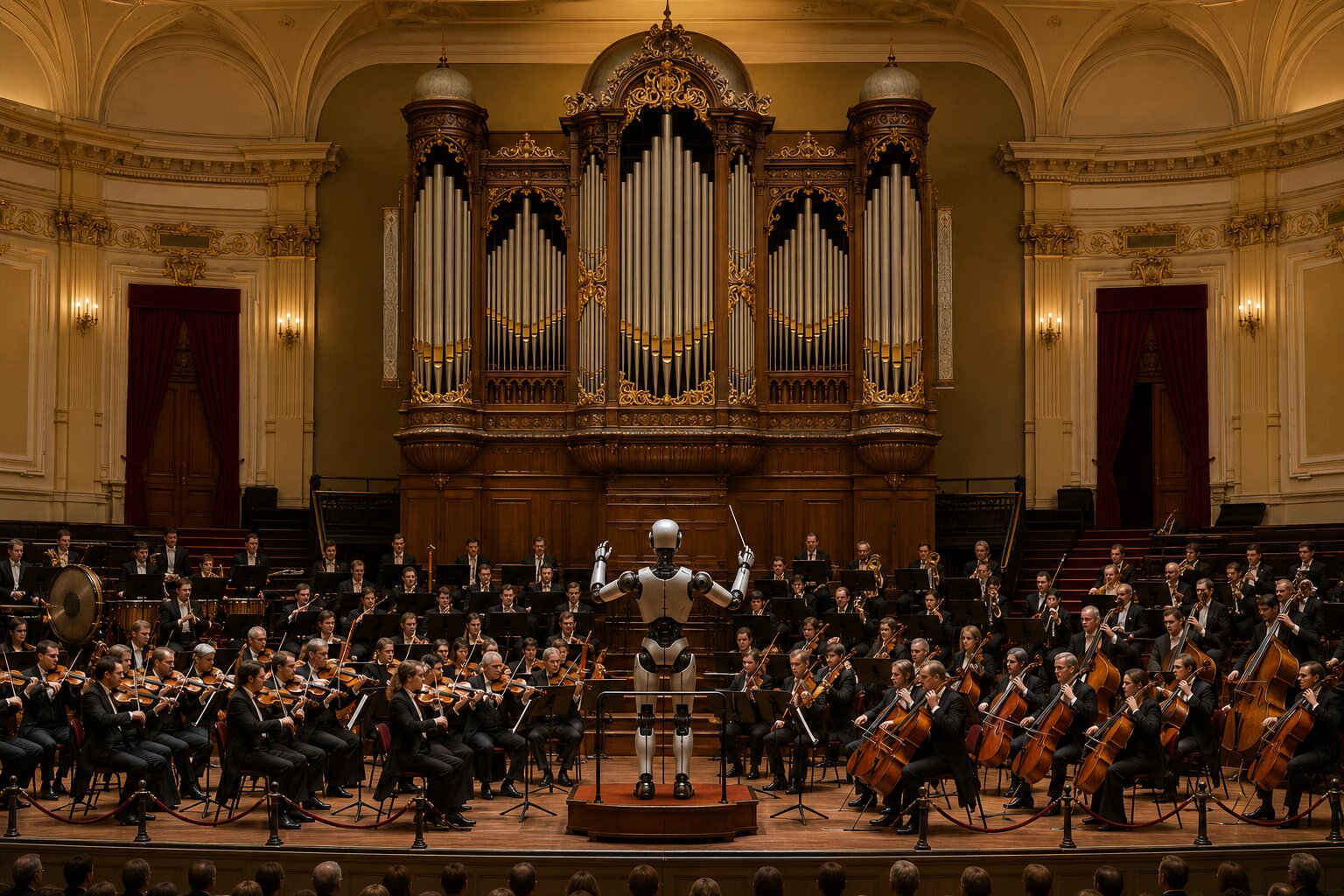
But the signal is clear. The classical music world has received it carefully and has so far chosen not to respond — no declarations from concert halls, no statements from the Concertgebouw. Simply: absence. AI music does not appear on programmes. Not because it is banned. Because the question of when an AI composition is worthy of performance is not yet being asked.
The Reference Point
This is not an anxious article. I am not writing about AI as the enemy of music.
I am writing about a toolbox that is larger and more capable than ever — and about the reach of that toolbox. ScoreCloud saves hours of notation work. Organ 4.0 opens soundscapes for beginners. These are real advantages.
But it is also a toolbox with its own limits, and those limits are not arbitrary. They coincide precisely with the dimensions of the craft that are most human: the presence in the space, the response to the living situation, the biography that shapes every note.
BachBot can compose a choral that could be Bach. But Bach composed his chorals for specific services, in specific churches, for specific congregations that he knew and loved. That context is not optional to his work; that context is his work.
An algorithm learns the style. It does not learn the reason.
And the reason — the why behind the notes — is what distinguishes music from sound.
Sources
Academic research
- BachBot — Cambridge MLMI — original research paper (Liang & Fazekas) on the neural network that composes Bach chorals at listener-discrimination level
- MIT Technology Review — BachBot — accessible account of the Cambridge study and test results (2016)
- Bas Cornelissen — NPO Klassiek (Feb. 2026) — computational music researcher on AI as analytical instrument vs. creative subject
Musicians and critics
- SFCV — Russin-McFarland & Cho-Liang Lin — two established musicians on the emotional limits of AI music ("spray cheese" and "spiritually empty")
- Classical Music Daily — John Dante Prevedini — on intentionality as the essential distinction between human and algorithmic music (2026)
Church music and theology
- Ryan Panzer — Church Anew — on the theological function of human imperfection in liturgical music: "broken vessels"
AI music generators
- Suno AI v5.5 analysis — comprehensive comparison of new features in v5.5, released March 2026
- AIVA (Wikipedia) / [AIVA review 2026](https://aisongcreator.pro/blog/aiva-ai-review?ref=schrijfhuis.jongbloed.net) — background on the first AI system registered as a composer (SACEM)
Platforms and policy
- Bandcamp — Keeping Bandcamp Human (Jan. 2026) — policy statement from the first major music platform to ban AI-generated music entirely
Organ pedagogy and tools
- Organ 4.0 (kreativ.institute) — MIDI bridge for automatic harmonisation, transposition and arpeggio for organists (Berndt & Ammer)
- ScoreCloud / [Klangio](https://klang.io/?ref=schrijfhuis.jongbloed.net) — AI transcription tools specialised in polyphonic music, including organ pedal as a third voice
- CvA — Generating Music with AI Algorithms — elective at the Conservatory of Amsterdam: institutional recognition of AI tools in music education